The Signal
On February 27, 2026, at the Latin American Conference on Air Quality and Health in Santiago, Chile, something happened that will take most newsrooms years to understand. The Colegio Médico de Chile and the International Society of Doctors for the Environment (ISDE) — backed by the Pan American Health Organization (PAHO) and the World Health Organization — launched the Santiago de Chile Declaration. Its central proposition: clean air is a fundamental human right in Latin America.
Alongside the Declaration, PAHO unveiled a Regional Action Plan on Air Quality and Health for Latin America and the Caribbean (2026–2031), developed in collaboration with the Ministries of Health across the Americas. The Plan’s stated vision: positioning the region as a global leader in clean air actions. Its operational target aligns with WHO’s global ambition of reducing mortality attributable to anthropogenic air pollution by 50% by 2040.
This is not a press release dressed as policy. It is the formal architecture of a legal claim that did not previously exist in the region’s environmental framework. If clean air is a human right, then a state that fails to protect it can be sued. That single sentence changes the entire calculus of environmental governance in 33 countries.
“The most radical act in environmental law is not creating a new regulation. It is reclassifying what people are already breathing as something the state is obligated to protect.”
The Context
The Declaration did not emerge in a vacuum. It arrived into a region where 370,000 people die annually from air pollution — a number that has remained stubbornly consistent for over a decade. More than 150 million people in Latin America and the Caribbean live in cities where air quality exceeds WHO guidelines. In countries like Honduras, Bolivia, and El Salvador, fine particulate matter is a greater threat to life expectancy than malnutrition, interpersonal violence, or tobacco. In Chile alone, air pollution causes an estimated 4,000 deaths per year, over a third from respiratory diseases.
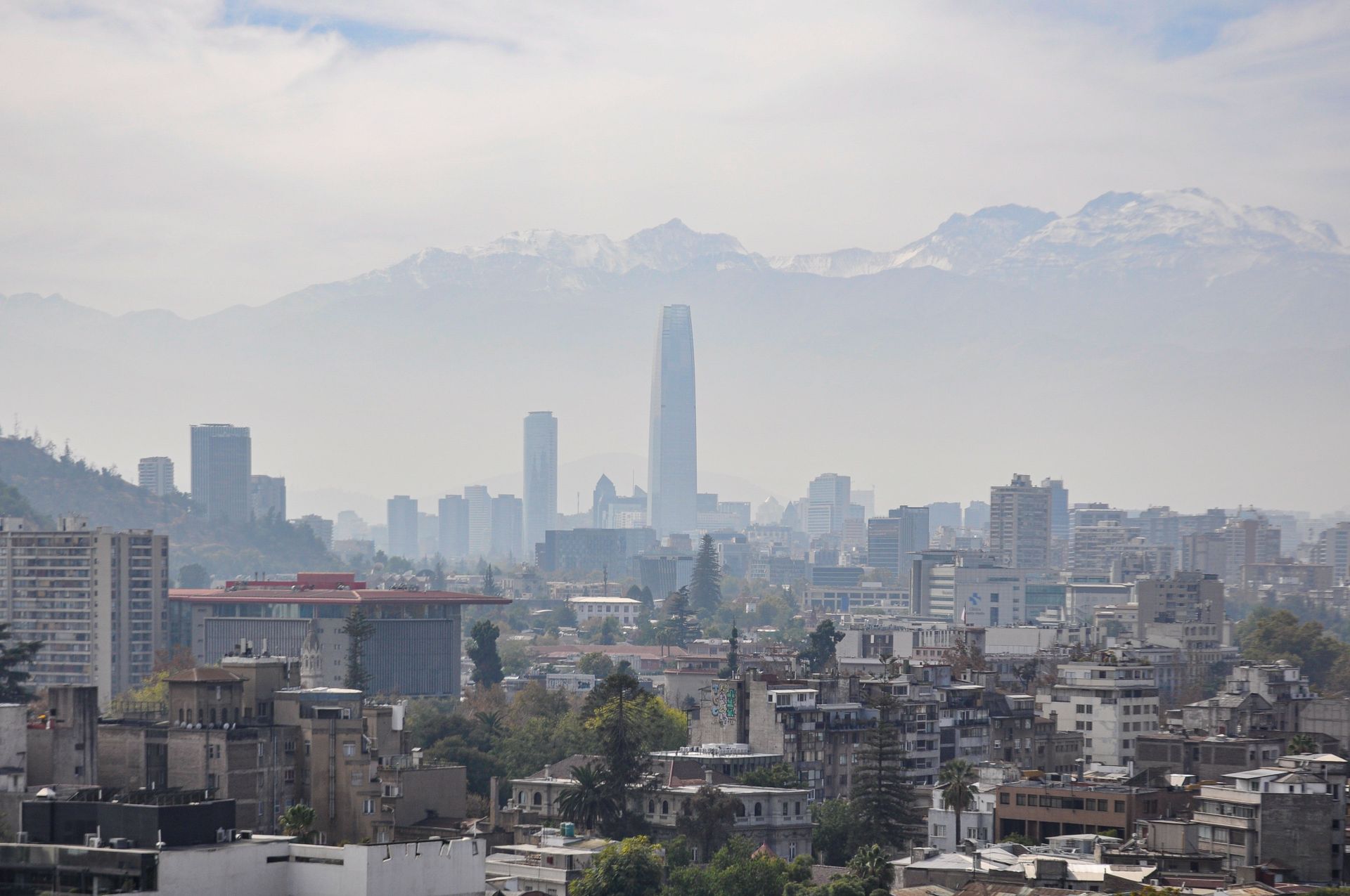
Santiago itself is a case study in geographic entrapment. Wedged between the Andes and the Cordillera de la Costa, the city sits in a natural basin where stale air accumulates and disperses slowly. Vehicle exhaust, industrial emissions, agricultural burning, and woodburning stoves feed a particulate cocktail that the topography refuses to release. In 2023, Latin America’s air pollution reached its highest level since the Air Quality Life Index began keeping records in 1998.
The region has not been idle. Chile introduced a vehicle emissions tax in 2014 that produced a 30% drop in CO₂ and nitrogen oxide emissions within two years. Bogotá and Mexico City have experimented with license-plate-based driving restrictions. Both cities joined the Breathe Cities Initiative in 2023 to share data and solutions. But these efforts have been fragmented, city-by-city, policy-by-policy, without a unifying legal framework that transforms clean air from a policy preference into a constitutional obligation.
That is what the Santiago Declaration provides. Not a program. A premise.
The Reading
To understand why this Declaration matters strategically, it helps to look at the most important environmental legal instrument Latin America has produced in the last decade: the Escazú Agreement.
Signed in 2018 in Costa Rica, the Regional Agreement on Access to Information, Public Participation and Justice in Environmental Matters — known simply as Escazú — was the first regional environmental human rights treaty in Latin America and the Caribbean, and the world’s first international agreement with specific provisions protecting environmental defenders. It guaranteed three procedural rights: access to environmental information, participation in environmental decisions, and access to justice in environmental matters. Eighteen countries have ratified it.
Escazú did not ban anything. It did not set emission limits or mandate technology transitions. What it did was far more consequential: it created the procedural infrastructure through which citizens could challenge environmental decisions. It gave standing to communities. It gave legal weight to participation. And slowly, case by case, it began reshaping environmental litigation across the region.
The Santiago Declaration is performing the same structural move — but for a different right. Where Escazú codified the right to know about environmental harm and participate in decisions about it, Santiago codifies the right to not be harmed in the first place. It shifts the legal center of gravity from procedural access to substantive protection. From process to outcome.
“Escazú gave Latin Americans the right to ask what their government was doing about the air. Santiago gives them the right to demand that it be breathable.”
The Litigation Pipeline
The timing is not accidental. In July 2025, the Inter-American Court of Human Rights issued an advisory opinion that will be studied for decades: states have a duty under international law to prevent, mitigate, and remedy environmental harm that threatens human rights, including through laws, policies, and actions aimed at curbing climate change. The court explicitly recognized a human right to a healthy climate and the obligation to protect the rights of current and future generations.
This ruling is already being cited in national courts across the region. Climate litigation in the Global South has entered a phase of dynamic growth, with nearly 60% of all recorded cases filed since 2020. By June 2025, a cumulative 3,099 climate-related cases had been filed across 55 national jurisdictions and 24 international bodies. In 2026, international rulings are expected to shape national jurisprudence at an accelerating rate.
The Santiago Declaration feeds directly into this litigation pipeline. Once clean air is recognized as a right — not merely a policy aspiration — the legal test for government inaction changes fundamentally. Courts will no longer ask whether a state tried to reduce pollution. They will ask whether citizens’ right to breathable air was violated. That is the difference between a policy failure and a constitutional breach.
The Five-Year Architecture
The Regional Action Plan (2026–2031) is the operational counterpart to the Declaration’s legal framework. It establishes five priority areas that reveal the strategic depth of this initiative:
First: health sector leadership. The Plan positions Ministries of Health — not Environment — as the primary institutional owners of air quality policy. This is a deliberate reframing. Environmental agencies regulate emissions. Health ministries count bodies. By putting the body-counters in charge, the Plan ensures that air quality metrics are measured in hospital admissions and mortality data, not just parts-per-million readings from monitoring stations.
Second: monitoring and data systems. You cannot litigate what you cannot measure. The Plan calls for enhanced air quality monitoring infrastructure across the region, creating the evidentiary foundation that future lawsuits will require. This is not bureaucratic housekeeping. It is the deliberate construction of a prosecutorial toolkit.
Third: integrated policies. Air pollution does not respect ministerial boundaries. The Plan advocates for cross-sectoral policy integration — transport, energy, agriculture, urban planning — recognizing that the causes of air pollution are systemic and the responses must be as well.
Fourth: awareness and participation. Echoing Escazú’s emphasis on public participation, the Plan builds communication and engagement mechanisms that empower communities to monitor, report, and challenge air quality failures in their neighborhoods.
Fifth: sustainable financing. The most pragmatic pillar. Rights without funding are aspirations. The Plan explicitly addresses financing mechanisms and regional cooperation to sustain air quality infrastructure beyond the typical political cycle.
A dedicated coordination group has been established to monitor implementation, mobilize stakeholders, and maintain ongoing dialogue. This is where declarations typically die — in the gap between announcement and execution. Whether the coordination group develops institutional teeth will determine whether the Santiago Declaration becomes a watershed or a footnote.
The Pattern
Step back far enough and a pattern emerges across Latin American environmental governance that is distinct from any other region in the world.
In 2018, Escazú codified procedural environmental rights. In 2025, the Inter-American Court recognized the right to a healthy climate. In 2026, the Santiago Declaration established clean air as a human right. Each instrument builds on the previous one. Each closes a gap the last one left open. Together, they are constructing a layered legal architecture for environmental protection that is more comprehensive than anything Europe, North America, or Asia has assembled.
The strategic implication is profound. Latin America — a region that contributes less than 10% of global greenhouse gas emissions but suffers disproportionately from their effects — is building the legal infrastructure to hold its own governments accountable for environmental outcomes. And because these instruments are grounded in human rights law rather than environmental regulation, they are far harder to repeal, dilute, or ignore.
Consider the second-order effects. If the Santiago Declaration gains legal traction, it creates precedent for other environmental rights claims: the right to clean water, the right to stable climate, the right to uncontaminated soil. Each right creates a new litigation vector. Each litigation vector creates accountability pressure. Each accountability pressure creates policy change. The Declaration is not the endpoint. It is the first domino.
Three Scenarios
Scenario one: declarative stall. The Santiago Declaration remains symbolic. Governments sign, issue press releases, and return to business as usual. The Regional Action Plan receives insufficient funding. Air quality monitoring infrastructure remains patchy. Litigation attempts are blocked by courts unfamiliar with the Declaration’s legal weight. This is the most historically probable outcome for any international declaration. Probability: moderate.
Scenario two: selective enforcement. A handful of countries — Chile, Colombia, Costa Rica, the usual progressive environmental actors — integrate the Declaration into domestic law and begin enforcing it. Landmark cases emerge. Air quality improves measurably in those jurisdictions. Other countries observe but do not follow. A two-tier environmental rights system develops within the region. Probability: high.
Scenario three: systemic cascade. The Inter-American Court’s 2025 advisory opinion, combined with the Santiago Declaration and the Escazú Agreement, creates a reinforcing legal ecosystem. National courts begin citing all three instruments together. A wave of litigation forces government action across the region. Latin America becomes the global laboratory for rights-based environmental governance. The 50% mortality reduction target by 2040 becomes achievable. Probability: lower than we’d like, but higher than cynics expect.
“The question is no longer whether clean air is a right. The Santiago Declaration settled that. The question is who enforces it first — and what happens to the governments that refuse.”
What This Means for Cities
For urban Latin America, the practical implications are immediate and specific. If clean air is a right, then every city’s transportation policy, industrial zoning, energy matrix, and urban planning decisions become potential grounds for legal challenge. The municipal official who approves a highway expansion without an air quality impact assessment is no longer making a planning decision. They are potentially violating a human right.
Santiago, Bogotá, Mexico City, Lima, São Paulo — these cities already struggle with air quality that exceeds WHO guidelines. The Santiago Declaration transforms that struggle from a governance challenge into a legal liability. It puts a timer on inaction. And for the 150 million Latin Americans breathing air that their own governments now acknowledge they have a right to breathe clean, that timer is already running.
The air was always there. The right was not. Now it is.
Sources
- WHO — Santiago de Chile Declaration Launched to Advance Clean Air and Environmental Justice
- Health Policy Watch — New Regional Air Pollution Plans Aim to Cut Health Burden
- DevDiscourse — Santiago Declaration Urges Clean Air Action Across Americas
- fundsforNGOs — Latin America Launches Santiago Declaration on Clean Air
- PAHO/WHO — Air Quality Topic Page
- UNEP — Global Climate Litigation Report: 2025 Status Review
- Grantham Institute — Global Trends in Climate Change Litigation: 2025 Snapshot
- Oxford Academic — Escazú Agreement Contribution to Environmental Justice (Climate Litigation)
- Climate Diplomacy — Environmental Litigation in LatAm Bolstered by Escazú
- Euronews — Inter-American Court Rules on Climate Duty
- State of Global Air Report 2025
- IQAir — 2025 World Air Quality Report
Disclosure
IN-KluSo identifies environmental and legal signals through cross-disciplinary scanning, then produces editorial analysis informed by verified sources. Our process uses computational tools to surface patterns that human editorial judgment shapes into narrative. This article interprets the Santiago Declaration’s strategic significance; it does not constitute legal advice.