
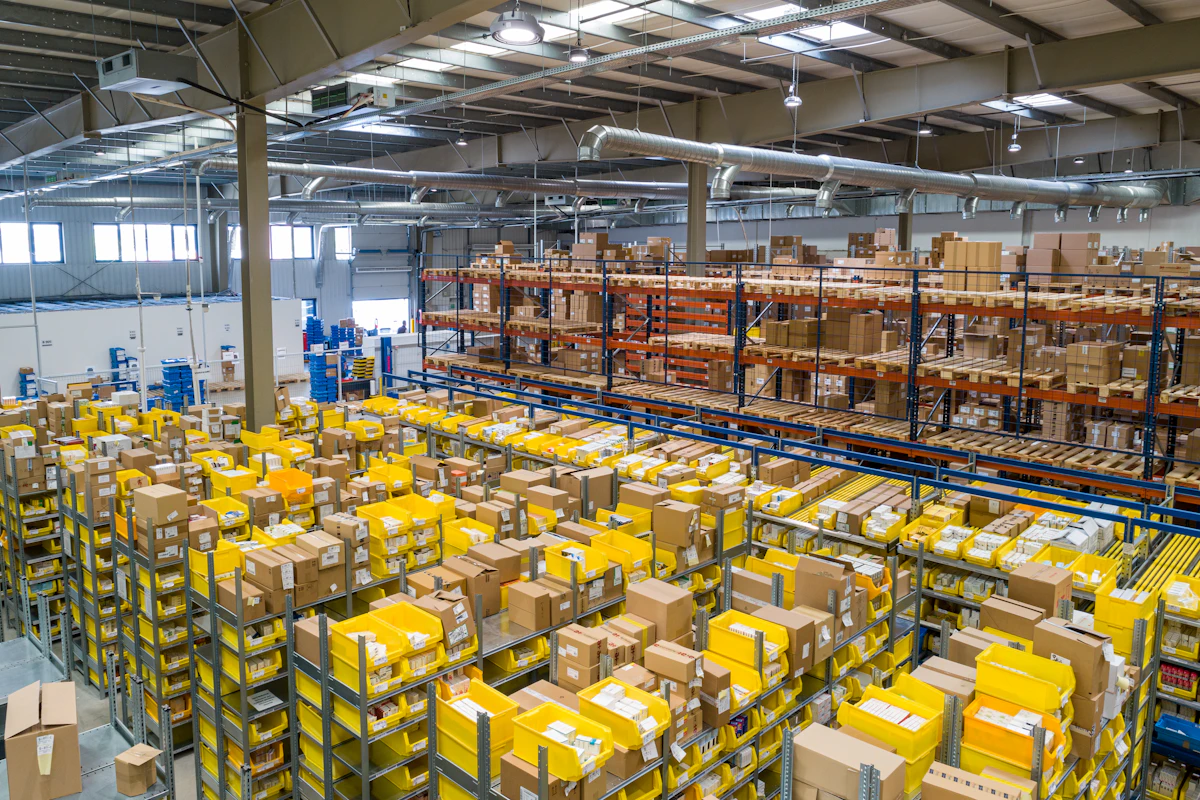
Photo by CHUTTERSNAP / Unsplash
Terre Haute celebrated the arrival of an Amazon delivery hub. The city's own wage data reveals that every job it announced pays below what a single adult needs to survive there.
On the southwest corner of Carlisle Street and Industrial Drive, there's a stretch of flat Indiana ground that the city of Terre Haute has been trying to fill for twenty years. The Vigo Industrial Park sits low along the road, buffered by scrub and a chain-link perimeter, the kind of place that appears invisible until someone in a press conference makes it matter again. In early 2024, someone did.
A woman who spent eleven years in production at a Terre Haute manufacturing facility — she left before the closures compounded — now works days at a regional grocery chain and evenings at a counter-service restaurant. She doesn't do this because her schedule affords flexibility. She does it because neither job reaches forty hours. She drives a 2014 Hyundai that needs tires. She keeps a handwritten budget on a yellow legal pad, the kind you find at Dollar General. Every few weeks, she crosses out a number and writes a smaller one below it.
She doesn't have an opinion about Amazon. She has rent.
Terre Haute is a city of approximately 59,000 people that has watched its economic identity dissolve without ever being given a clean story about what came next. The Pfizer plant on the north side — which made pharmaceutical products on that site since the 1940s — cut 660 jobs in 2007 and closed entirely by 2009. Sony DADC, which manufactured optical discs in the region, declined as streaming killed physical media. CertainTeed, Honey Creek operations, textile plants — the exits weren't dramatic. They were gradual, quiet, and cumulative, leaving behind a workforce shaped by shift work, union protections, and wages that, while not generous, were designed to be lived on.
What replaced them has a different logic. The new jobs come with a starting wage, a badge, and a scanning gun. They arrive in press releases. They get a ribbon cutting. And then, if you do the arithmetic — which almost no one at the podium does — something in the picture stops making sense.
Terre Haute's economic development strategy over the past decade has leaned heavily on geography. The city sits at the intersection of I-70 and US-41, a crossroads that makes it genuinely useful to distribution networks operating between Indianapolis, St. Louis, and Chicago. This is real. Menards, Casey's General Stores, and Staples have all sited distribution operations in the region. The strategy has a name — "advanced distribution" — and a logic: if manufacturing won't come back, logistics can occupy the same industrial footprint.
In February 2024, the Vigo County Redevelopment Commission voted to accept Amazon's bid for approximately 28 acres at the Vigo Industrial Park. The price: $1 per acre. Amazon committed to a $10.8 million investment in a 35,000-square-foot last-mile delivery hub. The Terre Haute Economic Development Corporation, led by president Steve Witt, celebrated the announcement. Witt's public statement, as published by the Tribune-Star, emphasized what Amazon's arrival would mean for customers receiving faster deliveries. He did not mention wages.[1]
The Bureau of Labor Statistics May 2024 Occupational Employment and Wage Statistics release for the Terre Haute MSA documents a mean hourly wage of $24.99 across all occupations — 23.5% below the national mean of $32.66. Specifically, transportation and material moving occupations (the category covering Amazon delivery and warehouse roles) pay a mean of $20.74/hr locally. Amazon's posted starting rate for Indiana delivery station workers is approximately $17.25/hr — meaning Amazon's entry rate falls 17% below the local sector average for comparable roles, and 47% below the national mean for all workers.[2]
Amazon's 90–100 announced jobs come in two structures: permanent full- and part-time positions, and up to 100 peak-season contractor slots. The contractor positions are consistent with Amazon's known last-mile model, in which independent Delivery Service Partners (DSPs) operate as third-party employers — meaning those workers do not receive Amazon's benefits package, regardless of starting wage. The mix matters because benefits access at Amazon requires maintaining minimum weekly hours thresholds. Part-time and contractor classifications systematically exclude workers from health coverage, even at the $17.25/hr rate.
The MIT Living Wage Calculator, updated February 2026 for Vigo County, sets the minimum living wage for a single adult (no children) at $20.90/hr — equivalent to $43,470/year before taxes. A full-time Amazon worker at $17.25/hr earns approximately $35,880/year at 40 hours per week. That is a $7,590 annual shortfall before the first bill arrives — and that's for workers with no children. For a single parent with one child, the living wage floor rises to $38.22/hr. Amazon's rate covers 45 cents on every dollar that household needs.[3]
The structural problem is not Amazon specifically. It is the pattern of treating job quantity as a proxy for economic recovery without measuring job quality against local cost-of-living baselines. Vigo County carries a 19.9% poverty rate — nearly double Indiana's statewide rate of approximately 11% — and a median household income of $52,976, roughly three-quarters of Indiana's $71,959 median.[4] These are not indicators of a labor market that can absorb a downward wage floor. They are indicators of a labor market that is already below the floor.
The NELP 2023 national study on Amazon's wage impact adds a corrosive secondary layer: counties where Amazon warehouses operate show warehouse worker wages approximately 18% lower than comparable non-Amazon counties — roughly $822/month less per worker. The mechanism is monopsony pressure: when Amazon becomes the dominant logistics employer in a market, it sets the effective ceiling for competing distribution wages, which then settles into the regional norm.[5] In a market already running at a 23.5% wage deficit to the national average, this is not a neutral addition.
Terre Haute's trajectory — union manufacturing base collapses, institutional anchors (university, federal prison) absorb some labor demand, logistics fills the industrial footprint — is not unique to Terre Haute. It is a documented Midwest pattern, and it has a structural name in regional economic literature: the transition from a traded sector economy (manufacturing goods that leave the region and bring money in) to a non-traded sector economy (services consumed locally and funded by low outside capital injection). The distinction matters because traded sector jobs generate wage multipliers; non-traded sector and logistics jobs tend to recirculate existing local income rather than expand the base.
The Indiana Business Research Center, in a widely cited 2020 analysis authored by Robert Guell (Indiana State University) and Kevin Christ (Rose-Hulman Institute of Technology), documented the contours of this shift for Terre Haute explicitly: "Since the early 2000s, the region has lost about 5,000 jobs, mostly in manufacturing and retail... For decades, Terre Haute has thought of itself as a manufacturing center... Now, both distinctions are more myth than reality."[6] The paper was published in the Indiana Business Review, a Tier A academic-adjacent source grounded in publicly available economic data.
Indiana's statewide picture reinforces the local reading. The Indiana Economic Digest, citing 2026 Indiana Business Review outlook data, identified Terre Haute as one of the state's metros where average hourly earnings "fell measurably" going into 2026 — alongside Bloomington and Michigan City.[7] This is not cyclical softness. It is structural downward drift in a city whose replacement economy is built on sectors with limited wage ceilings.
Nationally, NELP's 2023 report documents the specific mechanism by which Amazon's entry into a regional labor market interacts with existing wage pressure. Yannett Lathrop, a senior researcher at NELP, observed: "The one dollar raise to starting pay that Amazon just announced is not even a raise when taking inflation into account — today, $17 is worth less in real terms than Amazon's prior raise to $16 in 2022."[5] The real wage of logistics work is declining at the same moment cities are presenting it as economic recovery.
"Warehouse workers in counties where Amazon operates earn 26 percent less than the average monthly earnings for all workers in those counties." — National Employment Law Project (NELP), A Good Living: Amazon Can and Must Make a Middle-Income Livelihood Possible, 2023
The broader implication of the Terre Haute signal is this: when a city's economic development apparatus celebrates job creation without measuring wage quality against local living costs, it is not reporting economic recovery — it is reporting job reclassification as progress, and in a county where one in five residents already lives below the poverty line, that distinction is the difference between a policy intervention and a press release.
Amazon's $17.25/hr starting wage could function as a genuine entry point for workers with limited credentials or employment gaps, providing stable income, benefits access at full-time hours, and a documented employment record. In a county with 19.9% poverty, even a sub-living-wage job may represent a meaningful improvement over unemployment or informal work. This argument has validity: the absence of income is worse than insufficient income, and Amazon's jobs include some benefits access and scheduling regularity not available in gig or service sector alternatives. The evidence weakens this framing, however, when examined alongside the benefits structure: the 90–100 jobs are split between full- and part-time, and up to 100 positions are seasonal contractor roles. Part-time and contractor classifications systematically exclude workers from the benefits that make Amazon's wage offer more competitive. The stepping-stone argument depends on a full-time, benefits-eligible job — and those are not the majority of what was announced.
As the Terre Haute labor market tightens — currently sitting at a low but not zero unemployment rate — Amazon and comparable logistics employers may bid wages upward through natural competition. If other distribution employers in the Vigo Industrial Park raise starting wages in response, the Amazon rate becomes a floor, not a ceiling. This is a legitimate market dynamics argument and is not easily dismissed. The problem is the directional evidence from NELP's county-level analysis: in markets where Amazon establishes a dominant distribution presence, wages for non-Amazon warehouse workers trend downward, not upward. Monopsony dynamics — in which a single large employer sets effective wage ceilings for comparable roles — are more consistent with observed outcomes in Midwest logistics markets than competitive bidding-up effects. The burden of proof runs against the optimistic scenario.
Amazon's exact Terre Haute-specific starting wage is sourced from regional Indiana comparables and local job posting references, not a verified facility-specific pay stub, wage filing, or confirmed hire document. The $17.25/hr figure is consistent with Amazon's publicly documented Indiana warehouse rates but should be treated as a well-grounded estimate, not a certified figure.
Former manufacturing wage comparisons are absent. The claim that Amazon wages represent a quality downgrade from Pfizer-era union jobs would be structurally strengthened by documented union contract wage rates from Terre Haute's manufacturing peak (1990s–2007). Archived IBEW or USW contract records could confirm or sharpen this comparison. Without them, the wage decline framing rests on national pharmaceutical/manufacturing wage norms rather than Terre Haute-specific data.
No direct Terre Haute Amazon worker testimony was obtained. The signal's human-scale evidence comes from national proxy sources (NELP's documented worker testimony from other markets). Local worker testimony from Glassdoor, Indeed reviews, or WTHI-TV reporting would elevate the signal's lens coverage and SCI. Its absence is the primary gap in this dossier.
Confirmation needed: Whether the Amazon hub at Vigo Industrial Park is now operational and actively hiring would convert this signal from "announced trajectory" to "live labor market condition." TribStar or WTHI-TV follow-up reporting from late 2025 or early 2026 could confirm or deny the hub's status and any subsequent wage or hiring disclosures.
[1] Tribune-Star (Terre Haute). "Amazon locating delivery hub in Vigo County." February 2024. tribstar.com — Tier B
[2] U.S. Bureau of Labor Statistics. "Occupational Employment and Wage Statistics: Terre Haute, IN Metropolitan Statistical Area, May 2024." Released May 12, 2025. bls.gov — Tier A
[3] MIT Living Wage Calculator. Vigo County, Indiana. Updated February 15, 2026. livingwage.mit.edu — Tier A
[4] U.S. Census Bureau. QuickFacts: Vigo County, Indiana. 2024. census.gov — Tier A
[5] National Employment Law Project (NELP). "A Good Living: Amazon Can and Must Make a Middle-Income Livelihood Possible." 2023. nelp.org — Tier B
[6] Guell, Robert C. and Kevin Christ. "Terre Haute and West Central Indiana: The Economic Outlook for 2020." Indiana Business Review, Vol. 95, No. 4. Indiana Business Research Center, Indiana University. Winter 2020. ibrc.indiana.edu — Tier A
[7] Indiana Economic Digest. "Indiana's outlook for 2026 according to Indiana Business Review." indianaeconomicdigest.net — Tier C
[8] WTHR (NBC Indianapolis). "Pfizer eliminates 660 jobs at Terre Haute plant." October 2007. wthr.com — Tier B
[9] Federal Reserve Bank of St. Louis (FRED). "Median Household Income in Vigo County, Indiana." Series MHIIN18167A052NCEN. fred.stlouisfed.org — Tier A