
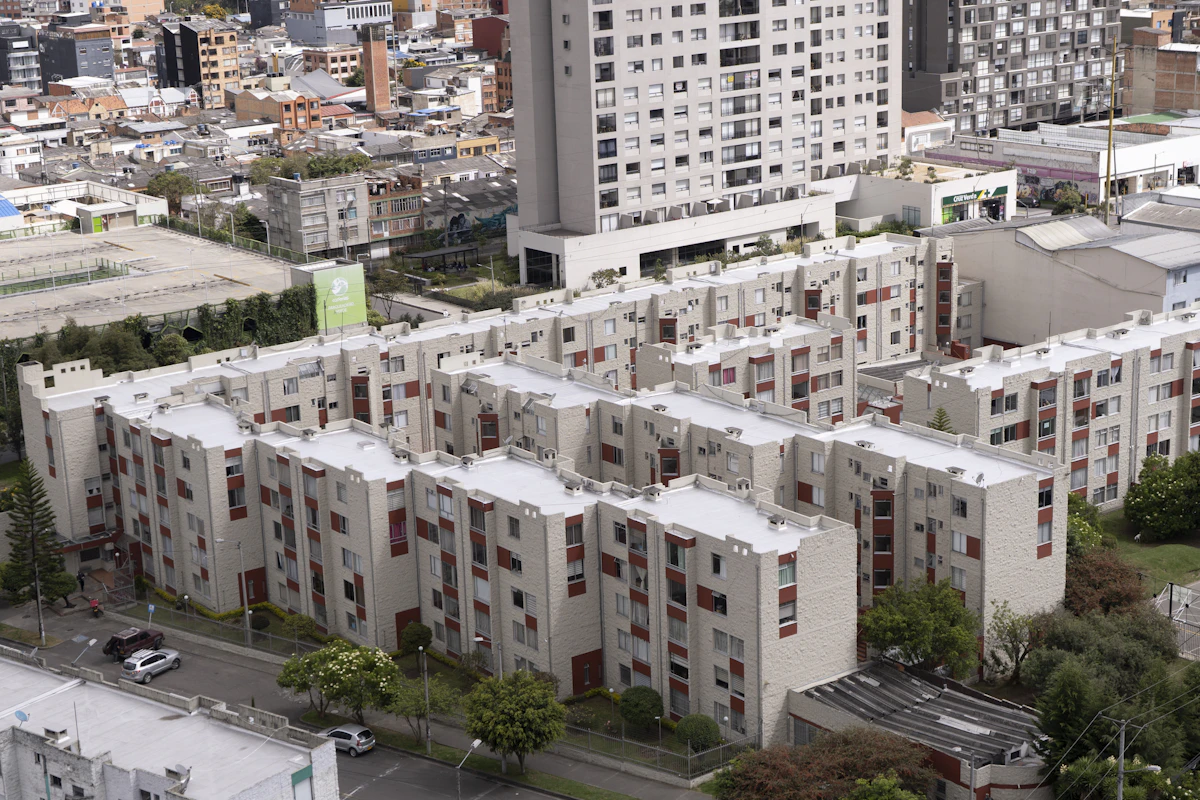
Photo by Aldward Castillo / Unsplash
The University of Tennessee's enrollment ambitions — 40,000 students and climbing, with 80% living off-campus — have compressed Knoxville's rental market beyond what its working-class base can absorb, producing the highest single-day eviction filing in Knox County history while the city's safety net quietly runs out of attorneys.
The courthouse on Main Street in downtown Knoxville opens at eight. The eviction docket runs on Tuesdays. By seven-forty-five the hallway outside Civil Court fills — not with attorneys in suits, mostly, but with people who look like they've been up since five. Parents with folders. A man in a logistics company polo. A woman maybe thirty, maybe forty-five, holding a cardboard folder and checking her phone, not for messages but because it gives her something to do with her hands.
Most of them won't have a lawyer. The math is direct: Knox County processes roughly two hundred fifty eviction cases every month. Legal Aid of East Tennessee — the only organization in the county that provides free tenant representation — has two attorneys left. They can accept about fifty cases per month. The other two hundred cases walk into that hallway alone.
Fort Sanders sits one mile west of that courthouse. It is a neighborhood of wide-porch houses and brick apartment buildings built mostly in the early twentieth century, the kind of dense residential grid that gets called "historic" when rents are low and "character" when they start moving up. For decades it housed Knoxville's nurses, line workers, graduate students, and kitchen staff — the people who keep a mid-size Southern city operational. UT's campus ends at its eastern edge.
Walk Fort Sanders now and you notice the turnover in small ways. A first-floor apartment where the blinds are always drawn because no one has moved in yet. A "For Rent" sign that's been there long enough to fade. A younger, louder weekend energy that comes and goes, leaving the sidewalk quiet by Monday morning. The people who used to anchor the neighborhood — the ones who stayed three, five, eight years — they're the ones in that courthouse hallway. They didn't leave by choice. They left because the number on their lease changed and the number on their paycheck didn't.
Tennessee's minimum wage is $7.50 an hour. It has not moved. The rent in Fort Sanders — and across most of the rental market in Knox County — has moved significantly. The two numbers are no longer in conversation with each other. The eviction docket is what happens when they stop talking.
The University of Tennessee Knoxville sits on a landlocked campus. Its physical footprint cannot expand meaningfully into surrounding neighborhoods without decades of acquisition and political conflict. In 2020, UT enrolled roughly 32,000 undergraduates. By Fall 2025, that number had crossed 40,000 — a 24% increase in five years. UT President Randy Boyd has publicly declared a target of 55,000 enrolled students by 2030. On-campus housing capacity covers approximately 20% of the current student body, or about 8,000 beds. The remaining 32,000-plus students must find housing in Knoxville's private rental market.
This is an enrollment policy that is also a housing policy — it just wasn't labeled as one.
"There's been a housing crisis in the United States and around the world for years, but Knoxville was pretty protected from that … but then with COVID, that really shifted."
— Dr. Solange Muñoz, Associate Professor, UT Department of Geography & Sustainability; lead author, AJRC eviction report (UT Daily Beacon, April 1, 2025)
The mechanism is straightforward. Students competing for off-campus housing constitute a structurally different renter bloc from working-class tenants. Many have access to student loan disbursements, parental income supplementation, and roommate-stacking arrangements that allow them to bid above the sustainable rate for a working-class household. When 32,000 such renters enter a market simultaneously, landlords — acting rationally — price to the ceiling. The ceiling is defined not by the median wage but by what the student renter pool will bear.
Knoxville metro rent rose more than 60% between 2019 and 2024, while wages grew only 26.7% — a 33.6 percentage-point disparity that ranks as the largest rent-to-wage gap among the 100 largest U.S. housing markets, four times the national average of 7.4%. Source: United Way of the National Capital Area analysis, reported by WATE 6, February 20, 2026.
The City of Knoxville's own Housing Office confirmed the parallel dynamic: rental prices increased 56% since 2020, against a 3.4% increase in median income. These are not abstract percentages — they land on households that are already at the margin. The UT Appalachian Justice Research Center (AJRC), in its April 2025 report, found that more than 50% of Knox County renters now pay above the standard affordability threshold of 30% of income on rent. One in four pays above 50%.
"A general rule of thumb is that a family should not pay more than 30% of their income on rent. The fact that over half of households renting in Knoxville pay more than 30% of their income on rent, and a quarter of households are now paying more than 50% of their income on rent has created precarious housing situations for so many, putting many families just one car payment, one medical bill, one unforeseen payment, away from facing eviction."
— Dr. Solange Muñoz, AJRC report (April 9, 2025)
The eviction cascade follows logically. Cost-burdened tenants, operating with no financial cushion, lose housing at the first disruption. By early 2025, Knox County Civil Court was processing a monthly average of 250 eviction filings. On March 11, 2025, that number hit 361 in a single session — a county record. The legal safety net that could theoretically intervene had simultaneously collapsed: federal Emergency Rental Assistance Program (ERAP) funding expired, stripping Legal Aid of East Tennessee of the resources that kept its attorney count at five. The organization dropped to two attorneys and one paralegal. Their monthly capacity: approximately fifty cases.
The AJRC report documented a $6.14 return on every $1 invested in Legal Aid's eviction prevention program — in the form of downstream savings to the city and county in education, medical, and housing system costs. The City of Knoxville's Eviction Prevention Office required $600,000 in local budget funding to remain operational. That budget fight was unresolved as of the April 25, 2025 City Council deadline. Meanwhile, the KCDC affordable housing waitlist sat at approximately 10,000 families.
The entry friction analysis is blunt. Students can typically access financial instruments — loans, parental transfers, multi-roommate units — that a working-class single parent cannot. When both groups compete for the same rental supply, the working-class tenant structurally loses. The displacement is not random. It follows the geography of proximity: Fort Sanders, the Strip corridor, Parkridge, and adjacent neighborhoods absorbed the most intense rental pressure first because they are closest to campus. Long-term, lower-income residents in those areas — disproportionately non-white, disproportionately service-sector workers — face the shortest path from rent increase to eviction filing. There is one additional detail worth recording: UT President Randy Boyd is, by background, a real estate developer. The enrollment expansion decision that has driven rental demand in Knoxville's private market was made by a person with a documented financial interest in the real estate sector. This has been flagged by community members and has not been formally investigated by any regulatory body. That gap in accountability is itself part of the structural read.
Knoxville is not the first mid-size American city to discover that its largest employer and institution can grow without absorbing the costs of that growth. The pattern has a name in urban policy literature: the "anchor institution" problem. Universities, hospitals, and large government employers are classified as anchors because their presence stabilizes local economic activity. What the anchor-institution framework does not resolve is what happens when the anchor institution's growth outpaces the surrounding community's capacity to accommodate it without displacement.
Research from the Harvard Joint Center for Housing Studies consistently shows that cost-burden rates above 30% of income function as structural preconditions for eviction rather than mere financial inconvenience — once a household crosses that threshold, any non-routine expense triggers a payment crisis.[1] The AJRC data places more than half of Knoxville's renter population in this precondition state. Princeton University's Eviction Lab has documented that cities with rapid enrollment growth and constrained on-campus housing supply show eviction rate acceleration two to four years after the enrollment surge begins — a lag that matches precisely the 2020–2025 timeline in Knoxville.[2]
The Tennessee policy context eliminates several standard mitigations. The state has no rent stabilization statute. Tennessee preempts local rent control ordinances, meaning the City of Knoxville cannot independently cap rental increases regardless of political will. The state minimum wage of $7.50 per hour is the federal floor — no state supplement has been enacted, and no legislative movement toward one is currently active. The social safety net reduction (ERAP expiration, Legal Aid defunding) was not a Knoxville policy choice — it was a federal unwinding that removed the short-term cushion just as the structural pressure peaked.
Nationally, Inside Higher Ed and the Urban Institute have both documented that when public research universities pursue enrollment expansion without proportional on-campus housing investment, the burden of housing provision falls on the private market and is paid for, disproportionately, by the non-student low-income renters in the same geography.[3] The university captures the tuition revenue and the reputational benefit. The city absorbs the displacement cost. There is no automatic accounting mechanism that transfers any portion of the university's enrollment-growth revenue back to the housing stability systems the growth is straining. In Knoxville, that gap is measured in court dockets and empty Legal Aid desks.
The broader implication of this signal is precise: when a public university's enrollment targets are set without binding on-campus housing obligations, those targets function as a de facto eviction policy for the working-class residents who share the same rental market — and no state-level framework currently exists to price that externality back into the institution.
The simplest challenge to this signal's framing is that Knoxville's rental crisis is primarily a reflection of national post-pandemic housing inflation, not a UT-specific phenomenon. U.S. rents rose broadly from 2020 to 2024 across markets of all sizes, driven by pandemic-era migration, supply chain disruptions in construction, and low housing supply relative to household formation. Under this reading, UT's enrollment growth is a concurrent trend rather than a cause — Knoxville would have seen significant rent increases regardless of enrollment expansion. This is a legitimate alternative with meaningful supporting evidence. It cannot be dismissed. The reason it is still secondary to the UT mechanism in this analysis is the magnitude and timing specificity: Knoxville's 33.6-point rent-to-wage gap is the largest among the top 100 U.S. metros — four times the national average. A purely national explanation would predict a more median outcome. The excess above the national trend requires a local amplifier. The enrollment-driven demand surge, operating in a landlocked campus market with 80% off-campus housing, is the most structurally complete candidate for that amplifier.
A second alternative frames the crisis as a supply-side failure rather than a demand surge: Knoxville simply didn't build enough housing over the past decade to accommodate population growth of any kind — students, remote workers, or otherwise — and the eviction cascade is the symptom of chronic underbuilding. This explanation has strong standing. Knoxville's Housing Affordability Index hit its lowest recorded level since 1984 (Inside of Knoxville, July 2025), which reflects a long-accumulating mismatch between supply and demand that predates both the pandemic and the UT enrollment surge. However, the supply-side framing as a standalone explanation cannot account for the speed and concentration of the crisis. The eviction record on March 11, 2025 occurred after a 24% enrollment increase in five years. Supply constraints were present before that increase — but the eviction cascade, the Legal Aid staffing crisis, and the record rent-to-wage gap all accelerated sharply within the enrollment expansion window. Chronic underbuilding set the conditions; the enrollment surge was the proximate trigger that transformed chronic underbuilding into acute displacement.
What is not known: Granular neighborhood-level displacement data below the Knox County aggregate is not confirmed in available sources. The signal infers that Fort Sanders and corridor-adjacent neighborhoods absorbed disproportionate displacement pressure based on proximity logic, but block-level eviction filing maps have not been reviewed. The demographic profile of evicted tenants — age, employment sector, whether student or non-student — is not disaggregated in available data.
What is absent: No direct, named interview with a long-term working-class Knoxville resident who has been displaced exists in the current evidence base. The SOCM organizing presence is documented, but its membership accounts are not individually sourced. The conflict-of-interest question around President Randy Boyd's real estate background has not been formally investigated, and no primary institutional documents connecting his personal financial interest to enrollment decisions have been reviewed.
What would upgrade or change this signal: Neighborhood-level eviction filing maps (available from Princeton's Eviction Lab for some jurisdictions) would sharpen the mechanism. A FOIA request for on-campus housing capacity expansion planning documents over the 2018–2025 period would clarify whether UT knowingly chose enrollment growth over housing investment. If the City Council did fund the $600K Eviction Prevention Program in April 2025, the monitoring outcome for that intervention would either confirm or complicate the legal-aid absence hypothesis. If UT increases on-campus bed capacity materially by 2028, and eviction rates decline in parallel, that would partially validate the enrollment-demand mechanism.
Note on Lens Coverage (L = 0.77): The THRIVE lens is well-supported at the aggregate level. Score held at MODERATE because the displaced working-class resident perspective is inferred from statistical and legal-aid data rather than directly reported through named individual testimony. A single sourced interview with a LAET client or SOCM member would raise L to ≥0.85 and upgrade this signal to HIGH.
[1] UT Appalachian Justice Research Center (AJRC). "Housing Stability and Tenant Representation in a Changing Knoxville." April 9, 2025. Lead author: Dr. Solange Muñoz, UT Department of Geography & Sustainability. https://ajrc.utk.edu/ajrc-releases-first-public-report-detailing-the-scope-of-evictions-in-knox-county/ — Tier A
[2] City of Knoxville Housing Office. "Strategy to Meet Housing Challenges." 2024. https://www.knoxvilletn.gov/news/2024/city_releases_strategy_to_meet_housing_challenges — Tier A
[3] WATE 6 (Nexstar ABC). "Rent hikes in Knoxville outpaced wage growth by nation's largest margin since COVID-19, study finds." February 20, 2026. https://www.wate.com/news/knox-county-news/rent-hikes-in-knoxville-outpaced-wage-growth-by-nations-largest-margin-since-covid-19-study-finds/ — Tier B
[4] UT Daily Beacon. "Knoxville housing crisis: raising awareness for record-high eviction rates." April 1, 2025. https://utdailybeacon.com/82876/countycity-news/knoxville-housing-crisis-raising-awareness-for-record-high-eviction-rates-how-they-affect-students-community/ — Tier B
[5] UT Daily Beacon. "Record enrollment rates pose questions for UT housing scene." August 20, 2025. https://utdailybeacon.com/83865/campus-news/record-enrollment-rates-pose-questions-for-ut-housing-scene/ — Tier B
[6] Inside of Knoxville newsletter. "Housing Report 2025: Knoxville's market is normalizing, but affordability lags behind." July 2025. https://insideofknoxville.com/2025/07/housing-report-2025-knoxvilles-market-is-normalizing-but-affordability-lags-behind/ — Tier C
[7] Reddit r/Knoxville. "Under control of local property developer Randy Boyd…" 2023. https://www.reddit.com/r/Knoxville/comments/163a0gv/under_control_of_local_property_developer_randy/ — Tier C (community color/context only)