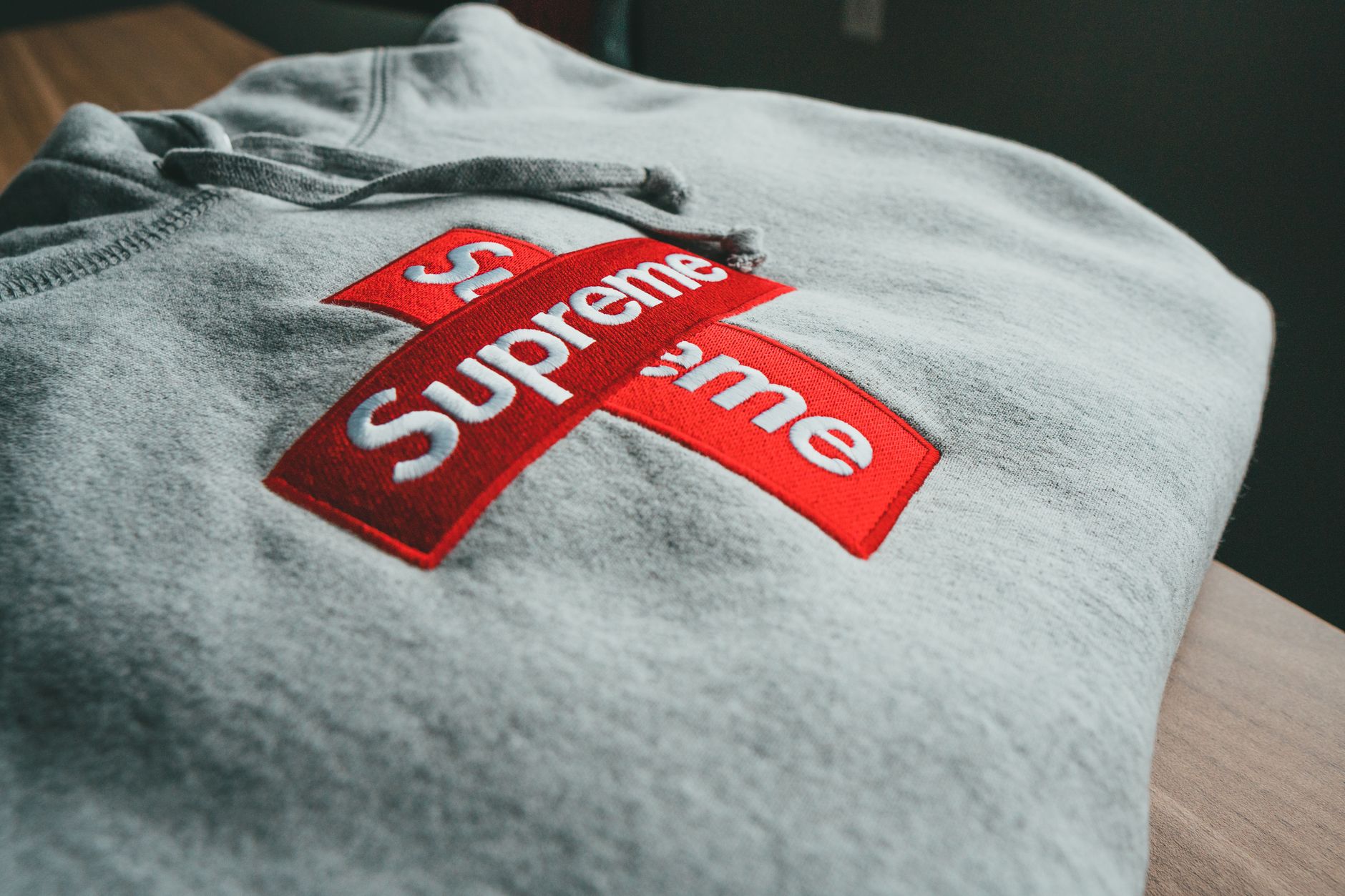
The most copied graphic in streetwear becomes raw material for its own deconstruction.
Supreme's Spring/Summer 2026 collaboration with MM6 Maison Margiela is a 35-piece collection that includes deconstructed Box Logo tees, inside-out hoodies, and a pair of Timberland 6-inch boots wrapped in $100-bill print fabric (Hypebeast). It is absurd. It is also the most strategically coherent thing Supreme has done in years.
The collection reads as self-parody until you understand it as self-autopsy. Supreme is not making fun of itself. It is dissecting its own iconography, handing the scalpel to a house that has spent four decades making dissection look elegant.
The Supreme Box Logo — white Futura Heavy Oblique on a red rectangle — is the most reproduced graphic in streetwear history. It has been bootlegged on every continent, tattooed on bodies, counterfeited at industrial scale, and auctioned at Christie's. It is, by any measure, a piece of cultural infrastructure: a symbol whose meaning exceeds the brand that owns it.
This is Supreme's asset and its problem. The Box Logo became so ubiquitous, so referenced, so absorbed into visual culture that it stopped functioning as a differentiator and started functioning as a commons. Everyone owns it. No one needs Supreme's permission to invoke it. The bootleg and the original carry the same cultural weight on the street.
The MM6 collaboration addresses this directly. By deconstructing the Box Logo — splitting it, inverting it, printing it on unexpected substrates — Supreme reclaims authorship over its own symbol. The message is: you can copy the logo, but you cannot deconstruct it. Only we can do that, because only we own the original meaning.
The choice of MM6 is not aesthetic. It is methodological.
Maison Margiela, since Martin Margiela's founding of the house in 1988, has operated on a single principle: clothing is a text that can be read, edited, and rewritten. The blank label. The exposed seams. The trompe-l'oeil prints of other garments. Every Margiela piece is a commentary on the act of making clothes.
MM6, the more accessible diffusion line, carries this DNA in a commercially viable format. It is Margiela's deconstruction grammar at a price point that intersects with Supreme's audience. The collaboration is not a brand mashup — it is a methodological merger. Supreme provides the iconography. Margiela provides the critical framework. Together, they produce objects that are simultaneously streetwear and commentary on streetwear.
The inside-out hoodies are the clearest expression of this. They literalize what Margiela has always done metaphorically: exposing the construction, showing the seams, refusing the fiction that a garment arrives complete and unconstructed. When applied to a Supreme hoodie — an object whose value has traditionally depended on surface graphics — the inversion is both visual and economic. The value moves from the printed exterior to the revealed interior.
Then there are the boots. Timberland 6-inch classics — the foundational footwear of New York hip-hop culture since the early 1990s — wrapped in a print of American $100 bills.
This is not subtle, and it is not trying to be. The Timberland boot carries specific cultural memory: Biggie, Wu-Tang, Harlem winters, construction sites, the working-class masculinity that streetwear aestheticized and then monetized. Wrapping it in currency imagery makes the subtext text. The boot that signified authentic New York culture is now literally wearing the money that culture generated.
Whether this reads as critique or celebration depends on where you stand. Supreme has always occupied the ambiguity — profiting from counterculture while being absorbed into corporate luxury (the brand was acquired by VF Corporation in 2020 for $2.1 billion). The $100-bill Timberland is that ambiguity rendered in leather and print. It is honest in a way that most brand collaborations avoid.
The MM6 collection signals a strategic evolution that has been underway since the VF acquisition: Supreme is transitioning from a clothing brand to a platform brand.
A clothing brand sells garments. A platform brand licenses its iconography, cultural position, and distribution infrastructure to partners who create within the brand's framework. Nike is a platform brand. Apple is a platform brand. Supreme, with this collection, is behaving like one.
The 35-piece range is not a Supreme collection with Margiela detailing. It is a Margiela collection using Supreme's visual language as raw material. Supreme provided the symbols — Box Logo, the brand color palette, the Timberland association — and let MM6 restructure them according to Margiela's design logic.
This is a fundamentally different creative model than the typical streetwear collaboration, where two brands merge their aesthetics into a hybrid. Here, Supreme cedes creative authority to a partner and benefits from the recontextualization. The logo is the platform. The collaborator is the developer.
The Supreme-is-dead narrative has been running for five years. It is wrong, but it is pointing at something real. Supreme the clothing brand — the one that sold box logo tees in limited drops to lines of teenagers on Lafayette Street — is dead. Supreme the cultural platform — the one that licenses its iconography to Margiela, to Nike, to whoever has a compelling critical framework — is what survives.
The Box Logo does not need to be worn to have value. It needs to be referenced, deconstructed, argued about. Supreme's SS26 play is to ensure that when the Box Logo is discussed, it is discussed on Supreme's terms — not the bootlegger's, not the reseller's, not the nostalgist's.
The Box Logo is dead. Its afterlife is the product.
Extended Analysis
Deeper Evidence
The SS26 Supreme × MM6 collection is not an isolated experiment. It is the culmination of a four-year evolution in Supreme's collaboration strategy that began immediately after the VF Corporation acquisition. Pre-acquisition Supreme collaborations prioritized cultural credibility and audience alignment: Nike, Louis Vuitton, Comme des Garçons. Post-acquisition, the pattern has shifted toward intellectually legible collaborations that justify Supreme's position as a premium platform: Jean Paul Gaultier, Yohji Yamamoto, and now Margiela. The collaborators are less about street credibility and more about institutional art-world legitimacy.
This matters because it maps directly to VF Corporation's strategic logic. VF does not own Supreme to sell $50 tees to teenagers. It owns Supreme to operate a cultural IP platform whose collaborations generate press, drive direct-to-consumer traffic, and maintain desirability at price points that improve overall brand margin. The MM6 collaboration's 35-piece range, priced at premium streetwear levels (Hypebeast confirms individual pieces running $250–$650), is optimized for this model — low volume, high margin, maximum editorial coverage.
The deconstructed Box Logo tees are particularly significant as data points. Supreme's original Box Logo tee retailed at $38–$44 in the mid-2010s. The MM6 deconstructed version sits in the $300–$400 range. The logo's movement from $38 to $400 is not inflation — it is the price of theoretical legitimacy. When Margiela's grammar is applied to the Box Logo, the object transitions from streetwear into design artifact. The market has been trained to pay differently for design artifacts than for streetwear, and Supreme is now operating in both categories simultaneously.
Context Bridges
The Supreme-as-platform evolution connects directly to how technology companies have understood platform dynamics for two decades. Microsoft in the 1990s learned that the most durable competitive advantage is not the product but the ecosystem — owning the infrastructure that other creators build on. Supreme's Box Logo is functioning like an API: a stable interface that developers (collaborators) can build on, generating value for both the developer and the platform owner without the platform having to create the product itself.
This is a meaningfully different business model than the one Supreme was founded on. James Jebbia built Supreme as a product company with cultural distribution. VF Corporation is running it as an IP licensing operation with cultural maintenance requirements. The distinction is not cynical — it is how successful cultural brands scale without destroying the conditions of their scarcity.
In contemporary art, the parallel is Andy Warhol's Factory model: a studio practice organized around the repetition and redistribution of iconic imagery, with the artist's role shifting from creator to curator and authorizer. Warhol did not make every print that bore his name; he created the conditions under which the prints were made and maintained the aesthetic standards that gave them value. Supreme is doing something structurally similar with the Box Logo — authorizing its deconstruction by a legitimizing collaborator while maintaining the conditions under which that deconstruction has meaning.
Historical Precedent
The closest historical parallel is not in streetwear — it is in punk. When Malcolm McLaren and Vivienne Westwood moved from running SEX boutique at 430 King's Road to licensing the aesthetic globally, they faced the same paradox Supreme faces now: the subculture they created could not survive institutional adoption without losing the quality that made it valuable, but refusing institutional adoption meant remaining marginal. The Sex Pistols were the product; punk was the platform. The platform survived the product's collapse.
Westwood's subsequent career — moving from punk provocation to establishment fashion house while maintaining subversive intellectual positioning — is the playbook Supreme is now executing, with a generation's delay and a corporate backer. The inside-out hoodies of the Margiela collection are Westwood's safety-pin jackets recontextualized: a foundational subcultural garment element treated as a design grammar rather than an ideology.
What the punk precedent teaches is that the transition from subculture to institution typically takes 15–20 years and requires a critical event — institutional adoption, corporate acquisition, or the death of the founding mythology — to trigger the shift from product company to platform company. Supreme's 1994 founding, its 2020 acquisition, and the 2026 Margiela collection form exactly this arc. The mythology is not dead; it is being consciously extended into new territory.
Contrarian Read
The Supreme-as-self-autopsy narrative is genuinely compelling, and it is also exactly what the brand wants you to think. The contrarian read is that the MM6 collaboration is not deconstruction — it is preservation through complexity.
By partnering with Margiela and generating a discourse of intellectual legitimacy, Supreme creates a cultural moat that makes it impossible to dismiss without appearing unsophisticated. The message encoded in the collaboration is: "If you don't get it, you're not the audience." This is not openness — it is the world's most expensive velvet rope. The deconstructed Box Logo is accessible to exactly the same narrow demographic as the regular Box Logo, but now protected by an additional layer of theory that makes criticism of the brand feel like missing the point.
The $100-bill Timberlands are the tell. That piece is not critique. It is product. The currency imagery gives intellectual cover for what is, at base, a premium sneaker with a provocative print. The decision to read it as cultural commentary rather than clever merchandising is the choice Supreme is counting on its audience making. The brand benefits whether you read it as commentary or not — it is commercially effective in both registers.
Implication Chain
6 months: The SS26 collaboration's critical reception — universally covered, unevenly understood — will generate a secondary wave of analysis in fashion media that treats Supreme's evolution as a case study in brand longevity. This meta-coverage is itself part of the product: Supreme generates not just clothing but discourse about clothing, and discourse is now a primary brand asset.
1 year: Expect at minimum two more intellectually positioned collaborations from Supreme in the 2026–2027 cycle, likely from different verticals — a contemporary art institution, a performance company, or an architecture practice. VF's strategy requires Supreme to expand its legitimacy infrastructure beyond fashion. The Box Logo as artistic raw material is more valuable if it has been engaged by multiple disciplines, not just fashion houses.
3 years: The question is whether Supreme's audience migrates with the brand's intellectual evolution or splits. Streetwear's core demographic — young men, urban, culturally attuned — has historically been willing to follow brands into conceptual territory (see: the Virgil Abloh effect on Off-White's evolution). But there is a ceiling. If Supreme's collaborations become exclusively theory-heavy, the brand loses its street authenticity claim entirely and becomes an art-world brand with a streetwear heritage — which is a valuable position, but a different one from what Supreme was. The Box Logo has never needed an explanation before. The moment it requires one, the game has changed.