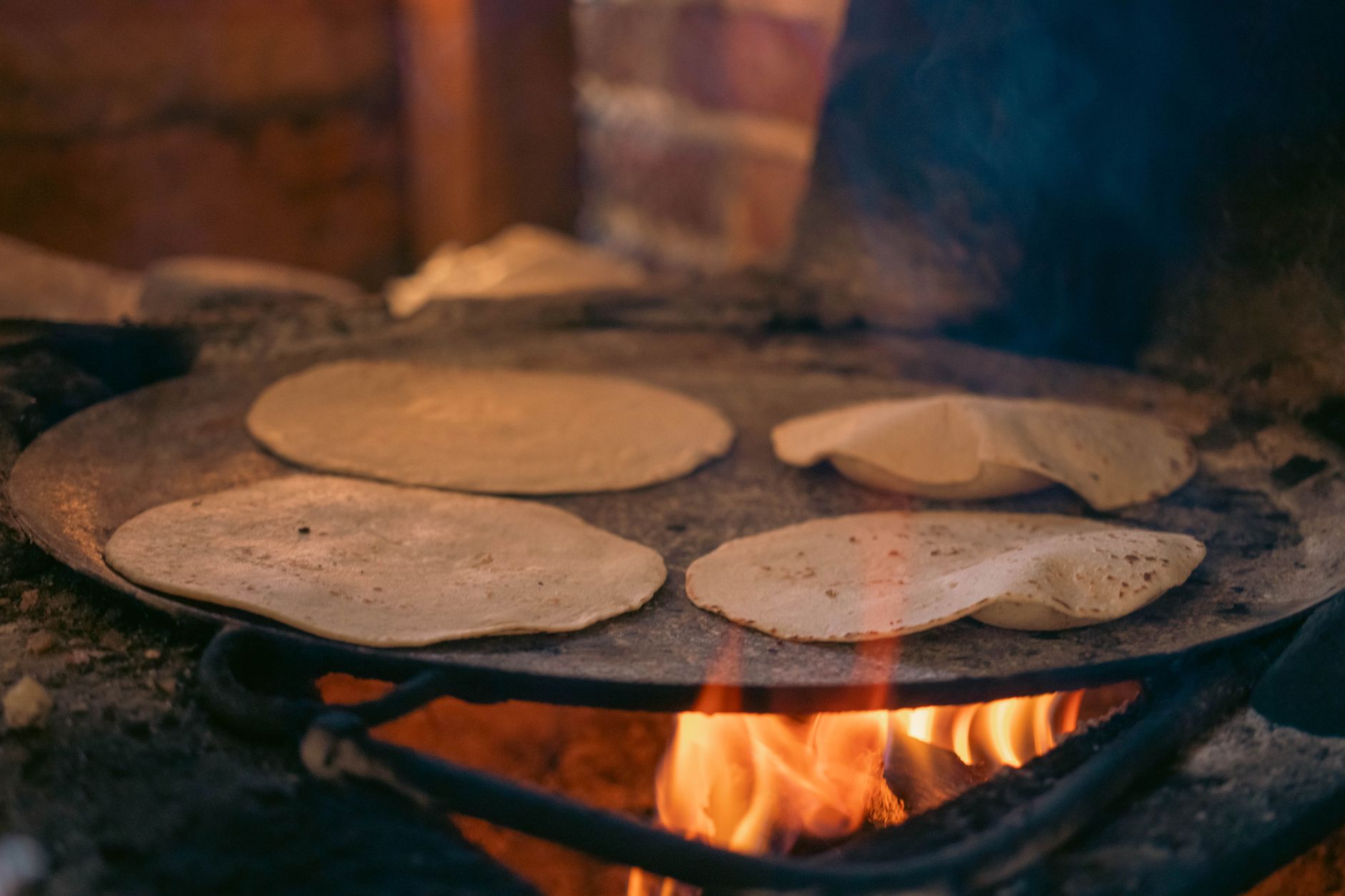
Eufemia got to the tortillería with her cloth bag folded in her hand, still morning. The sign at the entrance promised service from nine to five, Tuesday through Sunday.
The counter was empty.
Not empty of people: empty of tortillas. They told her what they had been telling everyone who walked in — that it was gone, that the whole day's production had run out in an hour and a half. Eufemia checked the time. 11:30.
Behind the counter the volcanic stone mill was still working, but for tomorrow. The corn it grinds does not come out of a warehouse: it comes down from the city's conservation land, from the milpas of Tlalpan, and before it becomes dough it has to sit all night in nixtamal. It cannot be rushed. The machine puts out what it puts out, and what it puts out is half of what the programme promised.
Eufemia had not come out of curiosity. Patricia, another neighbour, left it on the record with the line that orders the whole queue: we would rather it were a little more expensive, as long as the tortillas are good.
She tucked the empty bag under her arm and went out to the street, where there is another tortillería that never runs out and costs less.
What follows is not the chronicle of a shop that falls short. It is the question of who a price is for.
Scene reconstructed from documented behaviour and territory; sources at the foot of the article.
The Signal
In Utopía Libertad, in the Iztapalapa borough, a tortillería grinds native corn on volcanic stone. On most days the tortillas run out around 2:30 p.m., even though the posted hours run until 5:00 p.m. Patricia, a neighbour, sums up why she comes back: “We would rather it be a little more expensive, as long as they are good-quality tortillas.” Eufemia remembers one occasion: “Last time we came and there was none left. They told me it had all gone in about an hour and a half. We came around 11:30 and there was nothing.”
What looks like the news is the counter price. It is not. In October 2025, Chilango's field report recorded the kilo at $25 pesos —not the $22 announced by Clara Brugada, head of government of Mexico City— against $22 at the conventional tortillería down the street. Three pesos: 14% more expensive. At the other end of the chain, on the same date, the farmer was being paid $16 a kilo, $16,000 a tonne, against the market's $6,000 to $6,250. That is 167% more.
The Context
Francisco Contreras, the manager of the tortillería, runs the arithmetic that explains the rest. “Corn yields run between two and three tonnes per hectare. But the cost of corn averages $6,000 pesos a tonne. So if we do the math, that is $18,000 and we are taking a loss.” Investment per hectare runs from $20,000 to $30,000: planting native corn at market price means paying to work. Contreras completes it: “Here they are paying us $16 a kilo. So we are already getting $16,000 a tonne.” With that, the same hectare stops losing money.
The corn comes from San Miguel Xicalco and La Magdalena Petlacalco, in the Tlalpan borough, on conservation land. It is planted by Red Centli's 66 direct producers, 330 beneficiaries counting their families, aged 55 to 60 on average.
One fact that is usually told wrong: the decree declaring Mexico City a territory free of transgenic corn is dated 17 January 2025, Official Gazette No. 1529 Bis, and it binds production and conservation systems, not the retail sale of transgenic derivatives to consumers. It extends the 2009 Declaration of Protection of the Altiplano Corn Races: the area has been free of transgenics for seventeen years. What is new is not the ban. It is the price paid to the farmer.
The first tortillería opened on 24 September 2025. The government promised 38 by the end of 2026, and that remains a promise. There are sites that can be named: Utopía Centli Topilejo, in Tlalpan, from July 2026, and Utopía Elena Poniatowska, in Coyoacán, from August 2026, supplied by farmers from Milpa Alta.
The Reading
The load-bearing figures —the $25, the $16, the daily output, the number of employees— come from a single field report: the one by Edgar Ulises Segura for Chilango, dated 9 October 2025. No other outlet picked the $25 up again; the aggregators repeated the official $22.
A kilo of corn yields around a kilo and a half of tortillas, which puts the input at some $10.7 per kilo of tortilla against some $4 for the conventional one: an input gap of $6.7 against a counter gap of $3. What the consumer pays does not cover what the farmer receives. The public purse makes up the difference.
And the counter gap has already closed. In January 2026 the tortillerías of Iztapalapa reached $23 and $24, and on 13 April SNIIM placed the metropolitan area between $21.27 and $21.72, against a national average of $24.18. The $25 is no longer above the street: it is surrounded by it. That reinforces the signal, because the differential that mattered was never at the counter.
One more piece of honesty, from the operator: tortillas running out does not prove exceptional demand, it proves restricted supply. Between 150 and 200 kilos a day against a target of 400, five employees, a tortilla press rated at fifty kilos an hour, and eight hours of nixtamal resting time that cannot be rushed. “There are still failures, there are a lot of things to improve,” Contreras says.
The Pattern
When an ancestral food turns premium, the question almost never asked is who pays the premium and who receives it. Here both can be measured, and they do not match: the counter went up 14%, the farmer 167%, and the public budget absorbed the difference.
Selling subsidised food goes back decades in Mexico: CONASUPO, DICONSA, Liconsa, the Bienestar stores. What is new is on the other side of the counter, in a guaranteed price to the farmer, above the market, for corn from one specific territory.
That is where the fragility sits: a model held up by a fiscal differential does not depend on the market, it depends on political will, and it lives as long as the programme does. The hectare that is viable today goes back to running a deficit the year the price is not renewed.
There is a faster clock than the price one. Contreras puts it this way: “I think the countryside is not in danger of extinction; the one in danger of extinction is the producer, above all because of the generational change.” With an average of 55 to 60 years among those who plant, what the programme has to buy is not a harvest. It is a succession.
The sources this piece already cited, gathered and checked. Open to verify.
- Chilango, Edgar Ulises Segura, «Tortillería de maíz nativo CDMX: precio, horario, por qué sus tortillas son distintas» (field report), 9 October 2025
- Animal Gourmet, «Tortillería de maíz nativo en CDMX», 24 September 2025
- Chilango, «CDMX tendrá 38 tortillerías de maíz nativo: así serán» (government promise for the end of 2026)
- Ejecentral, «Brugada: cómo llegar a la Utopía Centli Topilejo y qué puedes hacer gratis en este nuevo espacio», July 2026
- El Financiero, «Clara Brugada inaugura la Utopía Elena Poniatowska Amor en Coyoacán», 9 August 2026
- El Financiero, «Precio de la tortilla en México: en qué ciudades se vende más cara y más barata» (SNIIM data as of 13 April), 14 April 2026