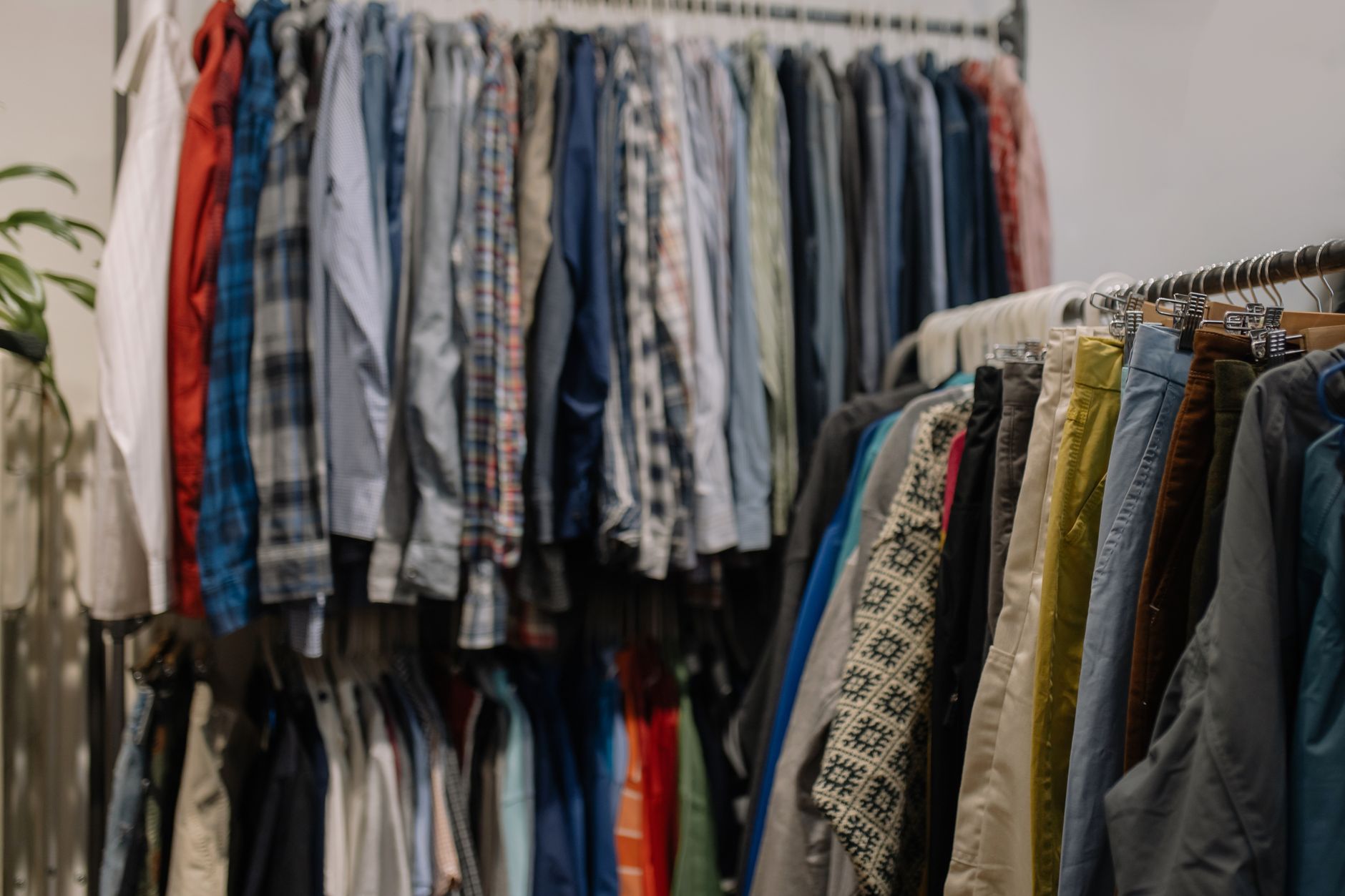
Ramiro works with people who send him bales. That is how he puts it, without ceremony: there are people, in another country, who gather clothing, press it, wrap it and send it to him.
The bundles arrive in Guaymallén sealed and they stay sealed. Each one weighs forty kilos. Anyone can buy a whole one without seeing inside, just as it came, and take their chances. Or they can buy by weight: the clothes go on the scale and you pay by the kilo. A kilo is five or six T-shirts. It can also be four dresses.
On any given Wednesday people come and go all day. Someone asks the size. Someone asks the price. Someone checks the label, if there is one. Nobody asks where each garment came from, because the answer changes nothing about what has to be decided right there, with the shirt in hand.
For that bundle to reach the scale, someone had to sign a form in the customs system beforehand, declaring under oath one very specific thing: that what is inside is not waste. That it is not garbage.
Nobody opened it to check. The oath is sworn over the sealed bundle, the same way it is bought.
And inside every bale there is a part that will never sell. It comes pressed in alongside the part that will.
What follows is about that piece of paper.
Scene reconstructed from documented behaviour and territory; sources at the foot of the article.
The signal
In twelve months Argentina's imports of used clothing went from 13 tonnes to some 3,521 tonnes a year: 11% of everything the country imports in apparel. 90% enters via Chile and 84% of that crosses at the Jujuy customs post. In four months more than 200 trucks came through (Diario Yerba Buena, March 2, 2026). From a fair in San Salvador de Jujuy the goods spread to neighbourhood "American" fairs across the country.
That is the volume. What matters is how it enters.
To import used clothing, the importer must file a sworn declaration in the customs computer system stating that the goods do not constitute waste under Law 24.051 —the hazardous waste law— and are not destined for energy recovery or final disposal. It is an oath about the contents of a pressed, sealed bundle that nobody opens at the border.
At the other end of the chain the bundle is still sealed. In Guaymallén, Mendoza, Ramiro sums it up: "we work with people who send us bales." The bales weigh 40 kilos and cost between $300,000 and $900,000 pesos depending on grade. They are sold sealed for resale. Anyone who does not want the whole bundle buys by weight: $20,000 a kilo, five or six T-shirts (Diario Uno, February 4, 2026, reported from the shop).
Nobody opens the bale before paying for it. Nor does customs.
The context
The trade exists because of a gap: decree 333/2017, which restricted imports of used clothing, expired in May 2022 and was not renewed. That is the background, not the news.
The news is the architecture of the procedure. Secondhand clothing arriving in the Global South is, at origin, a surplus: what the North donates, discards or failed to sell. Whether that is merchandise or waste has no physical answer —it depends on what fraction can be used again— and the system resolves it by declaration: someone signs that it is not garbage.
How much of a bale ends up unsellable is not measured in Argentina. The only available range is Kenyan and it comes split: up to 40% per bale per the Changing Markets Foundation with Clean Up Kenya and Wildlight; 1% to 2% per the importers' body. Neither party is neutral, there is no independent measurement, and it is not transplanted to Argentina as if it were local.
What can be asserted about the Argentine case is simpler and more uncomfortable: nobody is measuring. Not the person swearing at customs, who swears over a sealed bundle. Not the person buying the bale, who buys it sealed. Not the person buying by the kilo, who buys a T-shirt.
The reading
Public discussion of this trade runs between two frames, and both avoid the same thing.
The first is industrial: used clothing competes with domestic textile production. The second is environmental and about access, and it is the sellers who say it —in Tucumán, one trader puts it as "everyone wins: the environment wins, whoever sells the clothes wins, and whoever cannot afford the mall wins." It is a seller's line.
Both frames argue about the garments that sell. Neither argues about the ones that do not.
And that is the problem with calling this a circular economy. Circularity is not an intention, it is a measurement: the fraction of what enters that actually gets used again. That number exists in no register, and not because nobody bothered: the design of the procedure makes it unnecessary. If the oath replaces the inspection, the only official figure is the one the importer declared. The declaration is the data.
It is the same operation at both ends of the chain: in Kenya a tax proposed this year would have been charged on the customs value of the whole bundle; in Argentina an oath declares the whole bundle is not waste. Neither distinguishes, because opening the bale before deciding would cost more than deciding without opening it.
The pattern
A pressed bale is two commodities inside the same wrapping: the one somebody will buy and the one somebody will throw away. The wrapping is what travels, what is declared, what is taxed and what is paid for.
Every link resolves the ambiguity the same way —by passing it to the next one— until the bundle is opened. Whoever opens it has nobody left to pass it to.
That is why the paper matters so much: it does not describe the goods, it constitutes them. As long as the bale is sealed, it is exactly what the form says it is. Clothing becomes clothing, or becomes garbage, at the moment someone pulls it out of the bundle and decides. And by then it is already in a neighbourhood shop, at $20,000 a kilo, and the oath is a thousand kilometres and six months away.
Declared gaps: no Argentine figure exists for the unsellable fraction per bale; the range cited is Kenyan and comes from opposed interested parties. The name of the customs form circulates only on bale-wholesaler sites —an interested party— and is therefore not used: what is described is the verifiable mechanism, the sworn non-waste declaration under Law 24.051. Of the two available import series, the Diario Yerba Buena figure is used, dated and attributed.
The links this piece cites, gathered and checked. Open them to verify.
- Diario Uno, "Dónde se venden las prendas de los fardos de ropa importados desde Estados Unidos", February 4, 2026 (reported from the Guaymallén shop; Ramiro quotes, prices, sale by the kilo)
- Diario Yerba Buena, "Ropa usada: importación récord en Argentina y su impacto en la industria textil", March 2, 2026 (13 → 3,521 tonnes, 11% of total, 90% via Chile, 84% through Jujuy, 200 trucks)
- Law 24.051 on hazardous waste, updated text — Argentina.gob.ar (framework for the sworn non-waste declaration)
- Official Gazette of Argentina, Decree 1/2025 — recovered non-hazardous waste (certificates and importer sworn-declaration regime)
- Lampoon, "A third of all second-hand clothing shipped to Kenya is plastic waste in disguise" (unsellable fraction range, Changing Markets / Clean Up Kenya / Wildlight research)
- Greenpeace Africa, "How fast fashion is fuelling the fashion waste crisis in Africa" (fate of the unsellable fraction)