
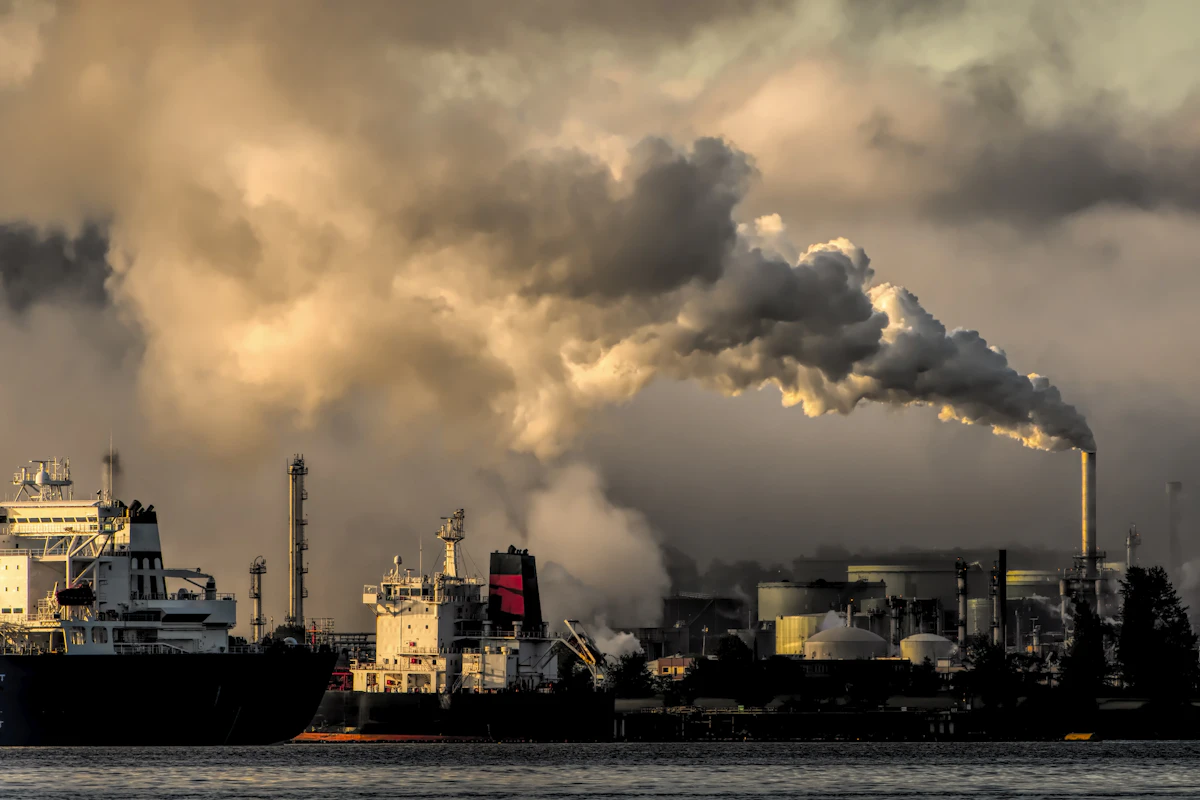
Photo: Michael Jin / Unsplash
The Vent and Burn
Norfolk Southern's train derailed in East Palestine, Ohio, on February 3, 2023. Three days later, the railroad detonated explosives on five vinyl chloride tank cars in an operation the NTSB later ruled unnecessary — exposing a community that would wait three years for a health study and face a settlement that bars future claims.
The Plume Over Rebecca Street
Zsuzsa Gyenes had been living in East Palestine for two years when she first smelled the chemical sweetness. It was a Friday night in early February, and the 9,300-foot Norfolk Southern freight train had just come apart half a mile from her house on the Ohio-Pennsylvania border. She heard the screech first — metal folding into metal — then the rumble that shook through her floor joists. By the time she looked out the window, the sky south of town was orange.
The next two days were strange. Fires burned at the derailment site. Emergency vehicles cycled in and out of the evacuation zone, which extended one mile from the tracks. Gyenes packed a bag for herself and her son. They drove to a hotel twenty minutes east, across the Pennsylvania line, and waited. There was talk on the radio about vinyl chloride — a chemical she had to look up — and about pressure building inside tank cars that might explode. Officials from the railroad told the fire chief they needed to act fast. The tank cars, they said, were going to blow.
On the afternoon of February 6, three days after the derailment, Gyenes watched from a gas station parking lot as the fireball rose over East Palestine. Explosives had been detonated on five tank cars. The vinyl chloride erupted into a column of flame that climbed two hundred feet, then flattened into a black mushroom cloud visible from twenty miles in every direction. The plume drifted northeast. Residents in sixteen states would eventually find traces of the chemicals in their rain and snow. But in East Palestine — population 4,700, one traffic light, two churches per block — the plume settled over the town like a lid.
Gyenes and her son came home a week later. The headaches started within days. Then the rashes on her son's arms, the kind that bloomed overnight and resisted every cream the pharmacist suggested. The creek behind their neighbor's house — Sulphur Run — carried an iridescent film that caught the light wrong. The state said the water was fine. The EPA said the air was safe. Norfolk Southern said the cleanup was proceeding on schedule. Gyenes stood at her kitchen sink, filling a glass from the tap, and tried to believe them.
The first thing the state tested was the municipal water supply. It came back clean. But Gyenes wasn't drinking from the municipal line — her neighborhood used well water, and the wells sat in the same aquifer as Sulphur Run. Nobody tested the wells for weeks. When they did, the results were not shared with individual households. Gyenes learned the numbers from a neighbor who knew someone at the county health department. The numbers meant nothing to her. There was no one in the county whose job it was to translate them into risk. Three years later, she is living with her son in another town. She agreed to the personal injury portion of the class-action settlement, which could mean a payout of up to seventy thousand dollars. Most of it will go to hotel bills from 2023. She did not sign the health monitoring portion — the one that would have capped her future medical claims against Norfolk Southern in exchange for participation. Her son still has the rashes. Nobody has told her what they mean.
The county has no toxicologist.
Thirteen Minutes to Decide
At approximately 8:54 p.m. on February 3, 2023, Norfolk Southern train 32N — a 150-car, 18,000-ton freight consist running from Madison, Illinois, to Conway, Pennsylvania — derailed near milepost 49.81 on the Fort Wayne Line. Thirty-eight cars left the tracks. Eleven were carrying hazardous materials. Three of those cars, older DOT-111 models known for their poor crashworthiness, were mechanically breached on impact, releasing butyl acrylate and other flammable liquids that ignited immediately. The fire grew. Five additional tank cars, these carrying vinyl chloride monomer — a compressed liquefied gas classified as a known human carcinogen — were engulfed but not breached.
The cause was a wheel bearing on a hopper car designated GPLX75465. It had been overheating for miles. Norfolk Southern's wayside detection system — a network of hot bearing detectors positioned along the rail — registered the bearing at elevated temperatures at multiple points, but the nearest detector to East Palestine was twenty miles away. By the time the system's critical alarm sounded, the bearing had already failed. The axle sheared. The car dropped. The train folded.
The NTSB found that Norfolk Southern's wayside detectors were spaced an average of 15 miles apart on the Fort Wayne Line — the same spacing that existed before the derailment. After the crash, the railroad adopted the industry's post-accident recommendation: an average spacing of 15 miles. The NTSB called this inadequate, noting it would not have prevented this specific derailment.
What happened next is where the mechanism reveals itself. Within minutes of the crash, the East Palestine Fire Department — a volunteer force — arrived on scene and established a command post four hundred feet from the wreckage, inside what the NTSB would later describe as the "hot zone." The firefighters began pouring water on the fire. It wasn't enough. The flames consumed more cars, and the fire chief, Keith Drabick, needed to know what was on the train. He asked Norfolk Southern for the train consist — the manifest that lists every car and its contents. It took hours to arrive.
That's the mechanism.
The information bottleneck that defined the East Palestine disaster did not start with the vinyl chloride decision. It started the moment the train derailed and the volunteer fire chief — who had no hazmat certification for an incident of this scale — could not get a basic list of what was burning in front of him. Norfolk Southern controlled the information. Norfolk Southern controlled the timeline. And when it came time to decide whether to vent and burn five tank cars full of a known carcinogen, Norfolk Southern gave the fire chief thirteen minutes.
On February 5, two days after the derailment, Norfolk Southern contractor Drew McCarty observed rising temperatures in the vinyl chloride tank cars and concluded that polymerization — a chemical chain reaction that could lead to explosion — was occurring. He recommended an immediate vent and burn. OxyVinyls, the manufacturer of the vinyl chloride, sent its own team to inspect the cars. Their assessment: the temperature was declining. The risk of explosion was low. OxyVinyls communicated this to Norfolk Southern. Norfolk Southern did not pass that information to the incident commander.
The NTSB's final report, presented at a public board meeting in East Palestine High School on June 25, 2024, stated it plainly. The vent and burn was unnecessary. The vinyl chloride was not undergoing polymerization. The tank cars were cooling. The chemical's manufacturer had communicated this to the railroad. The railroad withheld that communication from the decision-makers — the fire chief, the county emergency manager, and the Ohio governor's office — and instead created what the NTSB called "unwarranted urgency."
So Norfolk Southern detonated explosives on five tank cars full of a known carcinogen, created a toxic plume that spread across sixteen states, and did so based on information its own experts had told them was wrong.
Translation: they burned it because it was faster than waiting.
During the NTSB hearing, Senator J.D. Vance — then representing Ohio — questioned whether Norfolk Southern had pushed for the vent and burn to reopen the rail line faster. The NTSB did not make a determination on corporate motive, but its report confirmed that the vent and burn was the quickest path to clearing the wreckage and restoring freight traffic on the Fort Wayne Line.
NTSB Chair Jennifer Homendy accused Norfolk Southern of threatening the board, attempting to manufacture evidence, and withholding documents during the investigation. She called the railroad's conduct "unprecedented and reprehensible." The board voted unanimously to accept the findings.
The exposure aftermath traced a predictable arc. Residents reported headaches, respiratory irritation, skin rashes, burning eyes, nosebleeds, and hair loss. The EPA deployed air monitors and declared the air safe to breathe within two weeks. Soil excavation began and was largely completed by late 2023. But in October 2024, the EPA identified fourteen additional areas where contamination exceeded cleanup thresholds — areas the agency had previously called clean. Sulphur Run, the creek running through residential neighborhoods a mile from the derailment, was described by Ohio environmental officials as "grossly contaminated." Norfolk Southern continues to test it under EPA oversight.
A 2024 study published in Environmental Research Letters found that pollutants from the vinyl chloride burn were detected in precipitation samples across a 1.4-million-square-kilometer area spanning sixteen U.S. states. Chloride concentrations and pH levels exceeded the 99th percentile of historical measurements at monitoring stations as far as Virginia, South Carolina, and the New York-Canada border.
The health study gap is the second structural fault line. For three years after the vent and burn, East Palestine residents reported symptoms with no federally funded study tracking them. The NIH did not announce a long-term health research program until June 2025 — twenty-eight months after the exposure event. The University of Kentucky received $1.8 million to launch the first year of an expected five-year, $9 million study. The program is research, not treatment. It will measure health effects. It will not provide health coverage. Residents with rashes, respiratory symptoms, and unexplained conditions remain on their own for medical bills.
No federal health monitoring. No long-term exposure tracking. No treatment program.
And then there is the settlement. In September 2024, a federal judge approved a $600 million class-action settlement against Norfolk Southern. Individuals living within ten miles of the derailment could opt into a personal injury payment of up to $25,000 for medical issues. There is a catch: accepting the payment bars residents from filing future lawsuits against Norfolk Southern for any illness that develops later — including cancers that may take a decade or more to manifest from vinyl chloride exposure. Norfolk Southern also committed $25 million to improvements at the East Palestine city park, separate from the settlement. A group of residents has filed a motion to void the settlement, alleging fraud and concealment of information by both their own attorneys and the railroad. As of early 2026, most residents have not yet received payments because of pending appeals.
The Clock That Never Starts
East Palestine is not the first community to discover that the gap between toxic exposure and health study is measured in years. It is one of the most transparent cases of a structural pattern that repeats across American industrial disaster: the exposure happens fast, the corporate response prioritizes operational recovery, and the public health infrastructure arrives last.
The pattern has deep roots. After the 1984 Bhopal disaster — which killed thousands and exposed hundreds of thousands to methyl isocyanate — the Indian Council of Medical Research began health monitoring within weeks, but the first comprehensive cohort study did not produce results for nearly a decade. In the United States, the timeline is often worse. Residents of Libby, Montana, were exposed to asbestos from a vermiculite mine operated by W.R. Grace & Company for decades before the EPA declared a public health emergency in 2009. The Agency for Toxic Substances and Disease Registry published its final health consultation in 2014 — thirty years after the exposure was first documented by state health officials. In Flint, Michigan, the switch to Flint River water in 2014 exposed residents to lead contamination; the first comprehensive child health study was not published until 2019.
The mechanism across these cases is consistent. Federal health agencies — the CDC, ATSDR, NIH — operate on funding cycles that cannot be accelerated by local emergencies. University-based research programs require grant applications, institutional review, and recruitment periods. State health departments, particularly in rural and deindustrialized regions, lack the epidemiological staff to launch their own studies. The result is a structural lag: the chemical enters the body on day one, but the instrument that could measure what it's doing does not arrive for years. In East Palestine, the lag was twenty-eight months.
Vinyl chloride is classified by the International Agency for Research on Cancer (IARC) as a Group 1 carcinogen — the highest classification, indicating sufficient evidence that the substance causes cancer in humans. Chronic exposure is associated with angiosarcoma of the liver, a rare and aggressive cancer with a latency period of 15 to 40 years. The $600 million settlement's personal injury waiver asks residents to forfeit future claims within a window that may be shorter than the disease's incubation period.
The settlement structure compounds the timing problem. Class-action environmental settlements routinely include release clauses that extinguish future claims in exchange for present compensation. The legal logic is finality — the defendant buys certainty that the liability is closed. But for toxic exposures with long latency periods, finality is a fiction that transfers risk from the corporation to the individual. A resident who accepts a $25,000 personal injury payment in 2025 and develops angiosarcoma of the liver in 2040 has no recourse. The settlement closed the door. Norfolk Southern's liability ended. The disease did not.
This pattern — early settlement, long latency, closed claims — is not unique to East Palestine. After the Deepwater Horizon oil spill in 2010, BP established a $7.8 billion medical benefits settlement that included provisions for latent injuries, but required claimants to demonstrate a causal link between oil exposure and their condition within specific timeframes. Residents of communities near DuPont's Washington Works plant in Parkersburg, West Virginia — the subject of a prior IN-KluSo signal — settled PFAS contamination claims in 2004, only to discover years later that the chemicals had entered their blood at levels far exceeding what was known at the time of settlement.
The National Transportation Safety Board made over thirty safety recommendations following the East Palestine investigation. The NTSB has no enforcement power. As of March 2026, no comprehensive federal rail safety legislation has been enacted in response to the derailment. The bipartisan Railway Safety Act, introduced with significant momentum in 2023, stalled in Congress. Norfolk Southern has installed new automated inspection portals at several points on its network, including near East Palestine. The DOT-111 tank cars that breached during the derailment — cars the NTSB has warned about for years — remain in hazardous materials service. Their phaseout is still in progress.
Notice what connects East Palestine to Parkersburg, to Flint, to Libby. It is not the chemical. It is the clock. The exposure is immediate. The corporate settlement is fast. The health study is slow. And the waiver that forecloses future claims arrives before anyone knows what the chemical is going to do.
The pattern is not how the system fails after a disaster. The pattern is how the system is built before one.
Alternative Explanations
Norfolk Southern maintains that the vent and burn was recommended by two specialized firms certified by the Chlorine Institute to respond to vinyl chloride emergencies, and that conflicting information from OxyVinyls made the decision ambiguous. The railroad argues that a catastrophic explosion — had one occurred — would have been far worse than a controlled release. This is a legitimate argument about risk management under uncertainty. However, the NTSB's investigation found that Norfolk Southern's contractors misinterpreted temperature data, that the chemical manufacturer's assessment was that the cars were stable and cooling, and that the railroad created "unwarranted urgency" by giving decision-makers only thirteen minutes. The evidence supports the conclusion that the vent and burn was driven more by incomplete information transfer than by genuine scientific necessity.
Norfolk Southern and its legal team have noted that the $600 million settlement is among the largest ever reached in a train derailment case, and that the company has committed over $1 billion total to cleanup and community investment. No one was killed in the derailment itself. National Guardsman Eddison Hermond died during the 2018 Ellicott City flood, not here — though a February 2025 lawsuit alleges that at least seven people, including a one-week-old infant, have died from chemical exposure. The settlement's size is substantial. The question is not whether $600 million is a large number, but whether a settlement that bars future health claims is appropriate for a carcinogen whose effects may not manifest for fifteen to forty years. The structure of the settlement — not its magnitude — is the mechanism at issue.
Evidence Block
The long-term health outcomes of vinyl chloride exposure from the vent and burn are not yet known. The University of Kentucky study's first-year results have not been published. The actual number of residents who have developed or will develop cancer or other chronic conditions from the exposure is unknown and may not be determinable for decades. The total volume of vinyl chloride released during the vent and burn has been estimated but not precisely measured. Whether additional soil and groundwater contamination exists beyond the 14 areas identified by EPA in 2024 is unresolved. The outcome of the motion to void the $600 million settlement — filed by residents alleging fraud — is pending. Whether Congress will enact rail safety legislation remains unknown. Norfolk Southern's internal communications regarding the vent and burn decision have not been fully disclosed.
Signal Confidence Index
References
- National Transportation Safety Board. "Norfolk Southern Railway Derailment and Hazardous Materials Release, East Palestine, Ohio." Report RIR2405, June 2024. ntsb.gov Tier A
- National Transportation Safety Board. "Failed Wheel Bearing Caused Norfolk Southern Train Derailment." Press Release NR20240625, June 25, 2024. ntsb.gov Tier A
- UPI. "Feds fund 5-year, $10M East Palestine, Ohio, derailment health study." June 19, 2025. upi.com Tier B
- CNS Maryland / Howard Center for Investigative Journalism. "Health, environmental concerns divide East Palestine two years after train derailment." February 3, 2025. cnsmaryland.org Tier B
- Ohio Capital Journal. "NTSB: Norfolk Southern controlled burn of toxic chemicals in E. Palestine derailment unnecessary." June 26, 2024. ohiocapitaljournal.com Tier B
- C&EN / American Chemical Society. "Vent and burn 'unnecessary' in East Palestine, safety board finds." June 28, 2024. cen.acs.org Tier B
- The Allegheny Front. "5 takeaways from the NTSB investigation of Ohio train derailment." June 27, 2024. alleghenyfront.org Tier B
- Spectrum News 1. "Funds awarded to study long-term health effects of East Palestine derailment." October 14, 2025. spectrumnews1.com Tier B
- C&EN / American Chemical Society. "OxyVinyls will contribute to the $600 million settlement in the East Palestine train derailment case." April 2025. cen.acs.org Tier B