
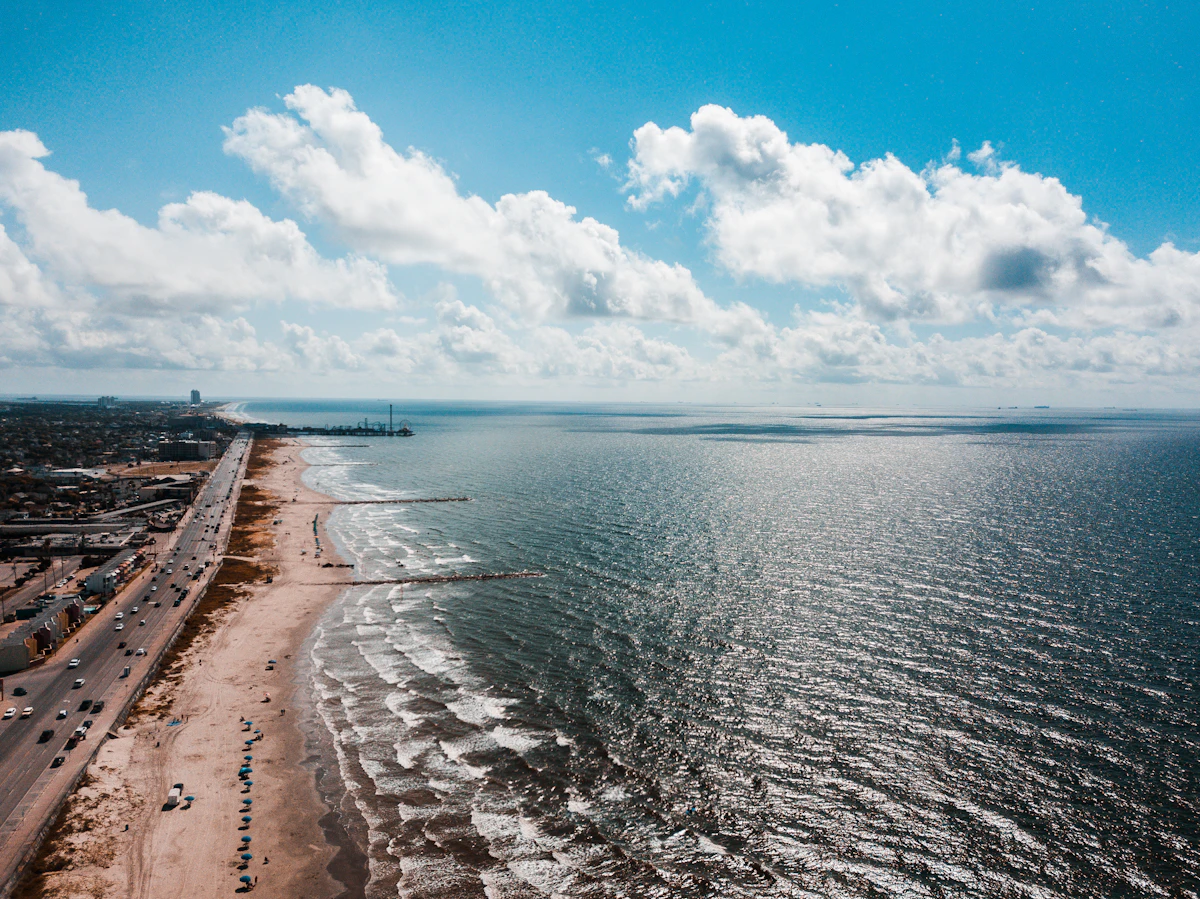
Photo by Chris Ainsworth / Unsplash
Galveston approved a $68M stormwater pump station — its first ever — with a sole bidder, while the $57 billion Ike Dike sits at 0.01% funded and luxury condos rise at the island's highest-erosion point.
The routine is the same every morning on 59th Street. Dario Romero, sixty-nine, semiretired longshoreman, opens his front door and looks down. Not out — down. At the street. At the water line that may or may not have crossed the curb overnight. If the street is dry, he puts on his boots and walks to his truck. If it isn't, he waits. There is no alarm for this. No city notification. Just a man standing at his threshold, reading the ground beneath his feet the way a farmer reads sky.
The 59th Street neighborhood sits in the belly of Galveston Island, in a section that was never raised during the great grade-raising project after the 1900 hurricane. The rest of the city went up. This part stayed where it was. A century later, the bay is coming back for it. Water pushes up through the storm drains — not during hurricanes, not during heavy rain, but on ordinary high tides. The drains were designed to let water flow downhill to Galveston Bay by gravity. When the bay is higher than the drain outlets, the system reverses. The sea enters the neighborhood through its own infrastructure.
Romero has lived here long enough to stop being angry about it. "It's something we deal with every day," he says. "People can't leave their house for work. People can't leave their house for anything." He doesn't say it with drama. He says it the way you'd describe traffic on a bridge — a fact of geography that has become a fact of life. Neighbors park on higher ground when the tide charts look bad. Children walk to school through standing water. The smell of brine sits in the walls.
Three blocks away, a construction crew is pouring foundation for something new. The island keeps building. The water keeps arriving.
In December 2024, Galveston City Council did something the island had never done in its 187-year history as an incorporated city: it approved construction of a stormwater pump station. The South Shore drainage project, designed by global engineering firm Stantec over a two-year period, will forcibly push stormwater out of the conveyance system near the 59th Street neighborhood — the same system that currently allows seawater to flow backward into people's homes roughly fifty times per year. Mayor Craig Brown called it the city's "salvation for drainage," explaining: "We'll have flooding, but the water will drain off in a reasonable period of time, much, much quicker than it does now."[1]
The contract went to MC2 Civil, LLC. They were the only company that bid. A $68 million public infrastructure project on a barrier island in the Gulf of Mexico — and one firm showed up. The majority of funding comes not from the city's own coffers but from congressional appropriations allocated after Hurricane Harvey in 2017, distributed through the Texas General Land Office. Federal disaster money, recycled seven years later, to fix a problem that predates the disaster by decades.
Galveston's entire drainage system was designed around gravity — water flows downhill to the bay. As sea levels rise, the elevation differential disappears. The bay-side drain outlets now sit at or below mean high tide, converting the drainage network from an exit route into an entry point. The pump station is the first mechanical intervention in a system that assumed static ocean levels. It is not an upgrade. It is the admission that the old physics no longer apply.
But the pump station is a neighborhood-scale fix. The island-scale protection project — the one designed to shield the entire upper Texas coast from hurricane storm surge — exists mostly on paper. The Coastal Texas Protection and Restoration Project, known colloquially as the "Ike Dike," was authorized by Congress in 2022 as the largest project in U.S. Army Corps of Engineers history. Its original estimate of $34.4 billion has swollen to $57 billion with inflation. The federal government is responsible for 65% of the cost — approximately $37 billion. As of March 2026, the federal contribution stands at $5.5 million: $500,000 allocated in May 2024 for pre-construction design, and $5 million added in January 2026.[2] The Gulf Coast Protection District hailed the January allocation as "a significant federal commitment."[3] Translation: $5 million toward a $37 billion obligation is now what counts as significant.
Texas, meanwhile, has put up $950 million across three legislative sessions. Governor Abbott signed HB 1089 in May 2025, creating the Gulf Coast Protection Account administered by the Texas General Land Office.[4] Design contracts have been awarded — Jacobs for the Bolivar Roads Gate System, HDR for the beach and dune components. Senator John Cornyn has declared that "the only remaining hurdle before construction begins is funding."[5] Cool. Now explain who pays.
The state-to-federal funding ratio for the Ike Dike is approximately 170:1 ($950M state vs. $5.5M federal). The project requires a 65/35 federal/state cost share. At the current rate of federal appropriation, full funding would take over six thousand years. This is not a pipeline problem — it is a commitment vacuum disguised as incremental progress. Design contracts can proceed indefinitely without construction dollars following.
While the protection project stalls in Washington, the development market at the island's most vulnerable point remains active. Tiara on the Beach — a ten-story, sixty-three-unit luxury condominium starting at $1.2 million per unit — was approved in 2021 at the western terminus of the Galveston Seawall, the exact point where engineered protection ends and raw erosion begins. The project's permit deadline was extended in 2024. A second proposal, Solarus, was rejected by the Planning Commission in March 2024 but the developer has scaled back and may resubmit.[6] Three existing condo buildings at this same stretch — Riviera I, Riviera II, and West Beach Grand — already have exposed foundations. In July 2022, engineer Luke Pronker assessed Riviera II and concluded the building was "at significant risk of collapse during a design storm event" due to beach erosion.[7] City chief building official Todd Sukup ordered occupants to be notified of immediate flood danger, writing: "We at the city are not unsympathetic to the fact that you and your owners have been confronted with a serious situation that we expect will require considerable money and effort to remedy, if it can be remedied at all."[8]
The beach at this point erodes approximately seven feet per year. The Pier 21 tide gauge shows 8.4 inches of sea level rise since 2010 — an acceleration from 0.25 inches per year over the previous century to 0.60 inches per year in the last thirteen years.[9] The seawall protects roughly ten of the island's thirty miles. The rest is open shoreline, subsiding land, and whatever the dunes can hold.
Galveston is not an outlier. It is a template. The United States has developed a reliable three-step pattern for coastal infrastructure: authorize a massive protection project, starve it of funding for decades, and permit private development in the unprotected zone while the protection remains theoretical. The Ike Dike follows the same arc as the South Florida Ecosystem Restoration Project (authorized 2000, less than 25% complete by 2025) and the Louisiana Coastal Master Plan (authorized 2007, perpetually re-scoped). Congress authorizes. Appropriations committees decide. And the ocean does not wait for either.
The 2024 Texas State Climatologist report projects that storm surge risk for low-lying coastal areas like Galveston will double by 2050, driven by compound effects of sea level rise, land subsidence, and intensifying hurricane wind speeds.[10] NASA's Sea Level Center and the University of Hawaii project 250 or more minor flooding days per year at Galveston by the 2050s — effectively converting tidal flooding from an event into a permanent condition.[11] The current fifty-times-per-year flooding on 59th Street is not the end state. It is the early phase.
Randall Parkinson, a coastal geologist at Florida International University who has studied barrier island dynamics for decades, put it plainly in his assessment of Galveston's trajectory: "I don't think people really understand what's coming. It's nothing anybody has ever experienced. It's taken a long time to get to where things are now, but now it is coming fast."[12]
The deeper pattern here is temporal mismatch at institutional scale. The Ike Dike's construction timeline, once funded, is estimated at twenty-plus years. The sea level rise rate used in the project's feasibility study is already being exceeded by observed data at the Pier 21 gauge. The pump station on 59th Street — funded by disaster money from a hurricane that hit in 2017 — addresses conditions that existed before that hurricane and have worsened since. Every infrastructure response on the island is calibrated to a climate that has already moved past the design parameters. Former Galveston Planning Commissioner Jeffrey Hill saw the disconnect clearly: "Somebody has to sound the alarm. And it is a very unpopular stance to take, but somebody has to do it."[13]
The signal is not that Galveston is sinking. The signal is that American coastal infrastructure policy has decoupled authorization from execution — and that the gap between what is promised and what is built is now being filled by private capital building luxury assets in the exact locations where public protection has failed to arrive.
Federal infrastructure projects of this scale routinely take decades from authorization to construction. The four years between authorization (2022) and the current funding level ($5.5M) may simply reflect the standard pace of pre-construction engineering and design, not a failure of political will. Design contracts have been awarded, state funding is committed, and the institutional framework (Gulf Coast Protection Account, GCPD governance structure) is in place. This view holds that comparing the $5.5M to the $37B obligation is misleading because the project is still in its design phase, not its construction phase. This is a plausible reading — mega-projects do move slowly. However, the rate of sea level rise acceleration (0.60 in/yr vs. the feasibility study's assumptions) is compressing the available timeline in a way that normal project pacing does not account for. The project may be "on track" by institutional standards while being decades behind the physical reality it is meant to address.
Luxury condo development at the western terminus of the seawall may reflect informed risk-taking rather than ignorance. Developers and buyers may be pricing in insurance availability, federal disaster relief expectations, and the eventual completion of the Ike Dike as a backstop. In this view, the market is not ignoring the risk — it is pricing it as acceptable given the expected return and the implicit government safety net. This argument has merit: coastal real estate markets have historically factored in disaster relief and subsidized flood insurance as part of the risk calculus. However, the engineer's assessment of "significant risk of collapse" at existing buildings, the exposed foundations at three condo structures, and the 2024 Planning Commission rejection of Solarus suggest that at least some institutional actors are no longer confident the risk is manageable. The market may be rational, but the ground beneath it is not cooperating.
The $68M pump station could be read as evidence that Galveston is actively adapting — investing in mechanical solutions as gravity drainage fails, rather than passively waiting for the Ike Dike. If pump stations can be deployed neighborhood by neighborhood, the island may not need the mega-project at all. This framing has some logic: localized, modular infrastructure can respond faster than centralized mega-projects. But the sole-bidder status of the contract signals limited market confidence in the viability of Galveston infrastructure work. And a pump station designed for current conditions will face the same obsolescence problem as the gravity drains it replaces — it is calibrated to today's sea levels, not the 2050s projections of 250+ flooding days per year.
What is not known: Galveston-specific homeowner insurance premium data is unavailable. Statewide Texas data shows 20%+ increases in 2023 (fastest in the nation), but the island-level cost burden on residents and condo owners remains undocumented in available sources. The actual balance of the Gulf Coast Protection Account created by HB 1089 is also unclear — the legislation creates the mechanism, but deposits may not yet match the $950M appropriation figure.
What monitoring would confirm or deny this signal: Tracking the federal appropriations cycle for FY2027 and FY2028 will reveal whether the Ike Dike receives construction-scale funding or remains in perpetual design phase. The Tiara on the Beach permit timeline — whether construction begins or the deadline lapses — is a direct indicator of developer confidence. NOAA's Pier 21 gauge data should be monitored quarterly to confirm whether the 0.60 in/yr acceleration is sustained or represents a multi-year anomaly. Finally, the pump station's contractor performance (MC2 Civil, sole bidder) and any cost overruns will signal market depth for island infrastructure work.
Key gap: Hurricane Beryl (July 2024, Category 1) demonstrated the island's vulnerability, but no Galveston-specific damage cost figure was located. Most Beryl damage reporting focuses on the broader Houston metropolitan area. Beryl-specific island data would sharpen the economic dimension of this signal considerably.
[1] "Galveston approves first-ever pump station in $68M drainage project," Houston Chronicle, Dec 13, 2024. Link
[2] Gulf Coast Protection District, "Congress sets new funding milestone for largest coastal protection effort in U.S. history," Jan 28, 2026. Link
[3] Coalter Baker, GCPD Executive Director, via Greater Houston Partnership, Jan 2026. Link
[4] HB 1089, Texas 89th Legislature, signed by Gov. Abbott, May 2025. Link; Houston Public Media, May 28, 2025. Link
[5] Sen. John Cornyn, via Galveston Daily News. Link
[6] "Where the Sea Wall Ends," Washington Post, Sept 23, 2024. Link
[7] Engineer Luke Pronker assessment, July 2022, via Washington Post, Sept 2024. Link
[8] Todd Sukup, City Chief Building Official, July 2022, via Washington Post, Sept 2024. Link
[9] NOAA Pier 21 tide gauge data, analysis via Washington Post, Sept 2024. Link
[10] Texas State Climatologist, 2024 Climate Report. Link
[11] NASA Sea Level Center / University of Hawaii sea level projections for Galveston.
[12] Randall Parkinson, Florida International University, via Washington Post, Sept 2024. Link
[13] Jeffrey Hill, former Galveston Planning Commission member, via Washington Post, Sept 2024. Link