The Signal
Stand at the corner of 185th Street and Hollis Avenue in southeast Queens and you are standing on a pond. Not metaphorically. The New York Botanical Garden's Freshkills Project has now catalogued more than 500 locations across New York City where buildings, roads, and subway lines sit directly on top of former water bodies — creeks, ponds, marshes, and tidal flats that were filled, paved, and erased from the city's memory between the 1800s and the mid-twentieth century. The interactive map, released at block-level resolution, does not show geology. It shows a decision architecture. Every filled pond was a choice to forget.
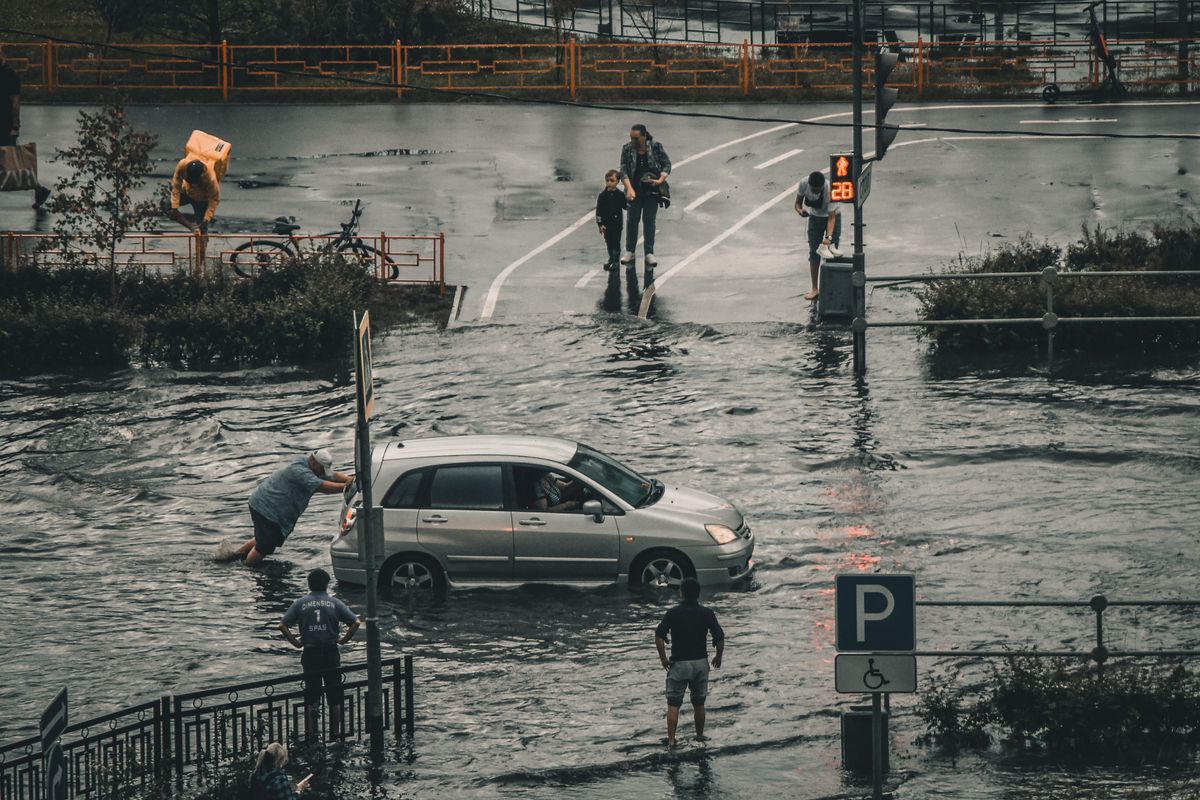
Hollis, Queens is one of the map's starkest lessons. When Hurricane Ida hit in September 2021, basements flooded so fast that eleven people drowned in the city, several of them in Queens apartments below grade. The Botanical Garden's overlay shows that Hollis sits on what was once a network of glacial ponds and streams — water bodies that the Army Corps of Engineers and successive city agencies filled, culverted, or simply declared nonexistent on planning maps. The water didn't leave. It waited.
Then there is "The Hole" — a sunken block straddling the Queens-Brooklyn border near the intersection of Ruby Street and Dumont Avenue, sitting several feet below sea level in a city that otherwise claims its lowest point at the waterfront. The Hole floods routinely. It has no sewer connection adequate to its actual elevation. On the Botanical Garden's map, it glows: a remnant depression where a creek once drained, now surrounded by fill that rises above it on every side. Twenty percent of New York City's land area, the study calculates, qualifies as a "blue zone" — terrain built over former water.
The Context
Why does a botanical garden produce the most consequential urban planning map in New York in a decade? Because no city agency did.
The Department of Environmental Protection manages combined sewer overflows. The Office of Emergency Management runs flood-zone evacuation plans. The Department of City Planning controls zoning. None of them had produced a comprehensive, block-level overlay of the city's buried hydrology against current population density. The Botanical Garden's researchers — working from historical survey maps, USGS topographic sheets, colonial-era drainage records, and LiDAR elevation data — assembled what amounts to a risk register the city never built for itself.
The Annals of the New York Academy of Sciences published findings that contextualize the scale: 1.2 million New Yorkers live in blue zones. That population includes the catchment areas of both LaGuardia and JFK airports, sections of the South Bronx, and a long corridor through central Brooklyn where Prospect Park's original watershed extended far beyond the park's current borders. The infrastructure beneath these neighborhoods — century-old combined sewers designed for a hydrology that no longer matches the surface — cannot handle the volume that comes when buried water reasserts itself during extreme precipitation events.
The Analysis
New York's blue zones are not an anomaly. They are the standard outcome of a particular mode of city-building: expand fast, fill what's wet, build on the fill, lose the records.
Shanghai confronts an amplified version. A 2024 study in Nature Sustainability found that 26% of Shanghai's urbanized area was constructed on reclaimed wetland and tidal flats, with subsidence rates of up to 30 millimeters per year in the Pudong district alone. During the July 2023 Typhoon Doksuri rainfall bands, Shanghai's Jinshan district — built almost entirely on filled marshland — experienced flooding that displaced 14,000 residents in 72 hours. The city's sponge-city retrofit program, launched in 2015 with a target of absorbing 70% of rainfall on 20% of urban land by 2030, has covered less than 8% of its target area.
Lagos reveals a more severe version of the same erasure. The city's Third Mainland Bridge corridor and much of Victoria Island rest on sand-filled lagoon. A 2025 report by the Heinrich Böll Foundation documented that over 300,000 residents of Makoko and surrounding settlements live on or immediately adjacent to filled tidal zones with no formal drainage infrastructure. When the rains come — and in Lagos, "when" means June through September, every year — the water reclaims its original footprint.
Buenos Aires carries the pattern into the Southern Hemisphere. The Riachuelo basin, one of the most polluted waterways in Latin America, was narrowed, channelized, and built over across its 64-kilometer length. The city's Arroyo Maldonado, once a visible creek running through what is now Avenida Juan B. Justo, was culverted in the 1930s. During the catastrophic April 2013 flooding, the arroyo's buried path became a damage corridor — the worst-hit areas traced the creek's original route almost exactly. Buenos Aires lost 89 lives. The Maldonado carries more water than its pipe can hold, every time it rains hard enough.
Houston's experience post-Hurricane Harvey in 2017 added the economic data: FEMA estimated $125 billion in total damage, and a Rice University study showed that 75% of flooded structures were outside the official 100-year floodplain — because the floodplain maps didn't account for the bayous and prairie potholes that had been filled and paved since the maps were drawn.
The Anticipation
The direction is forced transparency. Block-level hydrology maps like the Botanical Garden's will become mandatory disclosure tools — first for insurance pricing, then for real estate transactions, then for zoning decisions. The cities that build these maps proactively will manage the transition. The cities that wait will have the maps built for them by insurers, and those maps will not be generous.
Watch for the equity dimension. In New York, blue zones correlate with lower-income neighborhoods and communities of color — the communities that were historically pushed toward the least desirable land, which turns out to have been the wettest land. Climate adaptation funding that ignores buried hydrology will repeat the original injustice: investing in infrastructure that protects dry-ground neighborhoods while treating blue-zone flooding as an unforeseeable act of nature.
CORE Connection
This is a signal about the cost of institutional amnesia. Cities that erased their water did not eliminate risk — they relocated it from the map to the basement. The reader who lives in any city built near water, which is most of them, is not reading about New York's problem. She is reading about the map her own city hasn't drawn yet.
Verified Sources
- The City NYC — https://www.thecity.nyc — Coverage of NYC blue zones map and flood vulnerability in Queens
- Planetizen — https://www.planetizen.com — Analysis of NY Botanical Garden hydrological mapping project
- Annals of the New York Academy of Sciences — https://nyaspubs.onlinelibrary.wiley.com — Population risk data, 1.2M residents in buried-water zones
- Fast Company — https://www.fastcompany.com — Interactive map coverage and LaGuardia/JFK risk analysis
- Nature Sustainability — https://www.nature.com/natsustain/ — Shanghai subsidence and reclaimed-wetland urbanization data
- Heinrich Böll Foundation — https://www.boell.de — Lagos informal settlement and tidal-zone drainage report