
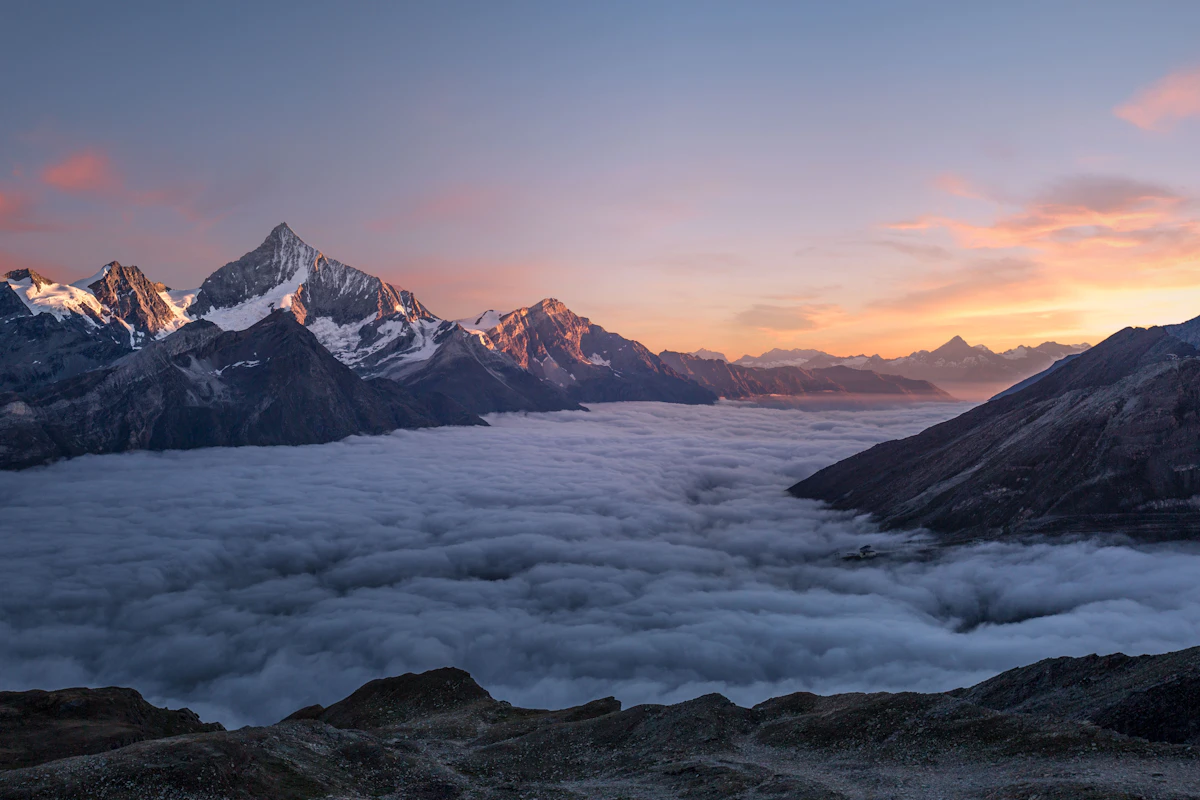
Photo by Samuel Ferrara / Unsplash
Missoula's tourism infrastructure has produced an exported identity so different from the city locals actually inhabit that the tourism bureau's own research now documents the fracture — and then proposes ten more years of the same.
The girl behind the counter at a coffee shop on Higgins Avenue knows her city better than the people photographing it. She is a University of Montana junior, double-majoring in environmental studies and music. She has a band. She goes to Griz games. On weekends she volunteers at a Native American cultural center two miles from the Clark Fork River. She knows which bars have good sound systems and which ones don't card anyone. She knows the local politicians by name and by reputation. She has opinions about the city council and about which breweries are actually good and which ones just photograph well for Instagram.
She also knows — in the specific, exhausting way that only people who live somewhere understand — that the Missoula she inhabits is not the Missoula being sold to the people in the REI fleeces waiting for their cortados. They flew into Missoula International. They are on their way to Glacier. They think of her city as a basecamp. A staging area. A charming pitstop on the way to something bigger and wilder. They will photograph the river. They will buy a "Montana" hat. They will tell people back home they visited a really cool college town.
She told a reporter from CNN — anonymously — that people often don't realize how much is going on here until they actually show up and look around. The anonymity is telling. She is not wrong to be careful. When you live in a city whose economy increasingly depends on an image you don't recognize yourself in, you learn to say the polite version of things.
Missoula is hip, musical, politically engaged, and complicated. It is also ranked #2 on CNN's America's Best Towns to Visit 2025. Those two facts are not in conflict. But they are not the same story either. And for the people who actually live there, the distance between those two stories is not an abstraction — it is the texture of daily life in a city that has become, quietly and incrementally, a set for someone else's vacation.
Missoula did not choose its tourism identity. It inherited it from an economic collapse and a Brad Pitt movie. The mechanism runs in seven steps, and by the time the city's own tourism bureau wrote it down in December 2024, the mechanism was already self-reinforcing at institutional scale.
The origin point is industrial. Missoula was a timber and sawmill economy through the 1980s. Environmental regulations and mill closures gutted the industrial base, leaving downtown underdeveloped and the economy in search of a replacement engine. The replacement arrived in 1992 in the form of A River Runs Through It, the Robert Redford film starring Brad Pitt, shot on Montana's rivers. Todd Frank, owner of The Trail Head outdoor gear shop in Missoula, describes the effect directly: "That movie shined a super bright spotlight on fishing in Montana. And it just blew up at that point, the number of people coming to recreate, we've been busy ever since then."[1] Tourism did not fill a vacuum — it created a new economic identity to replace the one the sawmills had provided. The problem is that economic identities, once institutionalized, tend to become permanent.
Destination Missoula/TBID, the city's official tourism bureau, has built a marketing infrastructure around rivers, wilderness access, and outdoor recreation — a narrative that is legible, photogenic, and scalable to national audiences. But the 2023 Missoula Visitor Profile Study (948 survey participants) found that out-of-state travelers do not perceive Missoula as "hip," musical, or culturally vibrant. Those attributes register only with Montana residents. The tourism product being exported is a different city from the one locals inhabit. The divergence is now officially documented.[2]
The financial architecture makes this divergence structural rather than incidental. KettleHouse Amphitheater — Missoula's premier music venue, operated by Nick Checota of Logjam Presents — now draws 67% of its summer ticket revenue from out-of-state zip codes.[1,2] When cultural institutions depend on tourist traffic at that level, their programming necessarily orients toward what tourists recognize and will purchase. The "hip, musical" Missoula that locals identify becomes a resource for the tourism economy, not an expression of resident culture. Cool. Now explain who pays.
Translation: the local arts and music scene is increasingly functioning as an amenity for the visitor economy, not as infrastructure for residents.
The representation failure has been documented publicly for at least eight years. In 2017, Missoula City Councilmember Ruth Ann Swaney — an enrolled member of the Three Affiliated Tribes — formally challenged Destination Missoula's tourism materials at a public budget hearing: "As a person of color – as a Native person – when looking at those materials, there aren't many people of color in any of the images."[3] Eight years later, the 2024 Destination Stewardship Plan describes Indigenous collaboration aspirationally — Goals 1.3 and 2.3 propose QR codes and wayfinding markers — without restructuring the financial relationships that determine whose stories get funded.
The 2024 Destination Stewardship Plan — a $390.4M economic impact document co-funded by the University of Montana, Missoula County, and the city airport — contains an explicit self-indictment in Key Finding #2: "Many locals do not feel that Missoula needs tourism promotion. For many, Missoula's tourism strategy is less about getting visitors to show up and more about managing what they do once they arrive." The plan does not propose reducing tourism marketing. It proposes a ten-year strategy to make tourism more palatable to residents while maintaining visitor-economy growth targets. The institution has documented its own legitimacy gap and decided to proceed.[2]
The University of Montana's involvement as a co-funder of the Stewardship Plan is the detail that closes the loop. UM enrolled 11,064 students in fall 2025 — the fifth consecutive year of growth after years of enrollment decline.[4] The university has institutional incentives to maintain and amplify the Missoula brand that attracts students and donors. This means that even the academic institution — the entity that most directly shapes how the city understands itself — has tied its recovery to the tourism-friendly image. Entry friction is structural: the residents who benefit least from the outdoor recreation narrative (Indigenous communities, students from outside the West, arts-scene workers) have the least institutional leverage over the story being told about their city.
Missoula is not an anomaly. It is a well-documented instance of a pattern that urban researchers have studied under various names — narrative capture, place branding displacement, tourism-led identity substitution — for the better part of three decades. What makes Missoula's case valuable as a signal is that the displacement mechanism is now formally self-documented by the institution that produced it.
The statewide context matters here. The University of Montana's Institute for Tourism & Recreation Research (ITRR) conducts annual surveys of Montana residents' attitudes toward tourism. In March 2022, UM researcher Jeremy Sage reported that 56% of Montana residents agreed the state is becoming overcrowded because of tourism — the highest level recorded in 30 years of annual surveys, representing a 75% increase since pre-pandemic 2019.[5] This is not a Missoula-specific grievance. It is a statewide pattern that Missoula's local mechanism makes visible at the city scale.
The social capital literature offers a useful frame. Robert Putnam's distinction between bonding and bridging social capital — and the more recent work on "narrative capital" in place-making research — helps locate what is actually at stake. When a city's exported story diverges from its internal story, the community loses not just representation but the institutional infrastructure through which residents negotiate shared meaning. The tourism bureau becomes the de facto author of local identity. The DMO's audience is not residents — it is visitors. The feedback loop between how a city sees itself and how it is seen is severed.
National media amplification accelerates the gap. CNN's #2 ranking of Missoula in July 2025 is not neutral coverage — it is a narrative event that reinforces the wilderness-basecamp identity at global distribution scale, regardless of what Missoula's residents actually think about their city.[1] The ranked-list industrial complex (SmartAsset, Livability, Condé Nast Traveler, CNN Travel) functions as a secondary DMO: it selects for attributes that are legible to external audiences and systematically underweights the interior complexity that makes places worth living in.
The financing structure compounds the problem in ways that are difficult to reverse. Destination Missoula receives only 11% of the total bed tax funds generated by Missoula lodging properties — the remaining 89% flows to the state.[2] This means the local DMO is chronically underfunded relative to the economic impact it is responsible for managing, creating pressure to continue growing tourism revenue simply to have more resources to manage the consequences of tourism growth. It is a structural trap, not a policy failure.
The broader implication of the Missoula signal is this: when economic necessity forces a city to outsource its identity to a tourism narrative, the eventual cost is paid in the currency of self-determination — and the invoice arrives, quietly, in the form of a planning document that documents the problem and then recommends ten more years of the same.
It is possible that the divergence between Missoula's internal and exported identities is not a problem to be solved but a functional equilibrium that residents accept. Many cities maintain tourist-facing personas that differ from daily resident experience without suffering significant cultural harm — Las Vegas, New Orleans, and Nashville all operate dual identities at scale. Under this reading, Missoula residents are not victims of narrative capture; they simply share their city with visitors who see it differently. The KettleHouse's out-of-state ticket revenue subsidizes a venue that locals also use. This alternative has real force. However, the evidence against it is specific: the formal, documented opposition of 953 surveyed residents, the eight-year record of public challenge to tourism branding starting with Councilmember Swaney's 2017 statement, and the explicit finding in the Stewardship Plan that resident opposition is not marginal but structural. The divergence in Missoula is not two parallel stories coexisting — it is a hierarchy in which one story controls the institutional resources.
One could argue that Missoula's tourism identity is simply what the market selected: visitors want wilderness access and fly fishing, so that is what Destination Missoula markets. The "hip, musical college town" identity is not being suppressed — it is simply not what out-of-state visitors are buying. The DMO is responding rationally to demand, not imposing a narrative. This framing is coherent but incomplete. It mistakes revealed preferences (what tourists purchase) for the full range of possible demand, and it ignores the role of the DMO in creating the demand it responds to. The wilderness narrative was not discovered — it was built, funded, and amplified over thirty years starting with a film. The market is producing an outcome that was institutionally constructed. More critically, this alternative cannot account for the representation problem: Indigenous and POC communities are not absent from Missoula's tourism materials because visitors don't want to see them. They are absent because the narrative infrastructure was never designed to include them, and the financial incentives have not changed in eight years of documented advocacy.
What is not known: There is no current first-person documentation from Missoula arts workers, music venue operators, or UM students about specific instances in which the tourism narrative has displaced or defunded local cultural programming. The signal's weakest link — the step connecting the tourist narrative to suppressed local storytelling — lacks a concrete case study: no art project killed, no venue closed, no program cut because of tourism capture.
Representation gap: The Missoula Current reporting on tourism material erasure of Indigenous and POC communities dates to 2017. Whether current Destination Missoula materials have changed — in response to eight years of advocacy — is not confirmed. Checking the 2024 travel guide and current website imagery against Councilmember Swaney's 2017 critique would either strengthen or partially undermine the signal.
Monitoring: The SCI score would increase if a reported conversation with a Missoula arts worker, venue operator, or UM student activist documented a specific funding decision, programming choice, or institutional constraint produced by the tourism narrative. It would decrease if the 2024 Destination Missoula materials show meaningful inclusion of Indigenous and POC representation, or if community arts funding has increased alongside tourism revenue growth.
[1] Frank, T. & Checota, N. Quoted in: Missoula, Montana Named #2 Best Town in America. CNN Travel, July 3, 2025. cnn.com/travel/missoula-montana-best-towns-america-2025
[2] Destination Missoula / TBID. Missoula Destination Stewardship Plan, December 18, 2024. Includes 2023 Visitor Profile Study (SMARInsights, 948 participants) and 2023 Resident Survey (953 respondents). destinationmissoula.org — Stewardship Plan PDF
[3] Swaney, R.A. Quoted in: Missoula Tourism, Diversity and Whose Story Gets Told. Missoula Current, c. 2017. missoulacurrent.com/missoula-tourism-diversity/
[4] University of Montana. UM Enrollment Grows for Fifth Consecutive Year. UM News, September 2025. (See also: UM co-funding cited in Stewardship Plan, p.3.)
[5] Sage, J. Survey: 56% of Montanans Say State Overcrowded Due to Tourism. University of Montana Institute for Tourism & Recreation Research, March 8, 2022. umt.edu/news/2022/03/030822itrr.php