
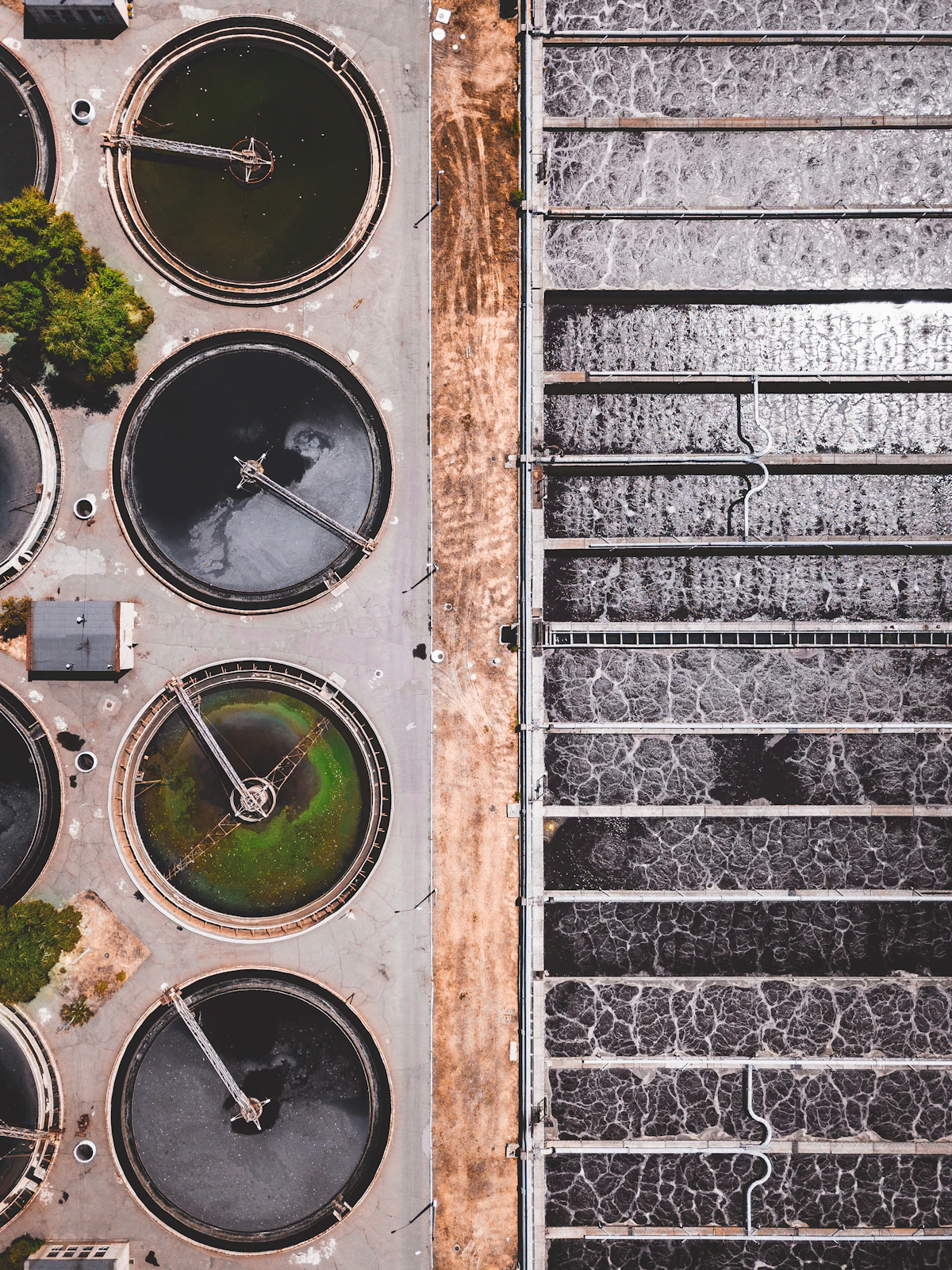
Photo by Ivan Bandura / Unsplash
A combined sewer system built in 1909 is still dumping into the Flint River. The federal government says fix it. The city says it can't afford to. The residents say their utility bills already cost as much as rent.
Charenthia Blocker opens the envelope the way you open something you already know is wrong. Her utility bill has changed again — not by a few dollars, but by the kind of swing that rewrites a week. Last month it was manageable. This month it's a wall. She has lived in the same house in Albany, Georgia, for years. She has not added appliances, not changed her habits, not suddenly started watering a second lawn. The number on the bill simply moved.
The city sent a man. He walked through her home slowly, noting windows and seals. "Oh, it might need some caulking here," he told her. "That could be a problem." Blocker stood in her own kitchen and listened to a stranger suggest that a bead of caulk explains why her bill doubled. She calls it what it is: "a cover-up." Because the bill was three hundred dollars last month too, and there was no caulking then either, and no one came then.
On a Thursday afternoon in February 2025, a bus from Albany pulled into the parking lot near the Georgia Capitol in Atlanta. Inside were residents who had taken a day off work — if they had work — to stand in the hallways of a statehouse and ask legislators to reinstate a Consumer Utility Council. Miranda Mathis, the organizer who chartered the trip, put it simply: "Your light bill being the same rate as your rent is not normal. It's not something that happens in other cities and other areas." The people on that bus knew this already. They knew it in the way you know something that costs you money every single month.
Back in Albany, the storefronts on Broad Avenue hold their breath. A few are occupied. Most are not. Community advocate Blythe Henderson drives through downtown and offers two words for it: "Pretty empty." She pauses. Then she says them again. "Pretty empty, pretty empty."
Albany's combined sewer system was built in 1909. Combined means exactly what it sounds like: sewage and stormwater share the same pipe. When it rains, the system overflows, and untreated human waste and runoff flush directly into the Flint River. This was standard engineering a century ago. It is a federal violation now. The Clean Water Act of 1972 and subsequent Georgia Environmental Protection Division mandates require the city to separate its sewer lines — to build, essentially, a parallel underground system beneath a city that cannot maintain the one it has.
The city's own documentation, published in an official ArcGIS StoryMap updated in January 2026, puts the price tag for the current phase at $105 million. The U.S. Army Corps of Engineers issued a Final Environmental Assessment in November 2024 authorizing $109 million in combined sewer overflow repair.[1][2] But these figures describe only the separation work currently funded and underway. A community analysis — citing interim plan costs of $33 million and a full combined sewer control plan — places the long-term liability closer to $850 million.[3]
Albany operates 85 lift stations, 32 water wells, and a wastewater treatment plant on Joshua Street whose last major bond-funded upgrade was in 1991 — a $38 million project. The dewatering facility rehabilitation alone is now estimated at $14.5 million. The city's entire FY2025 adopted operating budget is $318.8 million. The infrastructure mandate is not a line item; it is a second budget.
The mechanism that traps Albany is circular and self-reinforcing. To fund mandated infrastructure, the city must raise utility rates. But Albany's population is 76.3% Black with a 27.5% poverty rate and a median household income of $47,240.[4] Homeownership stands at 37.7% — compared to a national average of 65.2%. Median property value is $124,300 against a national figure of $332,700. The tax base cannot absorb the cost. So the cost lands on utility bills.
When bills spike, residents protest — or leave. Commissioner Chad Warbington acknowledged in February 2026 that "for the last decade or two, Albany has not built the number of new homes that we should have been building. I mean, there are some years that we had single-digit homes being built."[5] The population has fallen from approximately 78,000 in 2000 to 67,224 in 2024, with an estimated 65,506 by 2026.[6] Employment is declining 1.04% year over year. Each person who leaves narrows the base that must fund the same pipe.
The city's new meter installation — 87% complete as of April 2025, covering 78,275 of 89,931 meters — was intended to improve billing accuracy. Instead, it introduced a new layer of billing chaos. The city admits the system "may contribute" to high bills. Residents living in aging, poorly insulated housing see consumption-driven charges they cannot reduce because the housing itself is the problem. The infrastructure failure is not only underground; it is inside the walls.
Downtown revitalization, meanwhile, has become its own form of institutional theater. WALB's investigative "State of Downtown Albany" series documented that 17 downtown plans have been commissioned over the last 30 years.[7] The city now claims a $200 million project pipeline. City Manager Terrell Jacobs describes $13 million in low-interest municipal trust fund loans available for downtown development. But when WALB compared Albany's trajectory to Macon — which attracted roughly $1 billion in public-private investment over three decades through NewTown Macon — Albany's Downtown Manager LeQurica Gaskins could only respond: "What we do have are tax allocation districts. We got that… that is one of the tools in our toolbox."[8]
The most revealing recent episode: on March 11, 2026, the Albany City Commission voted 5-2 to approve a $2 million loan from public funds to Look Again LLC, a developer whose property at 106-114 North Washington Street had gone into default in December 2025. City Attorney Jamie Garner warned the commission directly: "I am advising you there are concerns this could violate the Georgia Constitution" — specifically the gratuities clause prohibiting public funds from benefiting private enterprises. Commissioner Diana Brown dissented: "If it ain't in writing, I don't believe it. We've got to be more strategic about what we're doing moving forward."[9] The loan passed anyway.
Albany is not an anomaly. It is a specimen. The pattern — legacy infrastructure mandates imposed on shrinking, majority-minority cities with eroding tax bases — repeats across the American South and Midwest with structural precision. The Urban Institute's federal infrastructure spending tracker for the Albany metro area reveals negative equity scores for poverty rate (-0.13) and population share of people of color (-0.12), meaning federal investment flows are not calibrated to the city's actual need.[10]
Jay Matthews of the Georgia Rural Water Association described the regional context in September 2025: "We're talking 50-, 60-, 70-year-old infrastructure in place that's well beyond its useful life, and it's past time to do major repairs or replacements. Small towns get the brunt of it because of a lack of resources, a lack of funding."[11] The Albany Herald's investigation confirmed that the crisis is not confined to Albany — it spans southwest Georgia, where municipal water systems built in the mid-twentieth century are simultaneously failing. Thomasville, just ninety miles south, lost approximately $20 million in EPA environmental justice grant funding when the Trump administration terminated roughly 800 such grants in May 2025.[11]
The academic literature on infrastructure burden in communities of color — from Dorceta Taylor's work on environmental justice to the American Society of Civil Engineers' Infrastructure Report Card series — consistently identifies the same mechanism: cities that were built for one population scale and economic era find themselves locked into maintenance obligations that outpace their fiscal capacity. When those cities are also majority-Black, majority-poor, and located in states with limited municipal aid frameworks, the gap widens into what some researchers call "infrastructure debt" — a liability that compounds annually and is never restructured, only deferred. Albany's 1909 sewer line is not a metaphor. It is the debt itself, running beneath every street.
Mayor Bo Dorough's own framing, offered in a Georgia Trend profile in July 2025, concedes the baseline: "There have been decades of disinvestment in city properties. We are doing what we can to improve the quality of life for our citizens and to make Albany a place people want to move to instead of away from."[12] There are signs of recent effort — $38 million in new capital investment and 189 new jobs over 18 months, the reopening of Driskell Park, the planned Davis Exchange apartments — but these are project-scale interventions against a system-scale problem. James Fritz, CEO of NewTown Macon, offered the comparative lesson plainly: "One of the things they realized was you couldn't really rely on county governments to do the revitalization. Administrations changed, budgets changed, priorities changed within local governments."[8]
Albany has produced 17 plans and is still looking for its first transformation. The signal is not that the city is failing to try. It is that the structural conditions — mandate cost, population loss, tax base erosion, federal funding instability, and the absence of sustained private capital — have produced a feedback loop that no plan, however well-intended, can interrupt alone.
It is plausible that Albany's crisis is primarily a governance failure rather than a structural trap — that better leadership, more transparent utility billing, and more disciplined capital allocation would produce different outcomes even within the same fiscal constraints. The $2 million loan to a defaulted developer over constitutional warnings, the 17 unrealized downtown plans, and the billing chaos surrounding the new meter rollout all point to execution problems that compound the structural burden. This explanation has merit: governance quality matters, and Albany's recent record invites scrutiny. However, the demographic and fiscal fundamentals — a 27.5% poverty rate, declining population, and a $105–850M infrastructure mandate — are not governance failures. They are pre-existing conditions that would stress even an exceptionally managed city. The governance issues make the structural trap worse, but they did not create it.
The Army Corps EA authorization, the ARPA allocations, the GEFA loans, the SPLOST revenues, and the CDBG-MIT and WRDA streams suggest that Albany is, in fact, receiving substantial federal and state support. Perhaps the infrastructure crisis is already being resolved — slowly — and the signal overstates the urgency. This counterargument is partially valid: the sewer separation project is underway, and the Army Corps involvement represents a significant federal commitment. But the current $105M phase addresses only a fraction of the estimated long-term liability. Federal funding under the current administration is demonstrably unstable — the $20M EPA grant loss in neighboring Thomasville is not a theoretical risk but a documented one. And the patchwork of funding sources (each with different timelines, match requirements, and political vulnerabilities) creates a fragility that any single disruption can cascade through.
The $850M total liability figure is unverified at Tier A level. It originates from a community-sourced analysis (Tier C) and is consistent with the scope documented in official city records, but no official city or state document has published a confirmed total long-term cost. If the actual figure is significantly lower, the signal's severity diminishes.
Population projections beyond 2024 rely on trend extrapolation (World Population Review), not Census counts. If the 2030 Census shows stabilization or reversal, the feedback loop mechanism weakens.
The impact of the 2025 EPA environmental justice grant terminations on Albany specifically is not yet documented. The $20M loss hit Thomasville, not Albany directly. Whether Albany held or applied for similar grants, and whether those were affected, is unknown.
Monitoring that would confirm or deny this signal: (1) Official city or state publication of total combined sewer control plan cost estimate; (2) 2026–2028 utility rate changes and their effect on population retention; (3) Status of federal WRDA and ARPA funding continuity under current administration; (4) Private-sector investment totals in downtown Albany over the next 24 months.
[1] U.S. Army Corps of Engineers, "Final Environmental Assessment: Combined Sewer Overflow Repair, Albany, Georgia," November 2024. sam.usace.army.mil — Tier A
[2] City of Albany, "Combined Sewer Separation Project," ArcGIS StoryMap, updated January 22, 2026. storymaps.arcgis.com — Tier A
[3] Community analysis via Facebook post, citing interim plan ($33M) and final combined sewer control plan (~$850M). facebook.com — Tier C
[4] DataUSA / Census ACS, "Albany, GA Profile," 2024 data. datausa.io — Tier A
[5] WALB News 10, "Albany utility bill follow-up: City responds to residents' fluctuating costs," February 25, 2026. walb.com — Tier B
[6] World Population Review, "Albany, Georgia Population 2026." worldpopulationreview.com — Tier C
[7] WALB News 10, "Promises & Progress: State of Downtown Albany" series, February 26, 2026. walb.com — Tier B
[8] WALB News 10, "State of Downtown Albany: Challenges of Revitalization — Can Albany Do What Macon Did?" March 10, 2026. walb.com — Tier B
[9] Albany Herald, "Albany City Commission approves $2 million loan for downtown development project," March 11, 2026. albanyherald.com — Tier B
[10] Urban Institute, "Federal Infrastructure Spending: Albany GA Metro Area." apps.urban.org — Tier A
[11] Albany Herald, "Southwest Georgia faces looming infrastructure crisis as systems age out amid funding hurdles," September 18, 2025. albanyherald.com — Tier B
[12] Georgia Trend, "Albany-Dougherty County: Building Momentum," July 2025. georgiatrend.com — Tier B
[13] City of Albany, FY2026 Budget in Brief. albanyga.gov — Tier A
[14] WALB News 10, "Albany residents take concerns with high utility bills to Georgia Capitol," February 18, 2025. walb.com — Tier B