
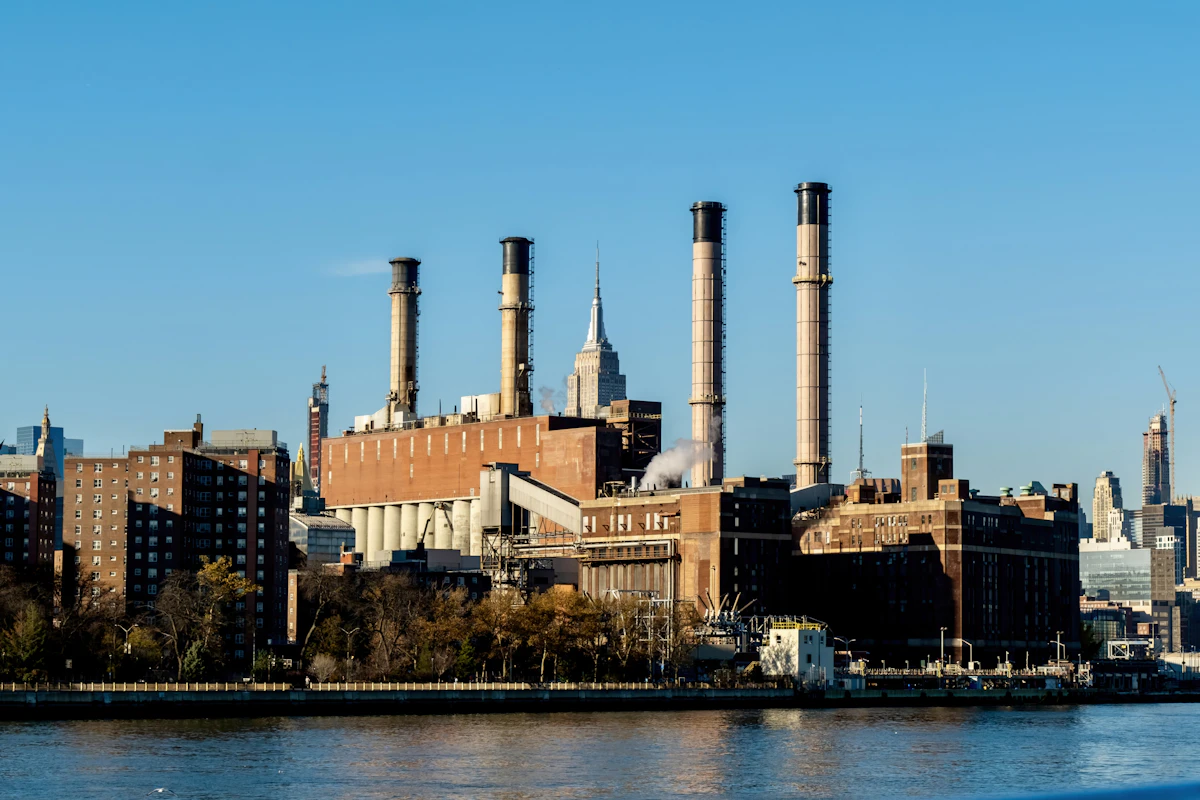
Photo by Adam Roye / Unsplash
When the pipes fail and the pensions run dry at the same time, the federal government shows up — not to help, but to document.
On the east side of the Mississippi, where Illinois meets Missouri without fanfare, there is a street off Bond Avenue where a woman named Denise has lived for thirty-one years. She knows when it rained hard the night before not by looking out the window but by the smell that rises through the drain in her basement utility room. It is a smell that doesn't belong indoors — wet earth mixed with something older, something the city was supposed to have moved underground decades ago.
She stopped letting her grandchildren play in the backyard after heavy rains. Not because of puddles. Because of what the puddles contain.
Three blocks east, the American Bottoms Treatment Plant sits off Falling Springs Road. The plant was built to receive the city's sewage and process it before releasing treated water into the Mississippi. The pipes that carry waste toward the plant are old — the kind of old that means combined: stormwater and sewage in the same channel, routed through the same aging infrastructure. When rain comes in volume, the pipes cannot hold both. The overflow goes somewhere. The EPA has documented where.
East St. Louis has about 18,000 people left. That figure matters less than what it used to be: 82,000 in 1960, the year the city was named an All-America City. There is a particular quality to streets in a city that lost sixty-four thousand people over sixty years. The lots between occupied houses aren't just empty — they carry the silence of things that were there and aren't anymore. Churches that held congregations of five hundred. Factories that employed thousands. Streets that were repaved on schedule because there was money to repave them.
Denise's neighbor, a retired school aide in her late sixties, still waters the plants on her porch every morning. She watches the cars on the road. She notes which houses are occupied and which ones aren't. She has watched the ratio shift slowly, year by year, toward the vacant. She is not leaving. She does not say this as defiance. She says it the way people say things that are simply true about themselves.
The city is still here. It is just running out of infrastructure to hold it together.
What is happening in East St. Louis is not a story about municipal incompetence. It is a story about what happens when the economic base of a city is destroyed and the political structure built around that base is left standing — still obligated, still legally responsible, still required to deliver water and sewage and police and fire, but without the revenue to do any of it. The fiscal collapse came first. The infrastructure collapse is what you get after sixty years of that.
The causal chain is documented in sequence. Between 1960 and 1970, nearly seventy percent of East St. Louis businesses left the city.[1] The Alcoa aluminum refinery — a 400-acre operation — closed. The meatpacking plants left. The zinc smelters wound down. What followed was not gradual decline. It was structural amputation: the tax base disappeared, and what remained was a population with nowhere else to go and a government with obligations it could no longer fund.
East St. Louis is the only city in Illinois to ever invoke the Financially Distressed City Law (1990). The city spent twenty-three years under state Financial Advisory Authority oversight — from 1990 to 2013. It emerged from receivership still carrying pension shortfalls that would compound into the 2024 crisis. The law was designed as a rescue mechanism. It functioned, at best, as a holding pattern.[3]
By 2024, the pension system had fully unraveled. The city's fire pension fund held thirteen cents for every dollar owed. The police pension fund was at thirty-eight percent funded. The city stopped making monthly pension contributions after September 2023. Pension boards — legally empowered under Illinois law (40 ILCS 5/3-125(c)) — did what the statute requires: they petitioned the state comptroller to intercept funds directly. On June 11, 2024, the Police Pension Board voted to request $3.5 million from Comptroller Susana A. Mendoza, targeting shortfalls from fiscal years 2016, 2019, and 2021. Nine days later, on June 20, the city filed suit in St. Clair County Circuit Court, arguing the intercept was "unconstitutional and contrary to public policy" and would "reduce the City's ability to provide essential services."
City Manager Robert Betts offered a summary of the situation that carries the weight of a man trying to negotiate between two fiscal walls: "Nobody wins when you do that. Everybody loses."[2] He is correct. The intercept mechanism doesn't create money. It redirects money that would otherwise fund police and fire operations into pension accounts — which means the city loses operational capacity in order to service a debt it created by not funding those same pensions years earlier. The fire pension board negotiated a $4.5 million deal with the city in March 2024, avoiding the intercept. The police board did not.
The pension intercept and the federal infrastructure lawsuit are not parallel crises. They are the same crisis expressed in two legal arenas simultaneously. The city receives roughly $3.3 million per quarter from the state. Pension boards seek over $3.5 million in intercepts. Federal infrastructure compliance will require tens of millions more. The city's effective property tax rate already exceeds six percent in a jurisdiction where forty-five percent of residents live below the poverty line. There is no revenue scenario that resolves this without external structural intervention.[3]
The sewage system operates on a combined sewer model — stormwater and sanitary waste share the same pipes. During significant rain events, the pipes overflow. This is not a design flaw unique to East St. Louis; combined sewer systems are common in older American cities. The difference is maintenance, monitoring, and investment. East St. Louis let its EPA discharge permit expire in August 2024 without filing for renewal. It failed to submit a required Preventative Maintenance Plan due December 24, 2023. It did not install required monitoring devices. EPA issued Administrative Orders on Consent in 2022 and 2023. The city failed to complete compliance work under both. On December 11, 2024, the U.S. Department of Justice filed a 51-page federal complaint — Case 3:24-cv-02592 — on behalf of the EPA and in coordination with Illinois Attorney General Kwame Raoul. The complaint documents 140 or more days of untreated sewage discharge into the Mississippi River since 2020. The American Bottoms Treatment Plant recorded at least 246 sewage overflows, including nineteen during zero-precipitation events — meaning the system was releasing raw waste even when there was no storm to blame.[4]
Courthouse News Service reported that EPA inspectors found toilet paper in the vegetation along the banks of Whispering Willow Lake at Frank Holten State Park — visible physical evidence of what the overflow data documents statistically.[5] The entry friction here is complete: residents of East St. Louis cannot opt out of proximity to this infrastructure. They cannot relocate to a neighboring development that chose a different sewer system. They are residents of a city whose collapse has become literal.
East St. Louis is not an anomaly. It is an extreme data point on a curve that has analogs across the post-industrial Midwest and Northeast. What makes it analytically useful is that every stage of its collapse is documented: the industrial exit, the population flight, the fiscal distress certification, the pension underfunding, the infrastructure deterioration, and now the federal enforcement action. No step was hidden. Each was recorded in court filings, actuarial reports, and regulatory orders.
The St. Louis Federal Reserve's community development publication documented the inflection clearly: between 1960 and 1970, the city lost nearly seventy percent of its businesses. Unemployment soared. The city could not pay its light bill or its garbage collection. Street lights were turned off. Abandoned lots became dumping grounds.[1] This is not a description of mismanagement. It is a description of what cities look like when the private-sector economic base that funds municipal government disappears faster than the obligations that government has accrued.
The pension dynamic follows a well-documented national pattern. According to the Illinois Policy Institute, up to two-thirds of East St. Louis's city revenues could be seized by the state comptroller to pay for police and fire pension obligations.[3] This is the end state of defined-benefit pension systems in jurisdictions that chronically underfund them: the legal obligation doesn't diminish because the tax base collapses. It accumulates. And when enforcement finally arrives — through the intercept statute, through the federal courts — the mechanism extracts from whatever is left, which in East St. Louis's case is very little.
The neighboring city of Cahokia Heights provides a direct comparison. On December 10, 2024 — one day before the East St. Louis federal filing — the DOJ announced a $30 million settlement with Cahokia Heights for similar Clean Water Act violations. Cahokia Heights has a smaller sewer system and a smaller population than East St. Louis. The $30 million settlement is understood to be a template for what East St. Louis's consent decree will require. The city's infrastructure needs have been estimated by community sources and regional observers at upward of $1 billion in total capital repair. The EPA's own transition briefing paper from 2024 documented over 150 infrastructure projects in development across the Metro-East area, with $62 million committed — a figure that provides context for the scale of the gap, not resolution of it.[4]
What East St. Louis confirms, at maximum documentary clarity, is this: when a city's economic base collapses and is never replaced, the infrastructure that served that base does not simply age — it becomes a legal liability that will eventually be enforced regardless of the municipality's capacity to comply. Federal environmental law does not negotiate with fiscal insolvency.
The most common counterargument is that East St. Louis's collapse reflects sustained mismanagement: missed deadlines, failed negotiations, a permit allowed to expire, maintenance plans never submitted. This reading has legitimate evidentiary basis. The city failed to file for permit renewal, failed to submit its Preventative Maintenance Plan, and failed to comply with two successive EPA Administrative Orders on Consent. These are not passive failures — they required active inaction over years. The governance failure reading acknowledges real dysfunction. However, it does not explain the primary mechanism: a city with a forty-five percent poverty rate, an $18 million annual operating budget, and no viable private investment pipeline cannot fund a combined sewer overhaul that would cost hundreds of millions of dollars, regardless of how competently it is managed. Governance failure is a multiplier on an already-irreversible fiscal collapse, not the root cause.
A second reading positions Illinois state government as the proximate cause: the state's pension intercept statute effectively weaponizes fiscal obligation against operational capacity, and the state's twenty-three years of receivership oversight (1990–2013) produced no structural economic transformation. This alternative is also valid. The Financially Distressed City Law, as applied to East St. Louis, did not resolve the underlying tax base collapse — it managed fiscal symptoms without addressing the economic cause. The intercept mechanism, designed as accountability enforcement, functions in practice as a transfer of operational capacity from a fiscally dead city to its pension creditors, leaving the remaining residents with diminished services. This is a real policy design problem. However, framing state policy as the primary driver understates the market-level disinvestment that preceded state intervention by decades. The state inherited a problem it did not create and chose instruments that managed obligations rather than rebuilt economies. Both readings are accurate. The weight of evidence places industrial abandonment as the originating force.
The consent decree outcome is not yet determined. The federal complaint was filed December 11, 2024; as of the research date, no settlement terms have been finalized. The Cahokia Heights settlement ($30M, December 10, 2024) is a comparable data point, but East St. Louis's infrastructure deficit is significantly larger. The actual capital cost to bring the combined sewer system into Clean Water Act compliance has not been formally established in public filings — the $1 billion figure circulating in regional commentary is unverified community estimation, not an engineering assessment.
The police pension intercept litigation (St. Clair County Circuit Court) is ongoing. Chief Circuit Judge Andrew Gleason issued a temporary restraining order; the ultimate disposition affects whether the city retains operating funds sufficient to maintain any service delivery. If the intercept is upheld and enforced at scale, the city's ability to participate in its own infrastructure consent decree becomes legally and financially incoherent. Monitoring this double-enforcement scenario — federal environmental compliance demanded simultaneously with state pension intercept — would significantly clarify whether East St. Louis faces a recoverable restructuring or a formal dissolution process. No research to date has modeled both obligations against available revenue simultaneously in a published framework. That analysis would sharpen the SCI toward its ceiling or reveal a trajectory the current signal does not fully capture.
[1] St. Louis Federal Reserve / Bridges — "East St. Louis: One City's Story." Federal Reserve Bank of St. Louis, Community Development. stlouisfed.org
[2] Belleville News-Democrat — "East St. Louis sues police pension board to block state fund seizure." July 5, 2024. bnd.com
[3] Illinois Policy Institute — "A Way Out: Bankruptcy Authorization Would Give Struggling Illinois Municipalities Options." February 10, 2025. illinoispolicy.org
[4] U.S. DOJ Press Release — "United States and State of Illinois File Complaint Against City of East St. Louis for Unlawful Discharges of Sewage." December 11, 2024. justice.gov
[5] Courthouse News Service — "EPA Blasts East St. Louis Over Repeated Discharges of Raw Sewage Into Mississippi River." December 11, 2024. courthousenews.com
[6] EPA Presidential Transition Briefing Paper — "Cahokia Heights / Metro-East Environmental Challenges." April 2024. epa.gov
[7] Federal Court Complaint — Case 3:24-cv-02592, United States et al. v. City of East St. Louis. S.D. Illinois, filed December 11, 2024. stateimpactcenter.org
[8] Illinois Police Pension Fund Annual Actuarial Valuation — East St. Louis Police Pension Fund, FY ending December 31, 2024. ipopif.org
[9] Fox 2 Now / "You Paid for It" — "Financial crisis looms in East St. Louis over police pension debt." June 12, 2024. fox2now.com
[10] Belleville News-Democrat — "EPA sues East St. Louis over sewage overflows into Mississippi River." December 11, 2024. bnd.com