
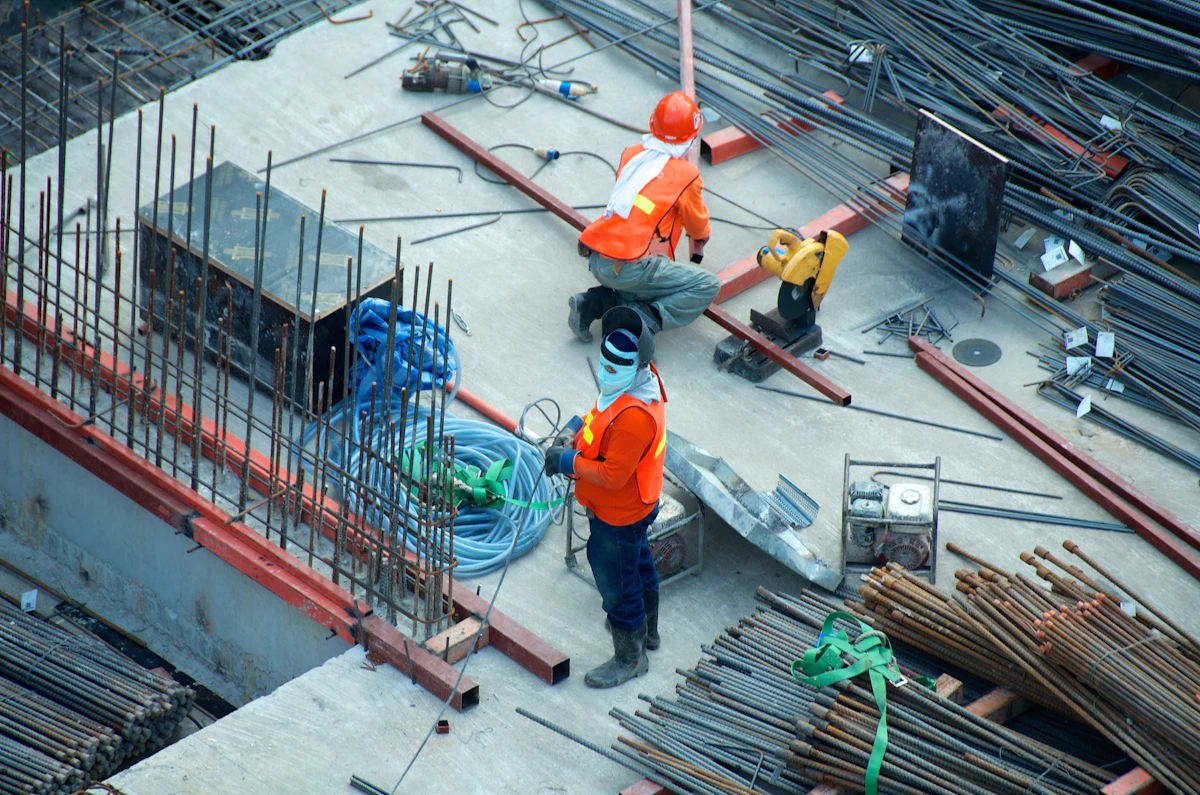
Photo by Scott Blake / Unsplash
Rockford faces a 10-year federal mandate to replace 30,000 lead service lines — but at its current pace and budget, the work will take 35 years. That gap is not a planning problem. It is a structural one.
Leticia Labrado does not drink from her kitchen tap. She has not in a while. There is a metallic edge to the water — faint, but present enough that she notices — and when you have lived long enough in south Rockford, you learn to notice things like that and act accordingly. She buys bottled water. The price of a flat has gone up, like everything else, but the alternative is worse.
In March 2026, a two-crew construction team is breaking up asphalt along a residential block not far from where Leticia lives. Orange cones, a backhoe, the particular percussion of a pneumatic hammer against old pavement. The crew is there to dig out a lead service line — one of roughly 30,000 still threading beneath Rockford's streets and yards, connecting homes built between 1900 and 1970 to a water system that has never had the resources to fully modernize. This particular line is one of 850 that will be replaced this calendar year. Project Manager Matt Moorman keeps the schedule.
Leticia has heard about the federal deadline. She is not reassured by it. "When I hear about a deadline," she told a local reporter, "I'm looking at, 'Okay, what is that going to cost tax-wise?'" It is not a cynical question. It is a practical one, from someone who has already calculated that trust in the pipe is not free, and neither is the water she buys to replace it.
Her kids are enrolled in Rockford Public Schools. The same week the lead pipe story runs on WIFR, the school district announces it is cutting 110 positions — attendance specialists, academy coaches, support roles. The second major restructuring in two years. The district's superintendent explains it the way administrators do: cost increases, post-pandemic staffing, an unavoidable correction. Leticia does not need the press conference to understand what is happening. The tape on the door of the school counselor's office says enough. Something is leaving Rockford — slowly, in pieces, in ways that are each individually explainable — and the water is only the most literal version of what she already tastes every day.
The mechanism is not hidden. Water Superintendent Jamie Rott has named the numbers publicly: Rockford has roughly 30,000 lead service lines remaining. The EPA's revised Lead and Copper Rule Improvements, finalized October 8, 2024, requires full replacement within 10 years of 2027 — meaning by 2037. To hit that timeline, Rockford must replace approximately 3,000 lines per year. The annual cost to do so: $50 million. Rockford's 2026 budget allocation for lead replacement: $5 million. The arithmetic is not ambiguous. The city is running at 10 cents on the dollar against a federal mandate with legal teeth.
Rockford has replaced approximately 4,400 lead service lines since its program began in 2017 — roughly nine years of work — against a total inventory of approximately 34,400. That is a completion rate of 12.8% over nine years. The EPA mandate requires 100% completion in ten. The funding gap is not incidental to this story; it is the story. At 850 lines per year with no budget increase, Rockford finishes in 2061 — 24 years after the federal deadline expires. "We have 10 years to get all of the lead out of the city," Rott told WIFR. He did not specify where the $450 million required to do so would come from. — Source: WIFR, March 6, 2026; EPA final rule, October 8, 2024.
The funding gap leads directly back to Rockford's tax base. Manufacturing employment in the Rockford MSA stood at 23,800 in December 2025 — down 2.5% year-over-year, continuing a multi-decade decline in a city historically built around machine tools, aerospace components, and fasteners.[1] Without a growing industrial base, assessed property values stagnate, sales tax receipts underperform, and capital maintenance becomes the first casualty of annual budget negotiations. Lead service lines installed between the early 1900s and 1970s accumulate in a queue that grows faster than the budget can clear it.
The entry friction in this system is geographic and demographic. South Rockford — where Leticia Labrado lives, where the oldest housing stock is concentrated — carries a disproportionate share of the remaining lead line burden. No city-published block-level data confirms this precise distribution, but the pattern is standard in rust-belt cities: pre-war housing density, lower homeowner incomes, and deferred service delivery cluster in the same neighborhoods. The residents who most need the replacement program are the ones least equipped to absorb rate increases that would fund it. Translation: the people paying the health cost are the people who cannot pay the infrastructure cost.
Rockford Public Schools' $15 million deficit, announced March 12, 2026, follows the same structural logic as the water crisis. RPS 205 Superintendent Ehren Jarrett attributed the gap to post-pandemic staffing expansions meeting declining state funding flexibility: "Unfortunately, that's how you go from a budget surplus to a budget deficit pretty quickly." The 110 positions cut represent approximately 12% of central office staff and targeted non-classroom support roles — attendance specialists and academy coaches — meaning the cuts are weighted toward the highest-need students, not the district's administrative overhead. The Rockford Education Association contested the framing, attributing the deficit to "years of mismanagement and administrative bloat." Both explanations are compatible with the underlying structural fact: the district's revenue base cannot sustain the staffing levels it built during a period of federal relief funding that has since ended. — Source: Northern Public Radio (WNIJ), March 17, 2026; Rockford Register Star, March 12, 2026.
What distinguishes Rockford from cities with similar demographic profiles is the simultaneity of the collapse vectors. The water crisis, the school budget crisis, and the unemployment rise are not independent events. They share a single root cause — a tax base that has been shrinking since the 1980s and has never been replaced with equivalent fiscal density. The city's $385 million 2026–2030 Capital Improvement Plan signals political will, but that plan carries debt service implications that have not been fully stress-tested against the current employment trend. Approving capital plans is easy. Funding them through a decade of 6.2% unemployment is a different problem.[2]
Rockford is not the only Illinois city confronting the arithmetic of the EPA's revised Lead and Copper Rule. Capitol News Illinois, tracking statewide lead pipe inventories in early 2026, documented that at current replacement rates across Illinois municipalities, full compliance by 2037 is a statistical fiction for most mid-sized cities. The Illinois Lead Service Line Replacement and Notification Act, effective January 1, 2022, required inventories to be completed — it did not conjure the capital to fund replacement. What it produced is a statewide map of unfunded mandates sitting on top of cities whose fiscal capacity has been eroding for two decades.[3]
The deeper pattern here is what urban fiscal scholars call the infrastructure debt spiral: deindustrialization removes the tax base; reduced revenue defers capital maintenance; deferred maintenance becomes a public health liability; compliance mandates arrive when the city is least financially capable of meeting them; rate increases and borrowing push households toward exit; population loss further erodes the tax base. Rockford is not in the opening chapter of this spiral. It is somewhere in the middle — still functional, still maintaining basic services, but unable to close the distance between its federal obligations and its fiscal reality without external intervention at a scale that is not currently on the table.
The Rockford metro's unemployment rate of 6.2% in December 2025 — up 1.4 percentage points year-over-year, compared to the U.S. rate of approximately 4.1% during the same period — is the economic signal that should be read alongside the infrastructure one.[1] Rising unemployment means a smaller tax base, more households under financial pressure, and reduced political tolerance for the water and school rate increases that would generate the revenue to close the compliance gap. These forces are not additive. They are mutually reinforcing.
The city's logistics and inland port narrative — anchored on Chicago Rockford International Airport's freight capacity — has not generated the offsetting job density that would relieve this pressure. Bureau of Labor Statistics data for December 2025 shows trade and transportation employment in the Rockford MSA declining 1.3% year-over-year, the same period during which the logistics recovery story was theoretically accelerating. The absence of a positive employment signal in the sector meant to replace manufacturing is the structural confirmation that Rockford's revenue problem is not temporary.
The broader implication: when a federally mandated infrastructure timeline arrives faster than a deindustrializing city can rebuild its fiscal base, the mandate does not accelerate investment — it accelerates the visible accounting of a gap that has been widening for thirty years.
The school budget deficit and staffing cuts could reflect an overshoot correction from pandemic-era federal relief funding (ESSER) that temporarily inflated district budgets and staffing levels. Under this reading, the $15 million deficit is a one-time normalization, not evidence of deepening structural fiscal stress. This argument has genuine merit — Superintendent Jarrett partially confirmed it, noting that post-pandemic staffing costs drove the gap. However, it does not explain the water infrastructure crisis, which predates the pandemic by decades, or the unemployment rate trend, which reflects manufacturing erosion independent of COVID-era policy. A pure "post-pandemic correction" thesis cannot account for all three simultaneous stress signals pointing in the same direction. The structural mechanism is more comprehensive than the correction thesis.
The Rockford Education Association explicitly attributed the school deficit to "years of mismanagement and administrative bloat" — a governance failure thesis rather than a structural one. If the city has consistently misallocated available revenues, the problem is political and managerial, not irreversible. This is a serious argument that deserves weight. Local governance quality demonstrably varies across comparable mid-sized Midwestern cities with similar manufacturing exposure. However, the 10-to-1 gap between the city's lead replacement budget and the EPA's required spending ($5M vs. $50M annually) is not a number that responsive management can close through efficiency gains alone. The fiscal constraint is too large to attribute primarily to waste. Governance failure may compound the structural problem, but it did not create the underlying $45M/year infrastructure gap.
Unknown: Census-tract-level distribution of remaining lead service lines by neighborhood demographic profile. The inference that south Rockford carries disproportionate burden is standard for rust-belt housing geography but has not been confirmed with block-level data from Rockford Public Works or the Illinois EPA lead service line inventory database. A FOIA request to either entity would verify or complicate the equity dimension of this signal.
Unknown: The City of Rockford's general fund condition for FY2025–2026. The school district's deficit is well-documented; the city government's own fiscal position — particularly the debt service implications of the $385M Capital Improvement Plan — was not confirmed in sources reviewed. If the city's general fund is also under stress, this signal's severity index should be revised upward.
Unknown: What specific federal or state grant commitments, if any, are currently in negotiation for the lead pipe program. Rott mentioned IEPA grants and principal forgiveness loans as funding mechanisms. The size, probability, and timeline of those flows is not confirmed in available sources. If significant federal infrastructure funding were awarded in 2026–2027, the compliance math would change materially — though it would not resolve the underlying tax base erosion.
Monitoring trigger: If Rockford's 2026 lead replacement count falls below 850 lines (i.e., the "banner year" fails to hold), or if the city's FY2027 budget reduces the water infrastructure allocation below $5M, the signal should be upgraded to a collapse-stage flag. Conversely, if state or federal grant announcements close more than 30% of the annual funding gap, the signal should be revised toward a managed-stress category.
[1] U.S. Bureau of Labor Statistics. Economy at a Glance: Rockford, IL Metropolitan Statistical Area. Data extracted March 20, 2026. bls.gov/eag/eag.il_rockford_msa.htm — Tier A.
[2] Rock River Current. "Rockford's Record-Breaking $385M Capital Plan Has Projects Big and Small." December 2025. rockrivercurrent.com — Tier C.
[3] Capitol News Illinois. "As State Continues to Inventory Lead Pipes, Full Replacement Deadlines Are Decades Away." 2026. capitolnewsillinois.com — Tier B.
[4] U.S. EPA. "Biden-Harris Administration Issues Final Rule Requiring Replacement of Lead Pipes." October 8, 2024. epa.gov — Tier A.
[5] WIFR (CBS/Gray Television, Rockford). "Federal Deadline Pushes Rockford to Replace 30,000 Lead Pipes." March 6, 2026. wifr.com — Tier B. [Primary quotes: Jamie Rott, Matt Moorman, Leticia Labrado]
[6] Rockford Register Star. "Rockford Public Schools to Cut Jobs to Close Budget Deficit." March 12, 2026. rrstar.com — Tier B. [Primary quote: Dr. Ehren Jarrett]
[7] Northern Public Radio / WNIJ (NPR affiliate). "Rockford Public Schools Cuts Over 100 Positions Amid $15 Million Deficit." March 17, 2026. northernpublicradio.org — Tier B. [Rockford Education Association quote; regional context]
[8] City of Rockford. "Lead Drinking Water — Water Division." Official city page, accessed March 2026. rockfordil.gov/320/Lead-Drinking-Water — Tier A.
[9] MyStateline / WTVO (Nexstar, Rockford). "Rockford's Unemployment Rate Rises to 6.2% as Job Losses Mount." January 29, 2026. mystateline.com — Tier B.