The Signal
The galleries at the University of North Texas in Denton are quieter than they should be in April. This is the season of senior exhibitions — the culmination of four years of studio work, critique sessions, and thesis development, the moment when art students put everything on the wall and invite the world to judge. But this spring, several students have taken their work off the walls. Not in protest. In refusal. They withdrew their pieces from UNT's official gallery spaces and carried them across town to venues that do not operate under institutional oversight.
The "Senior Exit Show" materialized off campus, organized by graduating students who decided that displaying their work inside UNT's galleries would constitute endorsement of an institution they no longer trust. At 2 Bed 1 Bath, an independent gallery space in Denton, five students mounted an exhibition explicitly titled "Institutional Critique." The work is not subtle. It addresses censorship, institutional cowardice, and the specific conditions that led the students to leave. The canvases and installations are confrontational not because the artists are angry — though they are — but because the work was made for walls that the university proved unworthy of holding.
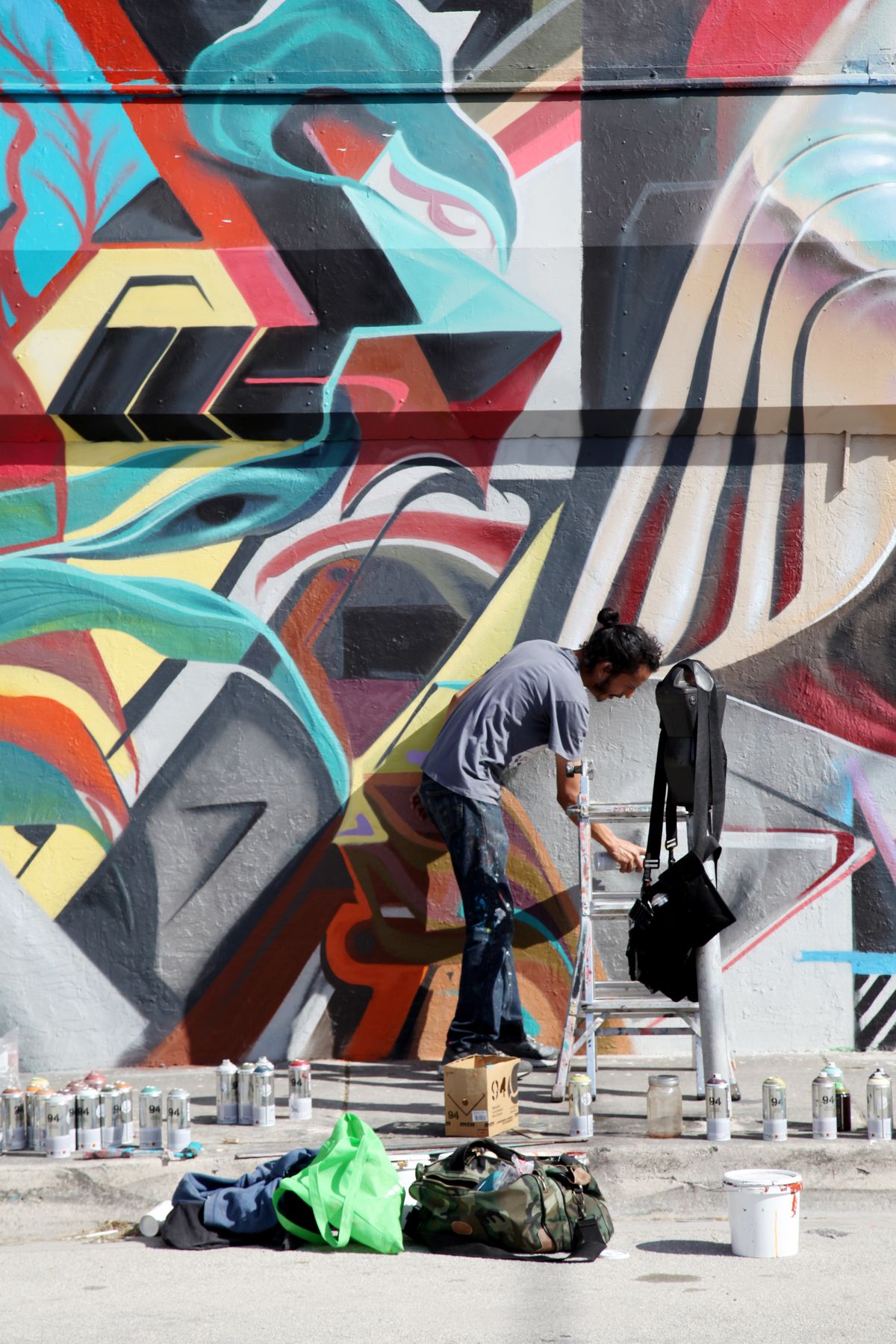
The trigger was specific. MARKA27 — a Chicano muralist and visual artist whose work has been exhibited internationally — had a show scheduled at UNT's gallery. The show included pieces critical of Immigration and Customs Enforcement. The university canceled it.
The Context
Denton sits thirty-five miles north of Dallas, a college town of 150,000 where UNT's 45,000 students constitute the gravitational center of cultural life. The university's art program is nationally ranked, a pipeline that feeds graduates into the Dallas-Fort Worth gallery scene, into Houston's museum ecosystem, and occasionally into New York. The program's reputation was built on exactly the kind of work it just suppressed: political, boundary-testing, rooted in the lived experience of communities that the art market has historically undervalued.
MARKA27 — born Mark Anthony Gonzales — is not an emerging provocateur. He is an established artist whose murals appear in cities across the United States and Latin America, whose work has been featured in the Smithsonian, and whose visual language draws directly from the Chicano art tradition that emerged in the 1960s as a political movement before the market decided it was an aesthetic one. His criticism of ICE is not incidental to his practice. It is his practice. Canceling his show was not a curatorial decision. It was a political one, made by administrators who calculated that the institutional risk of displaying ICE-critical work in Texas in 2026 outweighed the artistic cost of censorship.
The ACLU responded on April 8 with a billboard campaign in the Denton area, framing the cancellation as a First Amendment issue. The Foundation for Individual Rights and Expression — FIRE — issued a public statement documenting the sequence of events and flagging UNT's actions as part of a broader pattern of viewpoint-based censorship at public universities.
The Analysis
The UNT case is a signal because of what the students did, not what the administration did. Administrative censorship at American universities is not new. The Foundation for Individual Rights and Expression maintains a database of over 600 incidents of campus censorship since 2020, spanning disinvited speakers, defunded student publications, and canceled exhibitions. What distinguishes Denton is the response: students did not march, did not petition, did not write letters to the provost. They removed their labor. They took the one thing the institution needed — their art, their talent, their willingness to legitimize the gallery by filling it — and relocated it to spaces they controlled.
This is a labor action disguised as an art action. The Senior Exit Show is functionally a strike. The students withdrew the product of their work from an employer — the university — whose conditions they found unacceptable. The parallel to labor organizing is precise: when workers cannot change the factory, they leave and build a competing one. 2 Bed 1 Bath gallery became the alternative factory.
The pattern has precedents across the American art landscape. In 2019, artists withdrew from the Whitney Biennial over board member Warren Kanders' ownership of Safariland, a manufacturer of tear gas used against migrants at the U.S.-Mexico border. In 2024, dozens of artists pulled work from galleries and museums in New York and Los Angeles over institutional silence on Gaza. In Miami, the 2025 season saw three independent exhibition spaces open explicitly as alternatives to institutions that artists described as "morally compromised." Each case follows the same arc: institutions prioritize donor relations or political safety over artistic integrity, and the artists respond by building parallel infrastructure.
What makes UNT distinctive is the demographic. These are not established artists with gallery representation and market leverage. They are seniors — twenty-two-year-olds making the most consequential professional decision of their early careers. Withdrawing from the Senior Exit Show means forgoing the institutional validation that MFA programs and gallery scouts use as a filter. They chose integrity over access, and in doing so, they revealed something about a generation of artists for whom the institution is no longer the gatekeeper it once was. When your portfolio lives on Instagram and your community is built on Discord, the university gallery is one venue among many — and not necessarily the most important one.
The Anticipation
Expect the UNT case to accelerate a trend already visible in Texas: the migration of politically engaged art from institutional to independent spaces. Dallas and Houston both have robust alternative gallery ecosystems — warehouse shows, apartment galleries, pop-up collectives — that have grown since 2020 as institutional programming became more risk-averse. The MARKA27 cancellation gives this migration a specific, citable catalyst. UNT's art program will not collapse, but its reputation as a space for challenging work will erode among exactly the students it most needs to attract.
The ACLU billboard and FIRE's documentation ensure that the story enters the legal and advocacy record, which means future censorship incidents at Texas public universities will be measured against this precedent. The institutional cost of canceling a show is no longer limited to the show itself. It now includes the possibility that your best students will leave and take their talent with them — publicly, visibly, and with better press than you'll get for the exhibition you programmed to replace the one you killed.
CORE Connection
This is a CORE signal about the relocation of cultural authority. When UNT canceled MARKA27, it assumed that the institution controlled the venue and therefore controlled the narrative. The students' withdrawal proved the opposite: the institution needs the artists more than the artists need the institution. The gallery without the art is just a room. The art without the gallery is still art. What happened in Denton is a small-scale demonstration of a shift that is reshaping cultural production across the country: the center of gravity is moving from institutions that curate to communities that create, and the distance between those two is growing every time an administrator chooses safety over substance.
Verified Sources
- KERA News — https://www.keranews.org — UNT student gallery withdrawal, Senior Exit Show details, MARKA27 cancellation timeline
- Hyperallergic — https://hyperallergic.com — "Institutional Critique" exhibition at 2 Bed 1 Bath gallery, student artist interviews
- FIRE (Foundation for Individual Rights and Expression) — https://www.thefire.org — Documentation of UNT censorship incident, campus censorship database
- ACLU — https://www.aclu.org — April 8 billboard campaign in Denton, First Amendment framing