
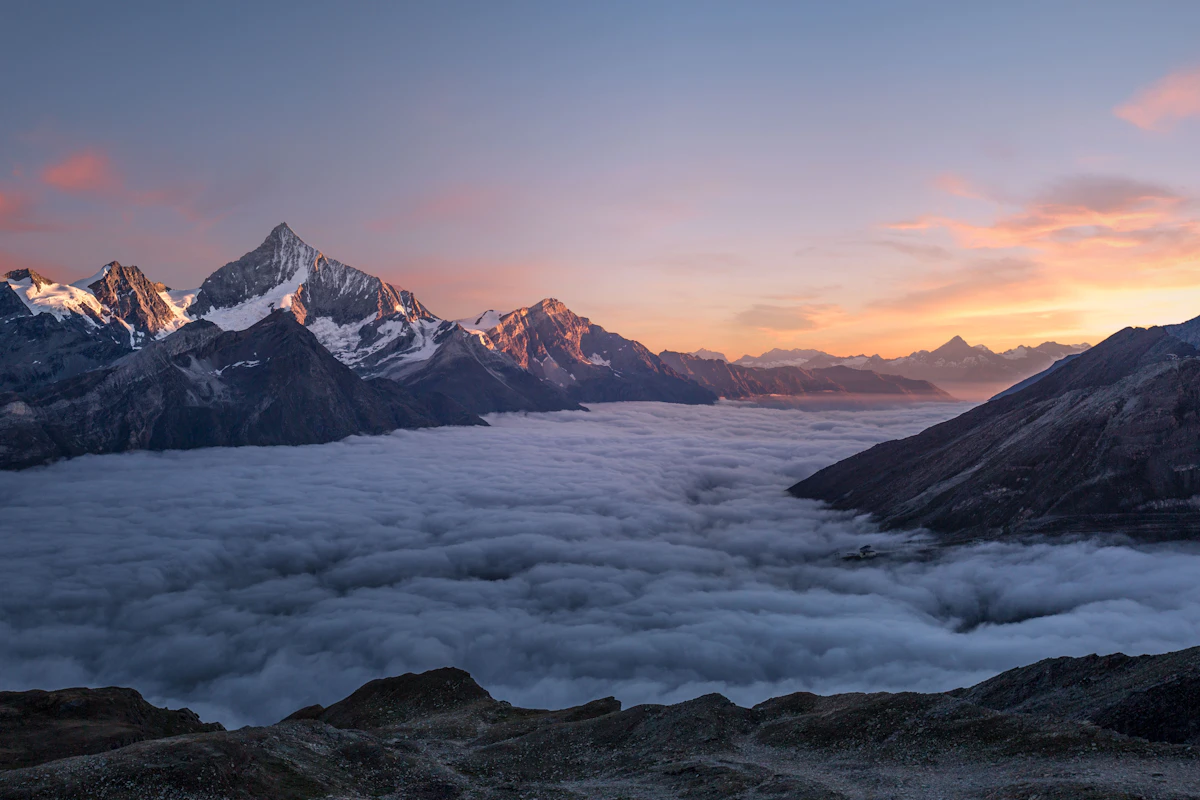
Photo by Sébastien Goldberg / Unsplash
In Flagstaff, the same tourism economy that pipes sewage effluent onto Indigenous sacred land is pricing Native renters out of the housing market — two faces of a single structural displacement.
She drives Route 89 north out of Flagstaff the same way her mother did, the same way her grandmother did before that. The San Francisco Peaks are always visible from the road — Humphreys Peak rising above the ponderosa line, white in winter, holding the sky in a specific way that has no equivalent elsewhere. There is a word in Diné Bizaad for what the mountain does. It doesn't translate cleanly into English. It is somewhere between "anchor" and "permission."
She doesn't stop at the trailhead the way she used to. There is no formal prohibition. She is free, legally, to park her truck and walk into the subalpine. But the spring her family visited for generations — the one where her aunt still collects water when she can bring herself to go — is different now. The snowmelt runs off differently. The smell is off. She heard a Havasupai elder say it in a meeting once: "We can't go there anymore because we don't know what this snowmelt has done to it." After that, she stopped going too.
This winter, the ski resort opened on schedule. The artificial snow machines ran through November and December, pushing up to 178 million gallons of treated municipal sewage effluent across the same subalpine terrain. On opening day, skiers lined up in bright gear at the base lodge. On the same day, protesters stood at the resort entrance with signs reading Protect the Sacred and No Desecration for Recreation. The two groups barely made eye contact.
She rents an apartment in east Flagstaff — has for seven years. The unit is not fancy. It is hers. Or it was. Her landlord sold the building last spring. The new owner listed three units on Airbnb by fall. Her rent went up 19 percent at renewal. She is still there. For now. She does the math every month.
She works at a clinic that serves Navajo patients who commute in from the reservation for care. Some of them used to rent rooms in Flagstaff to stay close. Most of those rooms are gone now, or too expensive. They drive farther. They miss appointments. This is also the mountain, doing what it does — holding the sky. The difference is that nobody is calling it sacred anymore. They're calling it a housing market.
Flagstaff occupies a structurally peculiar geography: surrounded on nearly all sides by federal land and Navajo Nation territory, it cannot expand outward the way most western cities can. Its housing supply is essentially fixed by topography and land-use law. Into that constraint, the city has absorbed one of the most intense tourism demand pressures in the American Southwest — gateway to the Grand Canyon, Sedona, Monument Valley, and Navajo Nation attractions, all within two hours' drive. When tourism demand monetizes land, it does so in a city with nowhere else to go.
Arizona Snowbowl operates on the San Francisco Peaks — land held sacred by 13 federally recognized tribes, including the Navajo Nation, Hopi, Havasupai, and Hualapai. Since 2004, the resort has used treated municipal sewage effluent for artificial snowmaking, piping up to 178 million gallons per season across subalpine terrain used for traditional ceremonies, medicine harvesting, and water collection from springs. The Navajo Nation sued in 2007 under the Religious Freedom Restoration Act. The federal appeals court dismissed the case, ruling that the presence of treated wastewater on the peaks only affects tribal members' "subjective spiritual experience" — not a cognizable harm under federal law. The Supreme Court declined to hear the appeal. The legal pathway is closed.[1]
The federal court ruling creates a legal architecture in which spiritual and ceremonial land use holds precisely zero protective weight against commercial infrastructure. The Snowbowl precedent does not merely affect one resort — it establishes that tourism capital operating on contested federal land cannot be blocked by Indigenous religious claims, regardless of historical relationship to the land. This ruling was not appealed to SCOTUS successfully; it stands as operative precedent in the Ninth Circuit.
In the housing market, the mechanism runs through Arizona Senate Bill 1350, passed in 2016. The "Airbnb bill" stripped all Arizona municipalities of the authority to ban or regulate short-term rentals. In Flagstaff — a city that had already declared a housing emergency in 2020 after average home prices rose 53 percent in the preceding decade — the deregulation was catastrophic in slow motion. STRs in Flagstaff grew from approximately 600 units in early 2021 to over 1,100 by March 2025, representing nearly 4 percent of total housing stock.[2] According to AirDNA data cited in NAU's student newspaper, 92 percent of those STRs are entire non-owner-occupied homes — properties removed permanently from the long-term rental pool, generating an average daily rate of $266.40.
In March 2025, Flagstaff City Council passed a resolution urging the state legislature to restore local STR control. Translation: the city cannot act. It can only ask. In March 2026, the Arizona legislature answered that ask — by giving cities only minor "repeat bad actor" enforcement tools while rejecting density-cap authority over STRs.[3] The structural trap remains fully intact.
The STR displacement does not land evenly across Flagstaff's population. According to the City's own 10-Year Housing Plan (2022), American Indian and Alaska Native alone, non-Hispanic households in Flagstaff are renters at a 68 percent rate — the second-highest renter rate of any racial group in the city. In a market where the long-term rental pool is being systematically converted to vacation inventory, households that rent overwhelmingly are the most exposed. In December 2024, Flagstaff reported a net loss of 34 designated affordable rental units despite over 100 new affordable units opening — because 144 existing units at one complex lost federal tax credit compliance status simultaneously.[4] Devonna McLaughlin, CEO of Housing Solutions of Northern Arizona, said of the accumulating pressures: "How many problems can we pile on? That's just another one we get to deal with."
The two crises — the Snowbowl effluent and the STR displacement — are not coincidentally affecting the same population. They are the same structural force expressing itself in two domains. Flagstaff's economy depends on tourism: the Grand Canyon corridor, Snowbowl, the gateway amenities that make the city legible to visitors. That same tourism demand is what fills the Airbnb units, pressures the rental market, and finances the resort that pipes sewage onto ceremonial terrain. Indigenous communities in and around Flagstaff absorb the negative externalities of both: spiritual land desecrated at the top of the mountain, housing market squeezed at the bottom of the valley. The entry friction is not incidental. It is structural.
Northern Arizona University adds a third pressure layer. Fall 2024 enrollment included a 47 percent increase in new Indigenous students — a signal of educational access and aspiration that collides directly with the city's collapsing affordable rental stock. Students, including Native students from the reservation, compete in the same rental pool as low-income workers and families with no tribal housing alternative in Flagstaff city limits. Cora Maxx-Phillips, a Navajo rights activist quoted in azcentral.com, described the stakes in terms that span both crises: "The Earth, with its air, water, food, soil, and living trees, and this mountain, are my extended family. We need to protect it."
Flagstaff is not anomalous. It is the clearest currently observable case of a pattern that runs through every American gateway tourism city adjacent to Indigenous land: the tourism-capital mechanism simultaneously consumes sacred geography and residential geography, with Indigenous communities absorbing the harm on both axes.
The ASU Morrison Institute of Public Policy documented the structural baseline in a 2022 Coconino County study: average monthly STR listings grew approximately five times in the county between 2016 and 2020 — the period directly following Arizona's SB 1350 deregulation. By January 2021, Flagstaff housing costs were already 33.5 percent above the national average.[5] The Morrison Institute's analysis predates the STR growth that followed, which means the documented five-fold increase understates the current condition. The March 2025 KJZZ report puts the current figure at 1,100+ units and rising.
Research on short-term rental market effects at the national level confirms the mechanism. The Economic Policy Institute's 2019 analysis of STR displacement documented that STR expansion concentrates harm on renters in constrained housing markets — precisely the condition Flagstaff's geography creates. When a city cannot expand its housing envelope and STRs absorb 4 percent of total stock, the compression is not a market inefficiency. It is a designed outcome of the state preemption law.
The legal architecture around Indigenous sacred land adds a layer that has no direct parallel in other displacement signals. Federal courts have now established, via the Navajo Nation v. U.S. Forest Service ruling and the subsequent failure to achieve SCOTUS review, that spiritual and ceremonial relationship to land does not constitute a cognizable legal interest when commercial infrastructure is involved. The Apache Stronghold appeal, filed September 2024 in a parallel case involving a proposed copper mine on Oak Flat — another site sacred to multiple tribes in Arizona — extends the same contested logic.[1] If that appeal fails, the precedent calcifies: the subjective–objective distinction becomes the legal instrument by which commercial extraction of sacred land proceeds without Indigenous remedy.
Ka-Voka Jackson of the Hualapai Tribe, speaking to azcentral.com in April 2025, described the practical consequence of the Snowbowl ruling with precision: "We can't go harvest on the peaks anymore. And the springs we collected water from, it's not the water it used to be." This is not a cultural grievance. It is a documented loss of material resource access — medicine plants, ceremonial water sources — produced by a legal ruling that called it merely subjective.
The signal's broader implication is this: when a tourism economy captures both the sacred geography above a community and the housing market below it, and when state preemption law and federal court precedent jointly remove the legal tools for response, displacement is not a risk — it is the policy.
The housing pressure in Flagstaff could be attributed primarily to the broader post-2020 Sun Belt and Mountain West housing inflation that affected Bozeman, Bend, Asheville, and similar amenity cities — rather than to STR deregulation specifically. Remote work migration, low interest rates through 2022, and supply chain constraints drove up costs everywhere. Under this reading, Indigenous renters are harmed by macroeconomic forces, not by a Flagstaff-specific or STR-specific mechanism. This is a legitimate argument. The evidence distribution undermines it, however: Coconino County's STR growth (5x) preceded and outpaced the general Sun Belt migration wave, and is directly traceable to the 2016 state preemption law. The Morrison Institute study documents the STR growth as the primary accelerant specific to this geography and timeline. The macro narrative explains part of the pressure; the STR mechanism explains the structural form that the pressure takes.
The Snowbowl effluent conflict could be read as a discrete, long-running cultural and legal dispute — one that pre-dates the current STR crisis by nearly two decades — rather than as structurally linked to the housing displacement. On this reading, the two stories are temporally proximate but causally separate: one is a religious freedom litigation, the other is a housing market problem. This is analytically coherent. The link between them is inferential, not directly measured. The primary mechanism argument — that both flows from the same tourism-economy demand structure and both disproportionately burden the same population — is a structural inference, not a proven causal chain. What the evidence supports is that the two are products of the same economic order. The inference of structural linkage is probabilistic, not demonstrated by a single study connecting them.
What is not known: No direct testimony from a Native Flagstaff renter explicitly linking their housing displacement to STR-driven market pressure has been located. The structural inference is supported by statistics but not by first-person testimonial evidence from the specific intersection of Native renter + STR displacement.
Water quality gap: The claim that ceremonial springs have been contaminated by Snowbowl snowmelt is supported by elder testimony (Dianna Sue White Dove Ukualla; Ka-Voka Jackson) but not yet by independent water testing. Navajo activist Shawn Mulford's sucralose-testing project was in early stages as of April 2025. If that study publishes and confirms contamination, the SCI score for physical harm evidence would rise significantly.
NAU enrollment impact: The 47 percent increase in new Indigenous NAU students in Fall 2024 is documented, but no rental market analysis exists specifically measuring the overlap between Native student housing demand and low-income Native renter displacement. This inference remains unquantified.
Monitoring that would confirm or upgrade this signal: Publication of the sucralose water testing results; a direct survey of Native Flagstaff renters documenting STR-driven displacement; Arizona legislature action (or continued inaction) on STR authority restoration in the 2026 or 2027 session; SCOTUS ruling on Apache Stronghold v. United States (if cert is granted).
[1] Ethics & Society / Duke University (December 2024). "Student Voices: Sacred Land in Arizona — Federal Courts in Tribal Land Litigation in Navajo Nation v. United States Forest Service and Apache Stronghold v. United States." ethicsandsociety.org — Tier A.
[2] KJZZ Public Radio (March 11, 2025). "Flagstaff Council Wants the Legislature to Let the City Control Short-Term Rentals." kjzz.org — Tier B.
[3] KJZZ Public Radio (March 11, 2026). Arizona legislature rejects STR density-cap authority for municipalities. kjzz.org — Tier B.
[4] KNAU Arizona Public Radio (December 27, 2024). "Even With New Affordable Units, Flagstaff Sees Net Loss of Designated Affordable Rentals." knau.org — Tier B.
[5] ASU Morrison Institute of Public Policy (September 2022). Coconino County Housing Insecurity Brief. morrisoninstitute.asu.edu — Tier A.
[6] City of Flagstaff (June 2022). Flagstaff 10-Year Housing Plan. flagstaff.az.gov — Tier A.
[7] azcentral.com / Arizona Republic (April 26, 2025). "Why Tribes Oppose Arizona Snowbowl's Use of Reclaimed Water." azcentral.com — Tier B.
[8] NAU Lumberjack (April 2024). "Short-Term Rentals and the Housing Crisis: One Complicated Piece of a Complex Puzzle." jackcentral.org — Tier C.
[9] Navajo-Hopi Observer (November 2023). "Arizona Snowbowl's Opening Day Sees Pushback." nhonews.com — Tier C.
[10] City of Flagstaff (December 2020). Housing Emergency Declaration — Resolution 2020-66. flagstaff.az.gov — Tier A.