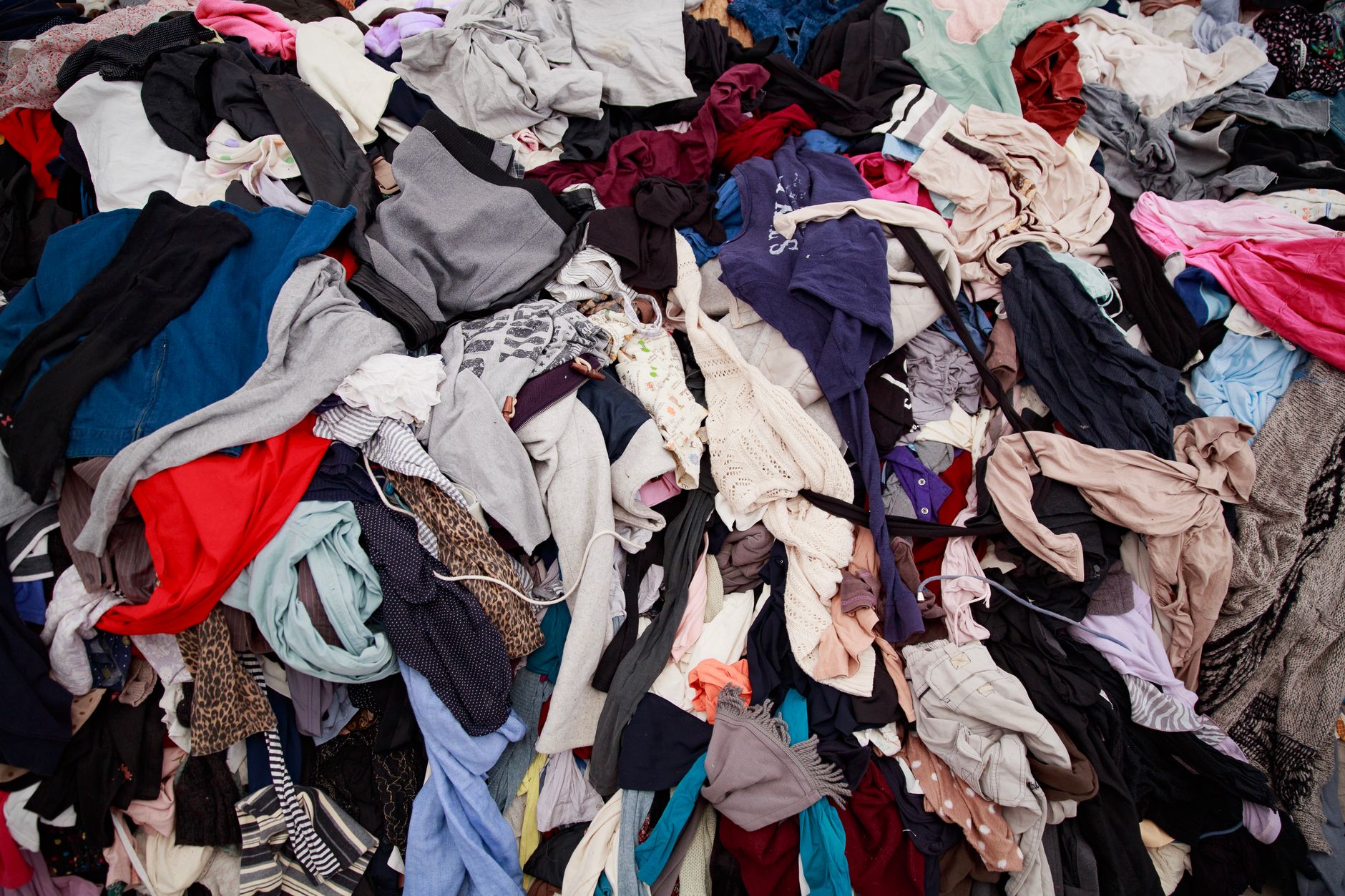
The bale arrives sealed and has to be paid for before it is opened.
That is all anyone knows about it: the weight, the price and the word of whoever sold it. Inside there may be shirts that sell the same day, or there may be sizes nobody in Nairobi wears, torn garments, winter coats for a city that has no winter.
So it gets opened on the floor, in Gikomba, and two piles are made.
One is the business. The other has its own name in Swahili: fagia, that which you sweep away. The word already says where it is going.
The first pile pays for the bale, pays for the stall, pays for the house. The second pays nothing and costs on top: it has to be hauled out. Someone from the rag trade takes it, or it ends up on the bank of the river that crosses the city.
Whoever buys a bale says it plainly: it is a gamble. The same money was paid for the pile that sells and the pile that gets swept, because at customs they came in together, in the same bundle, under the same declared weight. Nobody separated them there. Nobody ever separates them, until they are on the floor.
And that is where this story starts: the traders of this market went to ask the State to tax that bundle. Both piles, without telling them apart.
What follows is what happened when they asked.
Scene reconstructed from documented behaviour and territory; sources at the foot of the article.
The signal
In May 2026 Kenya's Treasury proposed a new tax on mitumba —secondhand clothing— and the notable part was not the tax. It was who asked for it.
John Mbadi, Cabinet Secretary for the Treasury, said it publicly: "This proposal actually came from people within that industry themselves. Leaders from Gikomba market came here and sat down with me." The leaders of the country's largest secondhand clothing market went to his office to ask to be taxed. The logic they brought him, in Mbadi's words: "instead of having many different taxes, there should be one single tax paid at the point of entry."
The design was written down: a new Section 12H in the Income Tax Act, with deemed profit of 5% of customs value on tariff heading 6309, payable before the revenue authority releases the goods and structured as a final tax. Expected revenue: 1.1 billion shillings.
It never came into being. The National Assembly's Finance Committee removed the provision, the Treasury asked for its reinstatement and did not get it. The Assembly passed the bill on June 18, 2026 and President William Ruto signed it on June 23. The Finance Act 2026 does not tax mitumba, and Ruto announced it as relief: no new taxes on land, on M-Pesa, on bottled water or on mitumba.
The traders asked for a tax. Parliament saved them from it.
The context
To understand why someone asks to be charged, look at what they already pay.
A Gikomba trader buys the bale sealed and does not know what proportion is sellable until it is opened and sorted on the floor. Research by the Changing Markets Foundation with Clean Up Kenya and Wildlight documented that up to 40% of every bale is unsellable, and that the traders interviewed put it between 20% and 50%: torn garments, sizes nobody wears, winter clothing for a climate that has none. That fraction is called fagia, that which you sweep away, and it goes to the rag trade or to the river.
The importers' body, the Mitumba Consortium Association of Kenya, holds a different figure: 1% to 2%, based on its own surveys.
The two cannot be averaged and this article does not average them. What matters is what each does to the proposed tax, because the 5% was calculated on the customs value of the whole bundle: not on what sold, not on actual profit. If waste is 1%, the tax is an accounting nuisance. If it is 40%, the State was about to charge deemed profit on garbage.
And the body that holds the low figure is the same one that negotiated the regime.
The reading
There is a question the coverage did not ask: why does a trader ask to be taxed?
The likeliest answer is not fiscal, it is predictability. A single tax, paid before the goods come out, can be budgeted: it is added to the cost of the bale and passed into the price. What cannot be budgeted is a regime of many separate charges, at separate moments, with room for discretion. The traders of Gikomba were not asking to pay more. They were asking to know how much.
What they were denied was not a privilege: it was a fixed price. And the argument used to deny it —protecting consumers from a 15% to 20% rise— is correct at the counter and silent about everything else.
There is a second silence, and it costs more. The withdrawn tax would have been levied on the whole bundle, and nobody in the debate discussed that. Not the Treasury, which wanted revenue on declared value. Not the trade body, which needs waste to be small for its own request to look reasonable. Not Parliament, which killed it without opening a bale. The unsellable fraction had no defender because nobody at that table carries it: it is carried by the retailer who opens the bundle on the floor, and there was none in the room.
The pattern
What appears here is not a fight between the State and traders. It is an information asymmetry turned into public policy.
A bale enters Kenya as a single object: one weight, one value, one tariff heading. It becomes two different things only afterwards, on the floor in Gikomba, when someone opens it. Everything decided before that moment —the duty, the tax that was proposed, the declaration of contents— is decided about a unit that does not materially exist.
That is the shape of the secondhand business at the receiving end: paper classifies what nobody has seen, and the gap between what the paper says and what the bundle holds is paid by the last link in the chain.
What Gikomba asked for and did not get was, at bottom, for that gap to have a number. It still does not.
Declared gaps: the real waste fraction per bale in Kenya is unresolved. The two available figures come from opposed interested parties and no independent measurement exists; both are published with their authorship. The full text of the proposed Section 12H was unavailable: its terms are reconstructed from Kenyan press, and two of those sources returned 403.
The links this piece cites, gathered and checked. Open them to verify.
- Capital FM, "CS Mbadi says mitumba traders proposed new import tax model in Finance Bill 2026", May 12, 2026 (Mbadi verbatim)
- The Kenya Times, "Finance Bill 2026: Kenya introduces new tax on mitumba imports" (Section 12H, 5% of customs value, heading 6309)
- The Eastleigh Voice, "Ruto: no new taxes on land, M-Pesa, bottled water or mitumba in Finance Act 2026"
- The Star, "Ruto signs Finance Bill into law, says no new taxes", June 23, 2026
- Money254, "Treasury & Parliament split on mitumba tax in Finance Bill 2026" (Treasury sought reinstatement of the removed clause)
- Lampoon, "A third of all second-hand clothing shipped to Kenya is plastic waste in disguise" (Changing Markets / Clean Up Kenya / Wildlight research)
- Greenpeace Africa, "How fast fashion is fuelling the fashion waste crisis in Africa" (the term "fagia" and the fate of the unsellable fraction)
- EfD Initiative, "Kenya's second-hand clothes pose major waste crisis"