
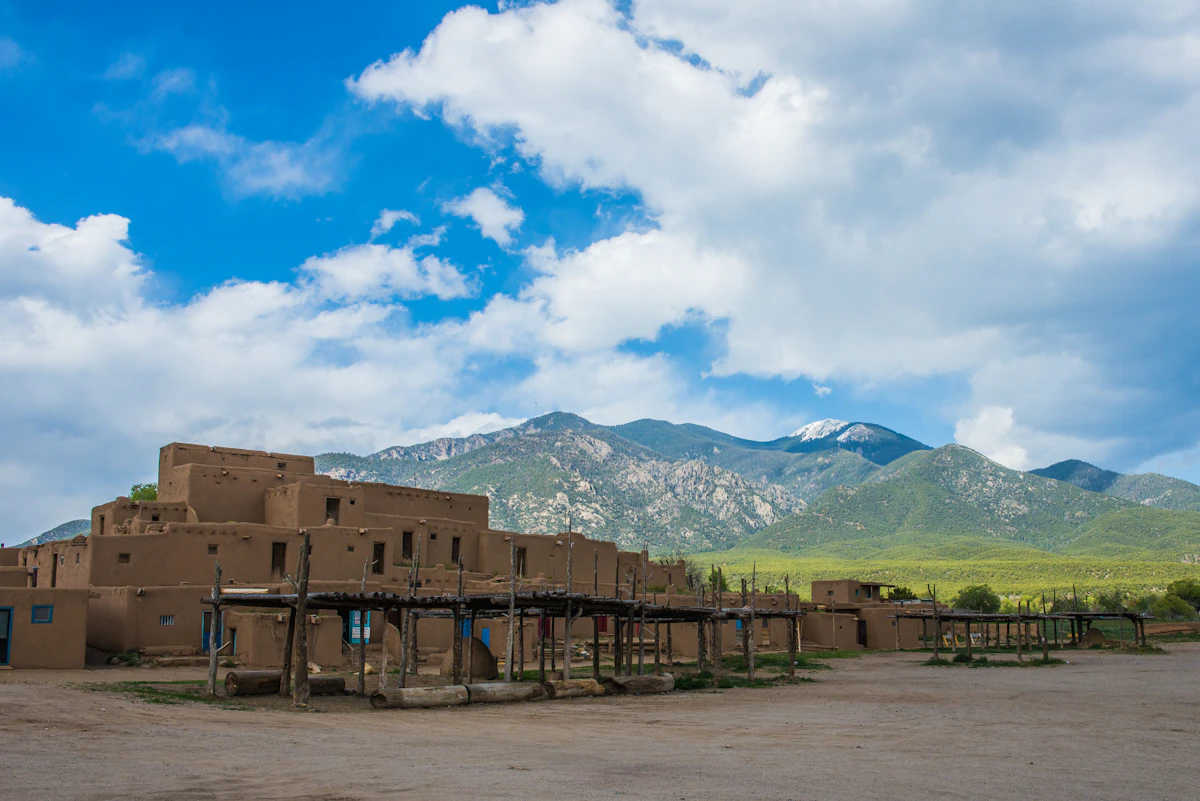
Photo by Richard Hedrick / Unsplash
In Taos, the artists and Hispanic families who built one of America's most storied cultural landscapes are being priced out — while the culture they created is packaged and sold to the remote workers and investors who replaced them.
The afternoon light in Taos hits differently than anywhere else in the country. It comes in low and golden off the Sangre de Cristo range, catches the adobe walls at an angle that makes everything look like it was painted — which, for over a century, it literally was. Artists came here for this light. They stayed. They built lives inside it.
On a Tuesday afternoon in early fall, a woman in her late fifties is loading boxes into a pickup truck outside a small house in Ranchos de Taos. Not packing for a trip. The deliberate, resigned rhythm of someone clearing out. She has lived in this neighborhood her whole life, in a house her parents' generation knew well. The landlord called three months ago. New ownership. The property is going vacation rental. She had sixty days.
She is not dramatic about it. That's what you notice. No performance of grief. Just the careful labor of dismantling a place. She wraps a small painting in newspaper — her own work, oils on board, the kind of piece that doesn't sell at the galleries on Bent Street, where the inventory now runs toward the tasteful and the expensive and the purchasable by people who arrived with a moving truck and a remote salary from Austin or San Francisco or Denver. She sets the painting in the truck cab, not in the boxes.
Down the block, a new lockbox gleams on a door. The house behind it has a listing name and a nightly rate. It is very clean. The photos are beautiful. The description mentions "walking distance to the Pueblo" as an amenity. The Pueblo has been here for more than a thousand years. The listing has been here for eleven months.
Taos has always been a place people came to find something. What is shifting, slowly and then quickly, is who gets to stay after they find it.
On May 16, 2023, Taos County Senior Planner Andy Jones stood before the County Commission and presented a number that clarified what had been happening for three years. Of the 900 to 1,200 active short-term rental listings operating in Taos County, 95% were owned by people who did not live in the county.[1] Of those, fewer than 300 held valid county permits — meaning roughly 75% were operating outside regulatory oversight entirely. Jones proposed capping permits at 1,000, roughly 5% of the county's 20,850 housing units. The cap was a response to a market that had already outpaced local capacity to respond.
At the same meeting, Lisa O'Brien — the newly appointed executive director of the Taos Housing Partnership, the first entity jointly funded by the Town and County to address affordable housing — delivered her inaugural report. The agenda itself illustrated the problem: STR saturation, development conflict, assessment failure, and local displacement were not separate crises. They were one mechanism, playing out in sequence.
The Town of Taos's own Destination Stewardship Plan Situation Analysis Report (2023), prepared by the Center for Responsible Travel and George Washington University's International Institute of Tourism Studies, documents 1,499 STR properties across Taos County, of which 91% are entire-home rentals averaging $256/night and $3,490/month in revenue. This is not supplemental income for residents — it is an investor asset class operating inside a residential housing supply that cannot absorb the conversion. The entry friction is asymmetric: outside capital accesses these properties at market rate; local buyers compete against investment-grade cash offers.
The structural chain is legible. Remote workers — predominantly from Texas, California, and Colorado, arriving post-2020 with household incomes 2–3x above the Taos median — identified the town as a lifestyle destination. Cultural cachet, landscape, the Taos Pueblo as aesthetic backdrop. They brought purchasing power the local market had never priced against. The Federal Reserve's All-Transactions House Price Index for Taos County recorded a 53.5% increase between 2020 and 2024 (from 165.61 to 254.16).[2] This is not a tight supply problem in isolation. Approximately 4,000 second homes already exist in the county — structural demand permanently decoupled from local wage levels.
The cultural economy inversion is the sharpest part of the mechanism. Taos has 84 art galleries, 331 retail shops of which 25% are classified as art galleries, and the Taos Art Museum's claim that more artists per capita live in the Taos area than in any other city in the world.[3] This cultural infrastructure was built by artists who lived here — many of them Hispanic, rooted in a 500-year tradition of craft, painting, and community art-making. It is now primarily consumed by a visitor class whose income profile is well-documented: 57.5% of Taos visitors report annual household incomes above $100,000, and 83% of Taos Air passengers earn above $75,000.[3] The cultural product has survived. The cultural producers are being displaced.
The Town of Taos's own community consultation process — producing the Destination Stewardship Plan from 2022 to 2024 — formally identified "gentrification — displacement of long-time residents and the loss of local culture and identity" as a Main Issue, and "inconsistent distribution of tourism economic benefits, felt most acutely by the Hispanic or Latino community" as a priority concern.[4] This is not an outside assessment. The Town commissioned and published these findings. The gap between formal identification and policy intervention is where displacement continues to operate.
The compounded pressure on the Hispanic community is specific. Local Taoseños — approximately 55% of county population — hold multigenerational ties to land adjacent to Taos Pueblo.[5] Assessed values increased roughly 13% in 2024 alone, from approximately $313,000 to $354,000, according to American Community Survey data cited by Kaitlyn Lange, Director of Outreach for Habitat for Humanity of Taos.[6] Property tax increases track assessments. Landlords facing higher carrying costs accelerate conversions to STR. A family that did not own its property has no floor. The labor market absorbs local workers in service roles — hotel, hospitality, gallery staffing — but the housing market no longer retains them.
Taos Pueblo, a UNESCO World Heritage Site and sovereign nation bordering the town to the north, draws over 100,000 visitors annually. The tourism infrastructure that monetizes this draw — STRs, galleries, luxury lodging — is overwhelmingly owned by outside investors. Tourism Director Ilona Spruce of Taos Pueblo sits on the DSP Steering Committee but exercises no jurisdiction over the off-Pueblo real estate dynamics compressing housing adjacent to tribal land. The Pueblo is the anchor attraction. It does not capture the appreciation its presence generates.
What is happening in Taos fits a well-documented pattern in amenity migration literature: high-amenity small towns with strong cultural identities are more susceptible, not less, to displacement pressure from remote worker influx. The cultural identity is the attractor. The attractor drives demand. Demand captures housing. The community that created the identity cannot afford to remain inside it.
The statewide context amplifies the local signal. New Mexico median rents climbed 60% from 2017 to 2024, compared to 27% nationally — a gap documented by the Pew Research Center and cited by the Taos Housing Partnership.[7] New Mexico is not a high-income state. Taos County's median household income sits in the range of $40,000 to $45,000. The state's rent acceleration is occurring in a context where wage growth has not tracked housing cost escalation. Taos represents the acute local expression of a statewide affordability compression already operating at twice the national rate.
The arts colony displacement pattern specifically has precedent. Marfa, Texas — the high desert analogue most frequently cited — underwent a similar sequence: art world legitimacy attracts affluent visitors; visitor demand captures housing; artists price out; the art infrastructure is maintained as aesthetic product while the producing community diminishes. The difference in Taos is scale and depth of historical community. Marfa's permanent population before its transformation was modest. Taos has a 500-year-old Hispanic community and a sovereign Indigenous nation on its border. The cultural continuity being severed here is not recent. It is generational.
"Taos is at a crossroads. No exaggeration — unless we counteract gentrification the continuity of Hispanic culture in Taos will be broken in this generation. Five-hundred years of historical memory on this land will end."
— Anita Rodriguez, artist and activist, Ranchos de Taos, The Taos News, 2022
Rodriguez's framing — "amenity migrants" arriving with capital to purchase a lifestyle and inadvertently (or deliberately) pricing out the culture they came for — maps precisely onto what the DSP data documents. The structural irony is not incidental. It is the mechanism. The town's distinctiveness is the asset that drives its own dissolution.
"Again we are being colonized and exploited from outside."
— Jim O'Donnell, community member, The Taos News, May 2023, responding to the 95% non-resident STR finding
The social capital literature on displacement offers a clarifying frame: what is being lost in Taos is not merely housing affordability but the spatial basis of cultural reproduction — the condition under which community knowledge, craft tradition, and intergenerational identity are transmitted. When the people leave, the knowledge does not transfer to the galleries. It dissolves. What remains is the aesthetic residue, sold to people who arrived after the community that created it was gone. When a cultural economy fully inverts — when the producers can no longer live inside the product — the signal is not only an affordability story. It is a question of whether the culture itself survives, or only its merchandise.
Taos has been a destination for wealthy visitors and second-home buyers since at least the 1970s. One could argue that the displacement pressure documented here is not a post-pandemic structural shift but an acceleration of a decades-long process — and that the community has always navigated this tension without the cultural collapse the signal implies. This is a legitimate reading. The historical pressure is real, and earlier cohorts of artists, particularly Anglo transplants in the mid-20th century, themselves participated in earlier displacement dynamics. The counterargument is the rate of change: a 53.5% housing price increase in four years (2020–2024), combined with the STR explosion from outside capital operating mostly outside permitting, represents a velocity discontinuity that historical analogy does not account for. The mechanism has not changed; the speed has changed in a way that forecloses the adaptive responses that earlier, slower change allowed.
The Town of Taos commissioned a Destination Stewardship Plan and formally identified displacement as a priority issue. The County Commission moved toward STR permit caps. The Taos Housing Partnership was newly formed with joint Town-County funding. One could read this institutional response as evidence that the market is being corrected — that Taos is doing the governance work required, and the signal is premature in its alarm. This is a meaningful counterargument. The institutional response is real and more substantive than most comparable towns have produced. However, the gap between policy identification and implementation is where displacement continues to operate at full speed. The DSP Situation Analysis was published in 2023. As of early 2026, the Redfin median home price for Taos County stands at $693,000 — up 33.2% year-over-year.[8] The policy machinery is in motion. The displacement is moving faster than the machinery.
What is not known: No direct count of displaced artists with named-individual specificity was found in available sources. The signal is supported by structural data and community testimony, but lacks a documented registry of specific artists or Hispanic families who have left with verifiable address-level evidence. The Taos Pueblo's specific exposure — how many housing units adjacent to tribal land have converted to STR, what the Pueblo's own economic stake in nearby real estate dynamics is — is not formally quantified in available data.
Research gaps: No academic study specifically on Taos artist displacement was found. The closest cultural documentation is community testimony (Anita Rodriguez op-ed) and the anecdotal observation that Taos has no gallery dedicated to Hispanic art despite a 500-year Hispanic artistic tradition. Confirming this absence empirically — a gallery-by-gallery ownership audit — would materially strengthen or complicate the cultural economy inversion claim.
What would change the signal: Evidence that the STR permit cap was successfully implemented and reduced non-resident ownership below 80% would lower the mechanism's current force. Evidence that the Taos Housing Partnership produced measurable affordable housing units — and retained working artists and Hispanic families in the community — would shift the signal toward managed tension rather than active collapse. Neither condition appears to have been reached as of the research date. Monitoring indicator: track Taos County Housing Price Index quarterly against Taos Housing Partnership unit delivery numbers.
[1] Andy Jones, Taos County Senior Planner, presentation to Taos County Commission, May 16, 2023. Reported by: Taos News, "Study: 95 percent of short-term rentals not owned by county residents," May 2023. taosnews.com
[2] Federal Reserve Bank of St. Louis (FRED). All-Transactions House Price Index for Taos County, NM (ATNHPIUS35055A). fred.stlouisfed.org
[3] Center for Responsible Travel (CREST) & George Washington University International Institute of Tourism Studies. Town of Taos Destination Stewardship Plan: Situation Analysis Report. 2023. taos.org
[4] Town of Taos. "Tourism Revisited — Destination Stewardship Plan Process Findings." 2023–2024. taos.org/tourism-revisited
[5] Anita Rodriguez, "We Must Counteract Gentrification," The Taos News, ca. January 2022. taosnews.com
[6] Kaitlyn Lange, Director of Outreach and Marketing, Habitat for Humanity of Taos. "Rising Assessments, Rising Stakes: Keeping Families in Taos," The Taos News, 2024–2025. taosnews.com
[7] Pew Research Center study on New Mexico housing costs, cited in: Taos Housing Partnership, "Pew Study Finds Restrictive Regulations Fuel New Mexico's Housing Shortage." taoshousingpartnership.org
[8] Redfin. Taos County, NM Housing Market Data, February 2026. redfin.com (Tier C — commercial platform; used for recency only)