
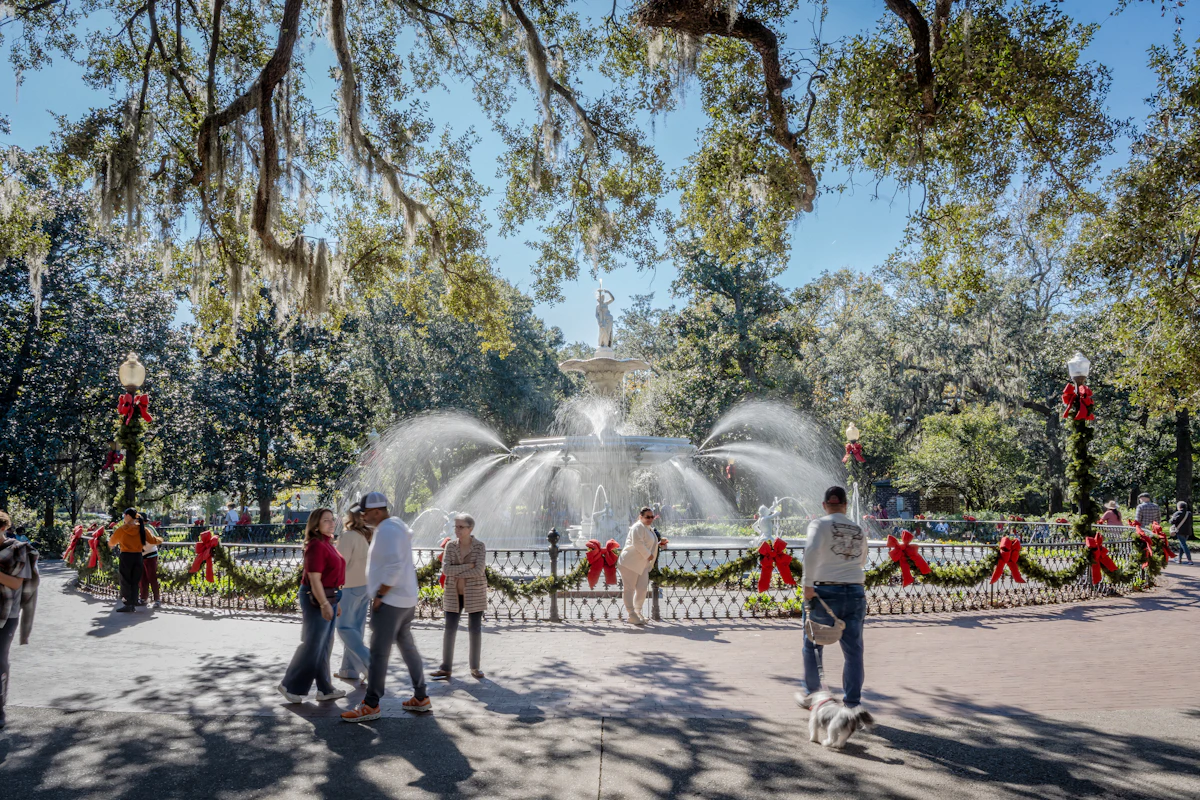
Photo by Nils Huenerfuerst / Unsplash — Forsyth Park, Savannah, GA
Savannah's transformation into a celebrated arts destination was built on a nonprofit land acquisition model that removed housing from the tax rolls, drove speculation through its corridors, and displaced the low-income and Black residents who made the city worth beautifying.
Gerrylyn Harvey is 75 years old. She uses a wheelchair. She lived at the Chatham Apartments, 609 Abercorn Street, for years — a 14-story building one block from Forsyth Park, where the fountain runs in the mornings and the Spanish moss catches the early light through the oaks. It is one of the most photographed views in Georgia. She could see it from her floor.
On October 29, 2020, she had to leave. The building was being cleared — had been clearing for over a year — for new ownership. By the time she packed, approximately 30 residents remained. Each received $1,750 from the seller. The prior buyer, an Atlanta investment firm, had cleared the rest — over 200 people, most on federal housing vouchers, most elderly or disabled — in the preceding twelve months.
Harvey moved into the Motel 6 Extended Stay on Montgomery Crossroads, a commercial strip on the western edge of the city. The rate was $340 per week. Her $1,750 relocation payment lasted just over a month. At least seven other former Chatham residents ended up in the same motel. In November 2020, she spoke to a local television news crew from her room.
"Some days I would just really like to punch somebody and other days I just want to sit here and cry because I've never felt so helpless in my life."
— Gerrylyn Harvey, 75, former Chatham Apartments resident, speaking from the Motel 6 Extended Stay, November 30, 2020
She also explained why no extension had been possible: "We couldn't get an extension because after the first of November — it was going to cost the owners $25,000 a day every day that the remodeling crew could not get in there."
In the Cuyler/Brownsville neighborhood on the other side of downtown, a man named Shaquille Sanders watched his mother sell the house she'd raised him in. The taxes kept rising as the neighborhood changed around her. She sold it to a white buyer. His words to a reporter from Savannah State University were precise: "Those neighborhoods changed over time from white to Black. Now, it is a reverse of Black to white." Former Mayor Otis Johnson confirmed it.
Savannah is a beautiful city. The question this signal tracks is a simpler one: beautiful for whom, and at whose cost.
The Savannah College of Art and Design is a registered 501(c)(3) nonprofit institution. That designation is not incidental — it is the load-bearing column of its land acquisition model. Every building SCAD purchases is removed from the city's property tax rolls. Over four decades of downtown acquisition, dozens of historic Savannah buildings have been pulled permanently from both taxation and the private housing market. The city collects no revenue on them. Private tenants can never live in them again.
SCAD's FY2023 economic impact study documents $1.3 billion in Georgia economic impact — but is silent on the tax revenue the city forgoes through SCAD's 501(c)(3) exemptions across its downtown portfolio. Savannah Agenda reporting and SCAD's own IRS 990 filings confirm the exemption mechanism. A full accounting of foregone municipal revenue has never been published. That gap is itself a structural fact.[1][2]
The Chatham Apartments acquisition — $38.9 million, November 19, 2020 — is the signal's most documentable event. But the mechanism predates it by twelve months. In October 2019, QR Capital, an Atlanta-based investment firm doing business as Abercorn Apartments LLC, purchased the same property for approximately $25.6 million from its prior owner.[3] Within that twelve months, the firm cleared more than 200 federally subsidized tenants — most elderly, disabled, or reliant on Section 8 vouchers — from the building. By late October 2020, the last 30 residents were out. QR Capital then sold directly to SCAD at a $13 million profit.
So we're calling this a nonprofit acquiring a "vacant building." Cool. Now explain who made it vacant, and why.
SCAD stated publicly that the building was "vacant at the time of purchase." This is technically accurate and structurally misleading. The vacancy was the product of a speculative clearing operation made possible — and profitable — by SCAD's documented acquisition pattern in the Forsyth Park corridor. Savannah Agenda reporting notes three other SCAD-owned properties surrounding 609 Abercorn at the time of purchase. QR Capital's play was not a coincidence; it was a read on institutional intent.
Laura Lane McKinnon, Executive Director of Housing Savannah Inc., stated on record in October 2025: "When SCAD acquires existing properties, whether for dorms, classrooms, or administrative uses, it inevitably reshapes surrounding neighborhoods. The pace of change can accelerate gentrification, making it harder to preserve mixed-income communities." She added: "When you combine those pressures with strong student demand, it becomes very difficult for other citizens to compete, especially low- to moderate-income households." This is not an advocate's opinion. It is the executive director of the city's primary affordable housing nonprofit describing a confirmed operational pattern.[4]
SCAD enrolls approximately 15,000 students across its campuses. On-campus housing costs more than $10,700 annually and is waitlisted. Students — many with parental financial support — enter the private rental market and outcompete low-income and working-class residents in the Victorian District, Thomas Square, and adjacent corridors. Landlords respond to the higher-rent student market by renovating, raising rents, or exiting the affordable stock entirely. SCAD's own 2020 economic impact report acknowledged the dynamic in writing: "off-campus student housing in stronger markets can also result in displacement of lower-income households by becoming a rival for affordable [housing]."[5]
The city's own data confirms the cumulative outcome. The Housing Savannah Task Force documented that housing expenses in Savannah outpaced income growth at least 2:1 over the preceding 30 years. By 2020, 40% of Savannah households — approximately 21,000 — could not afford quality housing. The City of Savannah did not pass an Affordable Housing Overlay District until March 2025.[4][6] That is five years after the Chatham displacement was televised on the local CBS affiliate, and approximately four decades after SCAD began accumulating downtown Savannah.
For longtime Black homeowners — many concentrated in Cuyler/Brownsville, the Yamacraw corridor, West Savannah — the mechanism ran through property tax assessments rather than eviction notices. As SCAD-driven aestheticization raised neighborhood desirability and property values, Chatham County assessments followed. Owners on fixed incomes, including many with heirs-property complications that complicated refinancing, faced rising tax bills they could not sustain. The result was forced sale — often at below-market prices, often to buyers positioned by the same market forces that elevated the tax burden in the first place.
Savannah is not anomalous. It is a well-documented version of a national pattern: arts institutions — universities, museums, performance venues — function as neighborhood anchors that concentrate investment, raise property values in adjacent corridors, and accelerate displacement of the populations least able to compete in the resulting market. What makes SCAD's version distinctive is the scale, the nonprofit tax structure, and the completeness of the causal chain from institutional acquisition to private speculation to resident displacement.
The Lincoln Institute of Land Policy has studied SCAD's specific impact on Savannah's historic district property values, finding measurable neighborhood change attributable to the institution's adaptive reuse of historic buildings.[7] This is not speculative. The academic literature on arts-anchor displacement — from NYU's Furman Center, the Urban Institute, and housing economists at institutions including the Federal Reserve — is consistent: when large educational institutions expand in low-income urban neighborhoods, surrounding property markets respond faster than policy interventions can absorb.
The HUD Comprehensive Housing Market Analysis for Savannah (2023) documents the on-the-ground outcome: a market in which demand pressures from tourism, second-home acquisition, and student housing converge on a physically constrained historic city center with limited new construction capacity.[6] In 2018 alone — before the pandemic and before the Chatham acquisition — Chatham County recorded an average of 28.5 eviction filings per day, approximately 10,400 annually, according to Eviction Lab data cited in Savannah State University's student investigative press.[8] This is not a displacement that began with SCAD. But the institution's model accelerated and structured it.
What Savannah also illustrates is the asymmetry of the nonprofit advantage. A 501(c)(3) institution competing for urban real estate carries structural cost advantages over market-rate buyers: no property tax liability, access to tax-exempt bond financing, and no requirement to generate returns on the acquired asset. When that institution is also a cultural brand that raises surrounding property values — as SCAD manifestly does — the nonprofit advantage compounds. Private speculators, reading the institution's acquisition patterns, move into adjacent corridors and conduct the displacement work that the institution itself does not have to perform directly. QR Capital and the Chatham sequence are the mechanism made visible.
The broader implication is this: when arts institutions function as the primary engines of urban beautification in low-income or historically Black neighborhoods, and when their tax-exempt status insulates them from the fiscal discipline that forces other real estate actors to internalize displacement costs, the "arts economy" becomes a mechanism for the structured transfer of cultural geography from the people who built it to the institutions that branded it.
Savannah's displacement could be driven primarily by tourism-sector growth, remote worker in-migration, and coastal market dynamics that would have occurred regardless of SCAD's presence. The city's proximity to the Georgia coast, its historic architecture, and its food and culture profile have made it a national real estate target since the early 2000s. Under this reading, SCAD is a coincident beneficiary of Savannah's appeal rather than its primary driver. This argument has merit for the most recent (post-2020) appreciation cycle. However, the Lincoln Institute study directly attributes measurable property value changes to SCAD's adaptive reuse activity, and the 40-year timeline of SCAD's accumulation predates the broader coastal/remote-work boom. The mechanism is additive rather than alternative: SCAD's model structured the neighborhood character that later attracted the broader investment wave.
SCAD's own 2023 economic impact study documents $1.3 billion in Georgia economic activity: jobs, vendor spending, student consumer spending, tourism generated by the institution's events and reputation. Under this reading, SCAD's presence raises the economic floor for all Savannah residents, and the displacement costs are outweighed by the aggregate economic benefits. This is a serious argument made by serious people, including Mayor Van Johnson. Its weakness is distributional: aggregate economic gains that flow primarily to the hospitality sector, commercial landlords, and tourism infrastructure do not compensate residents who lose housing. The 40% of Savannah households that cannot afford quality housing do not benefit proportionally from hotel occupancy rates. The question is not whether SCAD creates economic value — it demonstrably does — but who captures it and who bears the displacement cost.
What is not known: The full accounting of foregone municipal tax revenue from SCAD's exempt portfolio across four decades has not been calculated from publicly available records. The Savannah Morning News "Art of Gentrification" series (April 2022) — described as a direct, multi-part investigation into SCAD's displacement role — sits behind a paywall and was not fully accessible for this signal. Its quantitative data, if available, would likely strengthen the Source Score.
Research gap: A Tier C source (Reddit community forum) cited a 40% decline in Black population in the Cuyler/Brownsville area. This number has not been verified against census tract data and is excluded from the Evidence Block accordingly.
Monitoring indicators: The City of Savannah's Affordable Housing Overlay District (March 2025) and April 2025 zoning amendments covering Thomas Square, Metropolitan, and the Victorian District are the primary policy responses to track. If these overlays produce measurable preservation of affordable units in SCAD-adjacent corridors over the 2025–2030 window, they would partially counter the displacement mechanism — but would not address the property tax exemption dynamic. Rising eviction filing rates, continued SCAD acquisition activity in non-overlay corridors, and further gentrification of the Yamacraw and West Savannah corridors would confirm signal trajectory.
[1] SCAD 2023 Economic Impact Study. Savannah College of Art and Design. FY2023. scad.edu
[2] SCAD Economic Impact Report. Savannah Agenda. February 7, 2020. savannahagenda.com
[3] "SCAD Buys Chatham Apartments for $39M." Savannah Agenda. Based on Chatham County sales records. savannahagenda.com
[4] "SCAD's Housing Squeeze." The George-Anne, Georgia Southern University. October 2025. thegeorgeanne.com
[5] SCAD Economic Impact Report (2020). Acknowledgment of student housing displacement dynamic. savannahagenda.com
[6] HUD Comprehensive Housing Market Analysis: Savannah, GA. HUD Office of Policy Development and Research. 2023. huduser.gov
[7] Geideman et al. "SCAD Adaptive Reuse and Property Value Effects in Savannah's Historic Districts." Lincoln Institute of Land Policy. lincolninst.edu
[8] "SCAD Displacement Investigation." Tiger's Roar, Savannah State University. December 2023. Eviction Lab data cited. tigersroar.com
[9] "SCAD Purchases Former Low-Income Housing High-Rise." WTOC (CBS Savannah). November 30, 2020. wtoc.com
[10] "SCAD's Purchase of Former Apartment Building Highlights Need for Affordable Housing." WSAV (NBC Savannah). 2020. wsav.com