
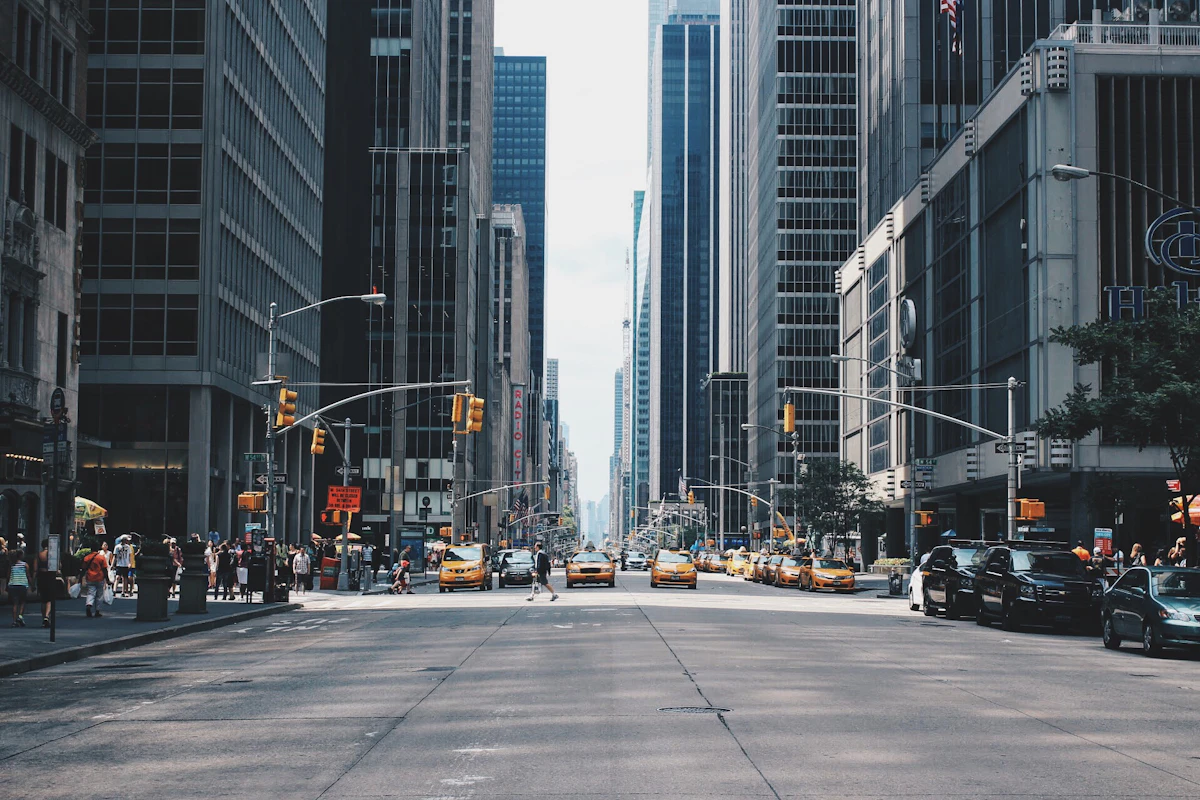
Photo by Nitish Meena / Unsplash
Tulsa Remote recruited 3,475 high-income transplants with $10,000 relocation grants — and the artists, Black business owners, and longtime residents who built the culture they came for are being priced off the same blocks the program put on the map.
Tori Tyson's family had been in the Greenwood area longer than most of its new zip code residents had been alive. Her salon sat a few blocks from where her people had operated since before 1921 — before the planes, the burning, the erasure. That's not metaphor. That's the actual address of her actual work.
The salon had regulars who walked. Saturday mornings, it held a particular kind of time — the long, slow exchange between stylist and client that doesn't have an app equivalent. The conversation that happens when someone trusts you with their head. Neighborhood knowledge, passed lateral and intact: who moved, who was hiring, whose landlord had gone silent, whose son had finally come back.
Then the corner changed. Then the block changed. A new apartment complex arrived with glass panels and a leasing office that handed out branded tote bags. A hotel opened two streets over and listed itself online as the "Tulsa Arts District," which is what some people had decided to call this part of Greenwood, the neighborhood that Black Wall Street built and white violence tried to bury. The new residents seemed unaware of both facts. They came for the vibe — and the vibe, in this case, was a hundred years of survival they didn't have to participate in to enjoy.
Tori eventually left. Not dramatically. People rarely leave dramatically — they leave when the math stops working and the neighborhood no longer holds the weight of what it cost to stay. She told NPR it was hard. She said: "It was hard leaving Greenwood — my family, the customers, the history."
Archer Street still runs east-west through the district. It still carries the name of the massacre's geography. But on certain mornings now, the foot traffic is different — men in Patagonia vests walking to co-working spaces, faces angled at phones, passing the addresses that once held other people's entire economic lives. They did not displace anyone on purpose. That's not how it works. That's precisely how it works.
The George Kaiser Family Foundation (GKFF) is the largest philanthropic actor in Tulsa, capitalized by Kaiser's oil and banking fortune — including, notably, BOK Financial, which has earned scrutiny for overdraft fee practices that extract from the same low-income communities GKFF claims to serve. This is not incidental color. It is the mechanism in miniature: wealth extracted from one end of the class ladder, redeployed as charity at the top, and presented as civic improvement.
Beginning around 2015, GKFF began acquiring and leasing commercial, residential, and cultural real estate in the Greenwood and Arts Districts — the same historically Black neighborhoods that had never recovered their pre-massacre density of wealth. GKFF also founded the Tulsa Artist Fellowship (TAF), which brought working artists from around the country to live and produce in GKFF-controlled studio and residential spaces along Archer Street and adjacent blocks.
GKFF controls both the real estate and the cultural legitimacy infrastructure in the same neighborhoods. Organizations linked to Kaiser own or lease multiple cultural centers, residential buildings, and commercial properties in Tulsa's Arts and Greenwood Districts — the same gentrifying neighborhoods where Tulsa Remote clusters its arrivals and where TAF fellows are housed. The foundation simultaneously sets rents, funds fellowships, runs co-working spaces, and manages district branding. This is not a conflict of interest. It is a vertically integrated displacement apparatus.
In 2018, GKFF launched Tulsa Remote — a program offering $10,000 relocation grants to remote workers willing to move to Tulsa. The program targeted knowledge workers. The median participant income exceeded $100,000 per year. By December 2024, 3,475 workers had relocated. Over 400 purchased homes. The program generated $622 million in direct employment income — income earned elsewhere, now spending in Tulsa, concentrated in the districts GKFF had already positioned to receive it.
The housing market absorbed this new demand on top of a pre-existing deficit. Tulsa's Citywide Housing Assessment (March 2023) documented a shortfall of 4,000 housing units, with the city permitting only 830 units annually against a need of 1,290. Into that constrained supply, Tulsa Remote deposited over 3,000 high-income households. Vox reported in June 2023, citing Zillow data, that Tulsa home prices had risen 47% between January 2020 and June 2023. HUD's Comprehensive Housing Market Analysis confirmed apartment rents rose 12% in 2022 alone, reaching a mean of $931 by Q1 2023. Vox acknowledged that "new demand for housing in the area, including from Tulsa Remote workers, of whom more than 400 have bought homes, has likely helped contribute to rising housing costs."[5]
The entry friction is asymmetrical by design. Tulsa Remote applicants must be employed full-time by an out-of-state employer or run a location-independent business — a barrier that structurally selects for a white-collar professional class. The program explicitly excludes most Tulsa residents, who are employed locally. 46% of Tulsa renters are already cost-burdened (spending more than 30% of income on housing). Tulsa's median household income is approximately $54,000 — less than half the mean income of incoming Remoters. The incentive is not available to existing residents. The displacement pressure it produces is not optional for them.
Meanwhile, inside the TAF studios on Archer Street, a more precise form of control was operating. In May 2019, artist Lucas Wrench delivered a performative lecture about how George Kaiser had accumulated his wealth — inside a GKFF-leased space, on the street where the 1921 massacre took place. According to multiple witnesses and available video footage, GKFF communications director Abby Mashunkashey physically walked in front of the audience, made a phone call, and gestured for Wrench to stop. The Art Newspaper documented the incident in December 2020, along with a pattern of similar interventions: fellows were silenced when discussing gentrification, racism, or the foundation's role in reshaping the district.[4]
Artist and fellow Naima Lowe was later given 72 hours to sign a non-disparagement agreement or face contract termination after raising safety and institutional concerns. She went on record anyway. "I'm probably risking some retaliation from [the foundation] for going on record," she told The Art Newspaper, "but it feels important." The contract terms that silenced fellows were not anomalous — they were structural. The same organization that subsidized artists' presence in the neighborhood controlled what those artists were permitted to say about the neighborhood's transformation.
Ricco Wright, owner of the Black Wall Street Gallery on Greenwood Avenue, described watching white-owned businesses move into historically Black commercial space: "What I'm seeing on the east side of the street has nothing to do with the history of Greenwood."[6] Longtime activist Kristi Williams was more direct: "This has been happening for years, and people are starting to notice. This city has been masterful at pulling people away from the area."[6] The Greenwood District — which once held over 300 Black-owned businesses before the 1921 massacre — now holds approximately 20. The city of Tulsa funded zero grants specifically for Black business owners on Greenwood in the five years following the district's renewed commercial development.
Remote work relocation incentives are now a studied policy class. Tulsa Remote was one of the first and most visible programs, but variants have proliferated — Savannah, Topeka, Vermont, West Virginia all ran versions in the same period. The academic literature on their distributional effects has caught up.
Cornell University economic sociologist Cristobal Young framed the category with clarity: remote relocation incentives are "a zero-sum competition that defunds programs for existing residents."[7] Young's argument is structural, not sentimental. When a city spends philanthropic or public capital recruiting high-income transplants, that capital does not simultaneously create affordable housing supply, increase wages, or protect existing community members from the demand pressure those transplants generate. The gains accrue to the program's metrics — jobs claimed, incomes tracked, press coverage earned — while the costs are borne by households too rooted to relocate and too underpaid to absorb the rent shock.
A 2023 Portland State University academic thesis analyzing Tulsa Remote's equity dimensions confirmed the asymmetry: the program's benefits were concentrated among program participants and the commercial real estate sector, while its costs — housing pressure, displacement risk, cultural erasure — were distributed across the existing resident population, with disproportionate impact on lower-income and Black households already occupying the target neighborhoods.[2] This matches the documented pattern from comparable anchor-institution-led district transformations in Philadelphia (University City), Atlanta (BeltLine Phase 1), and Nashville (The Gulch): when a single well-capitalized actor controls both the real estate and the cultural programming of a neighborhood, displacement follows the programming geography with precision.
The cultural dimension is not incidental. Social capital research — from Putnam's foundational work through more recent urban studies — demonstrates that the value of a creative district to incoming gentrifiers is precisely the social texture produced by the existing community: the galleries, the salons, the informal gatherings, the sense that something real is happening here. Transplants move toward that texture. Their arrival raises demand. Prices rise. The community that produced the texture is priced out. The texture eventually becomes a branded approximation of itself, maintained for new arrivals who never knew the original. This is not a side effect of creative-district policy. It is its mechanism.
What makes the Tulsa case analytically distinct is the degree of single-actor coordination. GKFF does not merely own buildings in a gentrifying neighborhood — it designed the gentrification architecture: the fellowship that lent cultural legitimacy, the co-working infrastructure that oriented transplants' daily geography, the district branding that renamed what had been Brady Arts District (named for a Confederate sympathizer turned out of its history) for a new audience. And when the artists it imported began narrating the displacement they were witnessing — in performances, in public letters, in interviews — GKFF used contract mechanisms to mute them. The philanthropy captured the testimony as well as the territory.
The signal is not that a relocation incentive program produced gentrification. The signal is that philanthropic control of cultural infrastructure, when combined with subsidized demand injection and suppression of dissident testimony, produces a closed loop: displacement without accountability, rebranding without memory, and a cultural economy built to serve the newcomers who arrived after the cost was already paid by someone else.
Tulsa's 47% home price increase between 2020 and 2023 may reflect the same forces driving price escalation in comparable mid-sized Sun Belt and heartland cities during the remote-work migration wave — rather than Tulsa Remote specifically. Oklahoma City, Boise, and Chattanooga all saw comparable appreciation without formal relocation incentive programs. Under this reading, Tulsa Remote was a marginal accelerant within a much larger national migration trend, and the displacement pressure would have arrived regardless of GKFF's $10,000 grants. This is a legitimate challenge to the causal specificity of the signal. However, it does not explain the geographic concentration of displacement in GKFF-controlled neighborhoods, the suppression of artistic testimony about gentrification inside GKFF spaces, or the fact that Tulsa Remote's explicit orientation infrastructure clustered transplants precisely in the Arts/Greenwood Districts. National migration pressure explains some of the housing math. It does not explain the institutional behavior.
The George Kaiser Family Foundation's investments in Tulsa — in early childhood education, park development, and economic infrastructure — represent a legitimate and documented record of civic investment in an historically underserved city. Under this reading, GKFF's Greenwood-area development is a net positive that increased commercial activity, cultural programming, and national visibility in a region that had suffered decades of disinvestment. The displacement effects may be unintended consequences of genuine revitalization rather than evidence of predatory intent. This alternative deserves honest weight: GKFF has funded real infrastructure that serves real Tulsans. The counterpoint is not about intent. It is about architecture. Revitalization that simultaneously concentrates land ownership, imports high-income demand, funds cultural legitimacy, and contractually silences dissent produces displacement as a structural outcome regardless of the actor's intention. Good intentions do not dissolve mechanism chains. The evidence of institutional silencing — documented by multiple named sources, corroborated by video, and reported by The Art Newspaper — indicates awareness of criticism sufficient to motivate suppression, which in itself is informative about how the foundation understood the stakes.
What is not known: The precise share of Tulsa's rent and home price increases attributable specifically to Tulsa Remote arrivals, as distinct from broader COVID-era migration, investor activity, and supply constraint, has not been independently quantified. Vox and academic sources describe Remoters as a "likely contributor" — this is probabilistic, not causal. A natural experiment comparing Tulsa's price trajectory to matched cities without incentive programs would sharpen the attribution, but has not been published.
What is absent: Recent (2024–2026) ground-level documentation of Greenwood District displacement is thin. The strongest field reporting (AP News, The Art Newspaper) dates from 2019–2020. Direct testimony from artists who remained or departed under the program's later phases is not publicly documented at Tier B or above.
What would confirm or raise the SCI score: Independent analysis isolating Tulsa Remote's specific contribution to the housing demand shock; documented evidence of GKFF lease or purchase agreements in Greenwood correlated with business departures; current interview testimony from TAF fellows about the post-2020 institutional climate; city data on Black-owned business counts in Greenwood through 2025.
What would alter the signal direction: Evidence that GKFF has materially changed its contractual terms for fellows post-2021; documentation that the city has funded targeted anti-displacement programs in Greenwood that offset Remoter demand; or evidence that Greenwood's Black business count has recovered or stabilized since 2020.
[1] HUD Office of Policy Development and Research. Comprehensive Housing Market Analysis: Tulsa, Oklahoma. Q1 2023. huduser.gov
[2] Portland State University. An Analysis of the Strengths and Weaknesses of the Tulsa Remote Program. PDXScholar Open Access ETDs, 2023. pdxscholar.library.pdx.edu
[3] Housing Solutions Tulsa. Tulsa Citywide Housing Assessment. March 1, 2023. housingsolutionstulsa.org
[4] The Art Newspaper. "Trouble is Brewing at the Tulsa Artist Fellowship." December 7, 2020. theartnewspaper.com
[5] Molla, Rani. "The Remote Work Boom Is Changing Cities. Here's How." Vox. June 12, 2023. vox.com
[6] Associated Press. "Residents Fear Losing Piece of Tulsa's Greenwood District." AP News. July 1, 2019. apnews.com
[7] Young, Cristobal (Cornell University), as cited in "Remotely Unfair." Morning Brew, republished by Cornell Sociology Department. September 6, 2023. sociology.cornell.edu
[8] KTUL / Channel 8 News Tulsa. "Tulsa Faces Housing Deficit as Rents Rise." September 21, 2025. ktul.com
[9] Lowe, Naima. "Dear Carolyn Sickles." Open letter published at naimalowe.net, 2020. naimalowe.net