The Signal
Somewhere between 2021 and 2024, Belgrade became one of the most surveilled cities in Southeastern Europe — not through parliamentary debate, not through public referendum, not through any of the mechanisms a European-aspirant democracy might deploy to justify a biometric apparatus. The cameras simply appeared. Over 8,000 units, manufactured by China's Dahua and Hikvision, installed across Serbia's capital and beyond, reaching into schools and palliative care centers. The infrastructure preceded the law. And in a country where infrastructure tends to outlast legislation, that sequence matters enormously.
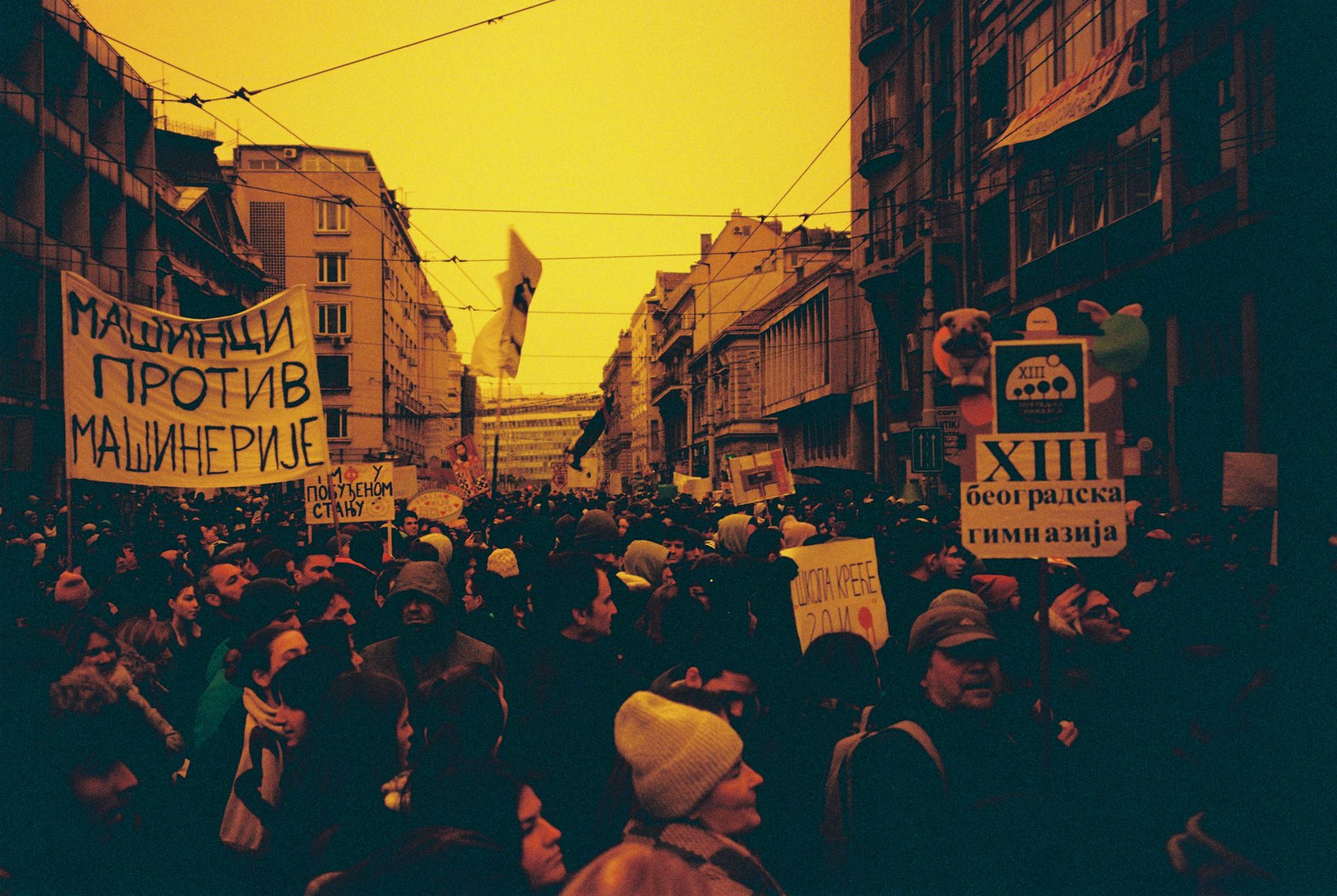
The cameras became protagonists during the June 2025 student protests at Branko Bridge. Journalists and civil society monitors documented units repositioned — not toward traffic or crime-prone corridors, but toward the faces of demonstrators. The Interior Ministry has not denied the repositioning. It has simply not addressed it. Silence, here, functions as policy.
What compounds the signal is a detail that deserves its own paragraph: Serbia's Interior Ministry holds an active software license from Moscow's Speech Technology Centre, a firm sanctioned by the EU for its role in Russian surveillance ecosystems. Belgrade now possesses both facial and voice recognition capabilities procured from two authoritarian suppliers — Beijing and Moscow — without a single legislative act authorizing biometric surveillance on its own citizens. The toolbox is full. The manual was never written.
The Reading
The pattern is not new, but its acceleration is. We might call it "surveillance without legislation" — the practice of deploying biometric infrastructure in the administrative gap between executive procurement and parliamentary oversight. Serbia is not inventing this. It is perfecting a sequence visible from Kampala to Caracas: acquire the hardware through bilateral trade deals (often bundled with infrastructure loans), install during periods of political distraction, and normalize through operational fact. By the time civil society raises the alarm, the cameras are already reading faces.
What Belgrade adds to the pattern is geographic context. Serbia is a candidate for EU accession. It sits in a corridor of strategic ambiguity — receiving Chinese infrastructure investment, maintaining Russian diplomatic ties, and performing the institutional rituals of European integration. The cameras are not just surveillance tools; they are geopolitical artifacts, physical evidence of which partnerships a government prioritizes when no one is drafting the rules.
The expansion into schools and palliative care centers deserves particular attention. Surveillance scholars have long noted that biometric systems enter through two doors: security and care. The school camera protects children. The hospital camera monitors vulnerable patients. The language of protection normalizes the gaze. Once the infrastructure is accepted in spaces of vulnerability, its extension to public squares and bridges requires no additional justification. Belgrade has executed this playbook with remarkable efficiency.
Connect this to two parallel developments. In Georgia, a similar surveillance architecture has emerged under equally thin legal frameworks, suggesting a regional template rather than isolated national decisions. And in May 2026, Human Rights Watch published a report documenting EU-manufactured spyware exported to authoritarian governments — revealing that Europe, while demanding rule-of-law reforms from candidate states, simultaneously supplies the tools of extralegal surveillance to third parties. The hypocrisy is not incidental. It is structural.
CORE Connection
The Belgrade signal illuminates one of AXIS's persistent themes: the moment when infrastructure becomes governance. When 8,000 cameras operate without a law, the cameras are the law. They define who is watched, when, and why — decisions that in a constitutional framework belong to parliaments, courts, and citizens. Serbia's trajectory suggests that biometric surveillance in semi-democratic states does not arrive through authoritarian decree. It arrives through procurement orders, bilateral trade, and administrative silence. The absence of legislation is not a gap. It is the design.
For IN-KluSo's readers across the hemisphere, the question is not whether this model will cross the Atlantic — it already has, in fragments, from Ecuador's ECU-911 to Buenos Aires's facial recognition pilot. The question is whether civic institutions can outrun hardware that is already installed, already reading, already remembering.
Sources
- Balkan Investigative Reporting Network (BIRN), "Face Down: Serbia's Expanding Surveillance Infrastructure," 2024 — https://birn.eu.com
- Share Foundation (Serbia), "Mapping the Surveillance State: Dahua and Hikvision in Serbian Public Spaces," 2024 — https://www.sharefoundation.info
- Human Rights Watch, "EU Spyware Exports: Digital Surveillance and Human Rights," May 2026 — https://www.hrw.org
- Access Now, "Serbia: Facial Recognition Without Legal Framework," 2025 — https://www.accessnow.org
- European Commission, Serbia 2024 Progress Report, Chapter 23 (Judiciary and Fundamental Rights) — https://ec.europa.eu